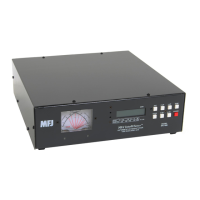
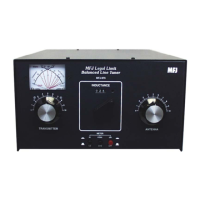
MFJ-976 Legal Limit Fully Balanced Antenna Tuner Instruction Manual
2
MFJ Legal Limit Balanced Line Tuner
Introduction
The MFJ-976 balanced line antenna tuner is a fully balanced true, balanced line antenna tuner, providing superb
current balance throughout a very wide matching range – 12 to 2000 ohms – and frequency range of 1.8 through
30 MHz, continuous. It is rated at 1500 watts PEP SSB and CW.
The MFJ-976 is designed to match 50 ohm output transmitters or transceivers to virtually any antenna. Peak and
average forward power, reflected power, and SWR are displayed on the MFJ-976's illuminated cross-needle
meter.
The MFJ-976 is a fully balanced wide range T-Network using four 500pF air variable capacitors for efficient
operation on 160 meters. The MFJ-976 also provides excellent performance on 10 meters using MFJ’s exclusive
Self-Resonance Killer
™
and low minimum capacitiance. The tuning components are mounted symmetrically to
ensure electrical balance and are centrally located in the cabinet for better isolation.
A 1:1 current balun is placed on the low impedance 50 ohm input (transmitter) side to convert the balanced T-
Network to unbalanced operation. The balun is made of 50 ferrite beads on RG-303 Teflon™ coax to give
exceptional and efficient isolation. It stays cool even at the tuner’s maximum rated power.
The MFJ-976 will match virtually any balanced-line-fed antenna: dipoles, inverted-vees, verticals, mobile whips,
yagi beams, quad loops, horizontal loops, sterba curtain arrays, random wires, and many other antennas. The
MFJ-976 has rear panel connectors for coaxial and single or two wire feedlines. The built-in balun works with
balanced open wire, twinlead, or twin-axial feedlines.
Understanding Power Ratings
There are no standardized power rating systems for tuners. The names used (i.e. 3 kW Tuner) carry over from the
time when amplifiers were rated by peak power input, and not the true RF power output. For example, the one
thousand watt Johnson Matchbox was rated to handle a 1000-watt plate modulated AM transmitter (four kilowatts
PEP transmitter input and 3000 watts PEP RF output).
The Heathkit SB-220 was called a two-kilowatt amplifier, and the rated CW output was approximately 600 watts.
Matching tuners were called 2 kilowatt tuners, and these tuners safely handled 600 watts of CW power and 1200
watts PEP SSB.
The FCC has changed the power rating system of amplifiers, and tuners no longer follow amplifier power ratings.
Most typical 1500 watt tuners remain able to safely handle 400 to 600 watts CW, and 600 to 900 watts PEP SSB.
Load conditions and control settings also greatly affect the power handling capability of tuners. T-networks
typically handle more power on higher frequency bands into higher load impedances. The worst operating
condition for T-network tuners are low-impedance capacitive reactance loads. T-network tuners always handle
the least power when operated on 160 meters into low impedance capacitive reactive loads.
Follow the guidelines in this manual to avoid exceeding the ratings of this tuner.


 To Next Page