EasyManua.ls Logo

MFJ Super Hi-Q Loop MFJ-1786 - User Manual

MFJ Super Hi-Q Loop MFJ-1786
14 pages
Print Icon
To Next Page IconTo Next Page
Loading...
MFJ Super Hi-Q Loop Antenna Instruction Manual
1
MFJ
Super Hi-Q Loop
Antenna
CAUTION: Do Not Attempt Operation Of This Unit Before Reading All Instructions
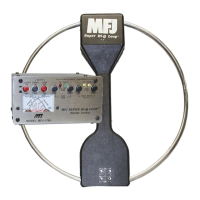
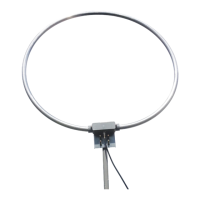
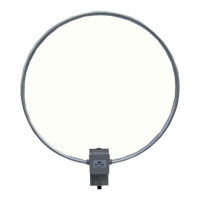
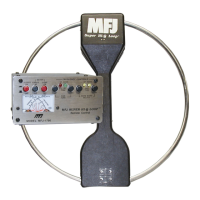
The MFJ "Super Hi-Q Loop" is the best performing and most convenient small space antenna available
to amateurs today. The MFJ-1786 covers 10 MHz to 30 MHz. The MFJ-1788 covers 7 MHz to 21
MHz. The antenna is only 36 inches in diameter and features an indoor semi-automatic tuning unit with
a built-in cross needle wattmeter. All tuning and control voltages are coupled to the antenna through
the coaxial feedline for simple, neat, one wire installation.
The loop antenna element is constructed from thick walled aluminum pipe. Every current carrying
joint is welded to eliminate high resistance pressure contacts that reduce efficiency. The loop element
is tuned with a low-resistance, high current, variable capacitor. The outdoor electrical and mechanical
components are protected by an attractive weather resistant molded cover.
WARNING! Never mount this, or any other antenna near power lines or utility wires! Any
materials: ladders, ropes, or feedlines, that contact power lines can conduct
voltages that kill. Never trust insulation to protect you. Stay away from all power
lines.
THEORY OF OPERATION
When resistive losses in a small loop antenna are kept low, a small loop antenna will transmit nearly as
well as a full size dipole. MFJ was able to make this small loop antenna radiate nearly as well as a full
size dipole by paying special attention to the electrical and mechanical construction of this antenna.
Because radio frequency currents primarily flow near the thin, outer edges of flat conductor loops, flat
conductor loops will have much higher RF losses. To avoid this problem the MFJ "Super Hi-Q Loop"
uses a thick wall, large diameter, round aluminum pipe for the radiating element. This construction
method results in much better performance since the RF losses in the round, large diameter pipe are
many times lower than the losses in a flat conductor.
MFJ forms the large diameter aluminum pipe into a circle on special machines and heli-arc welds all
joints to eliminate resistive pressure connections in the antenna. A specially constructed butterfly
capacitor using arc-welded construction has much lower loss resistance than conventional, less
expensive, pressure contact, air variable capacitors.
The care and expense used in selecting the best materials, not the most convenient materials, has
resulted in an extremely efficient small size antenna. Extensive "on the air" tests have confirmed that
most stations can detect little difference between the signal from the MFJ "Super Hi-Q Loop" and the
signal from a full size dipole at the same height.
Question and Answer IconNeed help?

Do you have a question about the MFJ Super Hi-Q Loop MFJ-1786 and is the answer not in the manual?

Summary

Theory of Operation

Patterns, Polarization and Location

Vertical Mounting

How to mount the antenna for vertical polarization.

Horizontal Mounting

How to mount the antenna for horizontal polarization.

Nulling Unwanted Signals

Vertical Polarization

Details vertical polarization pattern and radiation.

Horizontal Polarization

Outdoor Loop Installation

Interconnections

Indoor Control Box Installation

Control Head Theory and Operation

Control Head Power

Power requirements and connections for the control head.

Testing and Operation

General Operation and Troubleshooting

Tuning When You Do Not Know the Last Operating Frequency

Procedure for tuning when the last frequency is unknown.

Tuning With a Known Direction of Frequency Movement

Tuning the Antenna for Use With a Receiver

Troubleshooting

Technical Assistance

Summary

Theory of Operation

Patterns, Polarization and Location

Vertical Mounting

How to mount the antenna for vertical polarization.

Horizontal Mounting

How to mount the antenna for horizontal polarization.

Nulling Unwanted Signals

Vertical Polarization

Details vertical polarization pattern and radiation.

Horizontal Polarization

Outdoor Loop Installation

Interconnections

Indoor Control Box Installation

Control Head Theory and Operation

Control Head Power

Power requirements and connections for the control head.

Testing and Operation

General Operation and Troubleshooting

Tuning When You Do Not Know the Last Operating Frequency

Procedure for tuning when the last frequency is unknown.

Tuning With a Known Direction of Frequency Movement

Tuning the Antenna for Use With a Receiver

Troubleshooting

Technical Assistance

Overview

The MFJ Super Hi-Q Loop™ Antenna is a high-performance, small-space antenna designed for amateur radio enthusiasts. It offers excellent performance and convenience for its size.

Function Description:

The MFJ Super Hi-Q Loop™ Antenna is a magnetic loop antenna that functions as both a transmitting and receiving antenna. Its primary purpose is to provide efficient radio frequency (RF) communication in a compact form factor, making it suitable for situations where a full-size dipole antenna is impractical. The antenna features a semi-automatic tuning unit that allows for easy adjustment to different frequencies. This tuning unit, along with control voltages, is coupled to the antenna through the coaxial feedline, simplifying installation with a single wire. The antenna is designed to minimize resistive losses, which is crucial for the efficiency of small loop antennas. It achieves this by using thick-walled, large-diameter round aluminum pipe for the radiating element and heli-arc welding all current-carrying joints to eliminate high-resistance pressure contacts. A specially constructed butterfly capacitor, also arc-welded, further reduces loss resistance compared to conventional air variable capacitors.

The antenna's control head includes a cross-needle SWR-WATTMETER, which displays forward and reflected power on both high and low power scales. The high power scales are 300 watts forward and 60 watts reflected, while the low power scales are 30 watts forward and 6 watts reflected. Power readings are always taken from the top scale with a 0.1 multiplier in low power mode. The control head supplies the necessary control voltages to the loop antenna via the coaxial feedline. These voltages are low voltage and low current, ensuring that the length of the coaxial line does not significantly impact motor operation. The control head also incorporates circuits that detect the antenna's tuning condition, activated when the AUTO BAND SELECT "UP" or "DOWN" buttons are pressed. When these switches are "latched" in the presence of constant RF, the loop automatically tunes until the SWR drops or the end of the tuning range is reached. A "beeper" sounds when the SWR minimum is crossed, and the motor voltage is removed. If the end of the range is reached without crossing the SWR minimum, the FREQ "UP" or "DOWN" LED extinguishes, and the motor stops. After releasing the "latched" button, a "MOVE" LED near the "FINE TUNE" buttons illuminates, indicating the direction for fine-tuning. The control head also allows for slow, stepped motor movements using the FINE TUNE buttons to optimize SWR. The "MOVE" LEDs extinguish after the correct FINE TUNE button is pressed. Additionally, the control head features switches for wattmeter power sensitivity, meter lamp, and main power on/off. Two yellow LEDs, labeled "FREQ" UP and DOWN, monitor the current drawn by the loop motor (feedline). A continuous light indicates that an "AUTO BAND SELECT" switch is active and the motor is running, while a flashing LED indicates a FINE TUNE switch is active. These LEDs should extinguish within 40 seconds of fast tuning once the motor stops.
Important Technical Specifications:

  • Models: MFJ-1786 (10 MHz to 30 MHz), MFJ-1788 (7 MHz to 21 MHz).
  • Diameter: 36 inches.
  • Antenna Element: Thick-walled, large-diameter, round aluminum pipe with heli-arc welded joints.
  • Tuning Capacitor: Low-resistance, high-current, variable butterfly capacitor with arc-welded construction.
  • Control Unit Power: 9-15 VDC, ungrounded power supply (MFJ-1312B for 110 Vac, MFJ-1315X for 220 Vac, or equivalent). Center conductor positive.
  • Standby Current Draw: 6 mA.
  • Tuning Current Draw: Up to 20 mA (including motor and LEDs).
  • Meter Lamp Current Draw: 35 mA.
  • Max Transmit Power: 150 watts through the control head.
  • SWR-WATTMETER Scales:
    • High Power: 300 watts forward, 60 watts reflected.
    • Low Power: 30 watts forward, 6 watts reflected (0.1 multiplier).
  • Coaxial Feedline: Good quality 50 ohm lines.
  • Mounting Mast Compatibility: Up to 1-1/2" outside diameter.
  • Coax Resistance (Center Conductor to Ground): Should be more than 600 ohms.

Usage Features:

  • Polarization: Can be mounted for either vertical or horizontal polarization. Vertical mounting involves the loop standing up, while horizontal mounting involves the loop lying flat.
  • Omni-directional Pattern: The radiation pattern of a small loop antenna is essentially omni-directional, with two very narrow nulls along the axis of the loop (like a wheel's axle). Signals arriving within 15 degrees of the axis are attenuated by more than 10 dB.
  • Nulling Unwanted Signals: The narrow nulls can be used to reduce interference from fixed-direction ground wave signals. Tilting the loop may be necessary to null sky wave signals. Mounting the antenna horizontally above the middle of a metal roof can position a null directly below, reducing noise pickup from devices in the building and minimizing RFI.
  • Vertical Polarization Characteristics: When mounted vertically, the pattern is vertically polarized in line with the loop element, but also produces a significant amount of horizontally polarized radiation broadside to the loop, especially with imperfect ground or when mounted high above ground. It radiates straight up and down, useful for short-distance sky wave communication. This horizontal component can be reduced by laying a screen or grid of wires extending at least 20 feet from the antenna or by mounting it over a large metal roof.
  • Horizontal Polarization Characteristics: When mounted horizontally, the antenna exhibits an omni-directional, horizontally polarized pattern with a null straight up and straight below its center. This configuration can lead to cancellation of radiation along the horizon and at low wave angles unless mounted sufficiently high above ground (at least 20 feet above a metal roof or ground plane for best results). Horizontally polarized loops are generally quieter receiving antennas and are excellent for medium to long-distance sky wave communications, but not ideal for local ground wave communications.
  • Indoor Use: Can be used inside wooden or non-metallic buildings with some performance reduction. Caution is advised due to strong electromagnetic fields that can induce RF currents in wiring and metallic items.
  • Semi-Automatic Tuning: The AUTO BAND SELECT buttons allow the antenna to automatically tune to the desired frequency by searching for the lowest SWR.
  • Fine Tuning: Dedicated FINE TUNE buttons enable precise adjustment of the SWR after automatic tuning.
  • Receiver Tuning: For receiving, the antenna can be manually tuned using the fast and slow tune buttons while listening for the motor noise. Maximum motor noise indicates optimal tuning for the receiver frequency.
  • Power Supply: Requires an ungrounded power supply. Internal battery connections are available for portable operation using 4 "AA" batteries (two holders).

Maintenance Features:

  • Drain Holes: The black housing on the loop element has drain holes for moisture that should never be sealed.
  • Coax Connector Orientation: The coax connector must always be at the bottom when mounted vertically, or pointed towards the ground when mounted horizontally, to facilitate drainage.
  • Coax Support: Always secure the coax to the mast just below the mounting clamps to prevent its weight from hanging on the connector.
  • Lightning Protection: Coiling and taping the coax into a two-turn, one-foot diameter loop between the antenna and the mast (below the antenna plane and at right angles) can improve lightning protection. The mast should be grounded, and the coax feedline shield should be grounded where it enters a building.
  • Connector Sealing: Use sealing compounds like GE Dielectric Silicone Compound or clear silicone heat sink compound sparingly on the threads of coax connectors. Avoid sealing the bottom gap in the male coax fitting's outer shell or the gap between the black housing and the connector on the loop, as this prevents condensation drainage.
  • SWR Adjustment (Physical): If high SWR persists due to close proximity to buildings, wires, or trees, the feed loop inside the antenna can be physically tuned (shaped). This involves removing the bottom shell of the weather cover, locating the 10-gauge wire feed loop (circular or elliptical), and compressing or extending it until SWR is at an acceptable level.
  • R26 Adjustment: If the slow tune buttons tune too fast or too slow, R26 inside the control unit can be adjusted to change the pulse rate (LED blink speed). This adjustment should be done carefully and tested across all bands.
  • Troubleshooting Guide: The manual provides a comprehensive troubleshooting section for common issues such as the meter not lighting, LEDs dimming, tuning buttons not responding, no SWR dip, or issues with slow tune functionality.
  • Technical Assistance: MFJ provides technical service via phone, FAX, and email for problems not resolved by the manual. Users are advised to have their unit, manual, and station information ready when contacting support.

MFJ Super Hi-Q Loop MFJ-1786 Specifications

General IconGeneral
BrandMFJ
ModelSuper Hi-Q Loop MFJ-1786
CategoryAntenna
LanguageEnglish

Related product manuals