
 Need help?
Do you have a question about the MHS Boilers Ultramax 287 and is the answer not in the manual?
Overview of the Ultramax range's features, efficiency, environmental friendliness, and dimensions.
Information about MHS Boilers Ltd, their support for the Ultramax range, and contact details.
Explains the document's purpose, target audience (engineers, installers, users), and content structure.
Contact information for commissioning and assistance in maintenance matters.
Rules for application, installation, and maintenance of MHS products in accordance with regulations.
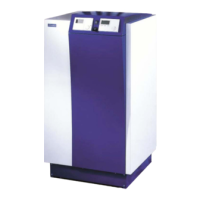
General overview of the Ultramax series, its environmental friendliness, output range, and CE approval.
Lists suitable heating systems for the R300 unit based on its construction.
Lists and illustrates the main components of the boiler with reference numbers and descriptions.
Explains the operating principle of the Boiler Management Unit and PID control for modulating capacity.
Lists the integrated safety components within the boiler, such as flame, water flow, and temperature protection.
General safety instructions to be read carefully before starting the installation.
Safety regulations for electrical, gas, and hydraulic installations during maintenance.
Rules regarding casing panels, safety devices, and operation when panels are removed.
Guidelines for maintaining the legibility and presence of instruction and warning stickers.
Requirement for written manufacturer approval for any modifications to the installation.
Safety precautions to follow when activities are undertaken in the boiler room.
Instructions for receiving, checking for damage, and verifying the delivered unit against the order.
Details on the unit's supply packaging, typically cardboard packaging on a pallet.
Guidance on handling, positioning, and moving the appliance to prevent casing panel damage.
Requirements for installation by a recognised installer and commissioning by MHS Technical Service.
General requirements for the boiler room, including noise, space, and frost-proof conditions.
Covers the requirements for gas, electrical, water, combustion air, and flue systems.
Requirements for connecting the gas supply, including pressure reduction and pipework.
Guidelines for making electrical connections, wiring diagrams, and mains isolator switch installation.
Table detailing electrical specifications for fan, pump, and total power consumption for different types.
Information on the boiler's proportional regulation system and available control options like BME and E6.
Description of various terminal functions for appliance operation, sensors, and external signals.
Recommendations for supporting water pipes, pump requirements, and system pressure.
Information on the standard room-sealed combustion air supply and installation possibilities.
Guidelines for installing flue gas discharge and air supply systems according to national regulations.
Details on permissible materials (plastic, aluminium, stainless steel) and construction of the air supply pipe.
Diagram and text regarding air supply pipe connection to the unit, including heights and distances.
General requirements for installing the flue system, including connection and condensation formation.
Guidelines for flue system installation, connection to the appliance, and potential condensation issues.
Details on chimney length, back-pressure considerations, and flue gas resistance.
Instructions for calculating the internal diameter and length of a flue system.
Requirements for discharging condensate to a drain and the function of the water trap.
Overview of the hydraulic system, emphasizing the unit's low water content and flow rate requirements.
General information on the hydraulic system, water flow rates, and system water quality.
Discusses water flow rates, the importance of the flow switch, and system resistance.
Explains how to measure water flow, compare it with boiler resistance, and system interference.
Presents pump characteristic curves (head vs. flow rate) for different UPS models.
Table providing electrical pump data (power, current) for different types and pump speeds.
Table providing electrical pump data for the bronze version, specifically for water heaters.
Recommendation for fitting manual valves between flow/return connections and the installation.
Use of mechanical non-return valves to prevent short-circuiting the appliance on the water side.
How the water flow switch operates to shut down the appliance if flow falls below minimum.
Details on minimum operating pressure requirements based on supply temperature and flow rate.
Defines minimum operating pressure requirements in bar based on flow temperature.
Guidance on fitting an expansion tank in the return pipe between the pump and boiler isolating valve.
How to determine the size of the system expansion tank based on system water quantity.
Requirement for a suitably sized pressure relief valve set to a maximum of 6 bar.
Maximum permissible water flow temperature and the function of the high limit thermostat.
Importance of system water quality, hardness limits, and chloride concentration.
Shows examples of hydraulic systems, emphasizing they are not for direct practice without analysis.
How to dimension a low velocity header and the formula for calculation based on flow rate and speed.
Describes systems using separate flow and return headers, common in renovation projects.
How the Ultramax unit is ideal for systems with weather dependent regulation and DHW priority.
Notes on pump behavior and switching off after boiler shutdown in multi-appliance installations.
Describes the boiler's prepurge, gas/air mixing, ignition, and flue gas removal process.
How the unit modulates capacity between 0% and 100% based on heating demand.
Explains the control module interface, including parameter indications and function selectors.
How to set the boiler's operating mode (standby, automatic, service) with the cover closed.
How to read information and parameters from the boiler management unit with the cover open.
Lists readable parameters available on the LCD display, such as flow temperature and capacity.
Lists and explains various input signals to the boiler, like flame ionization and water flow switch.
Lists and explains various output signals from the boiler, like power to gas valve and fan.
Steps to set the flow temperature for central heating using the control module.
Steps to set the flow temperature for domestic hot water using the control module.
Explains how faults are indicated, the need for correction, and lists specific fault codes and meanings.
Importance of commissioning by skilled personnel for optimal operation and warranty.
Steps for commissioning the water/hydraulic system, pump, chimney, and gas pipework.
Safety precautions to observe during maintenance activities, including clothing and personal safety.
Guidelines for annual inspection and routine maintenance activities for continued safe operation.
Step-by-step procedure for performing maintenance tasks like electrode renewal and cleaning.
Conditions and procedure for cleaning the burner and heat exchangers, requiring qualified engineers.
Procedure for cleaning the filter/screen in the gas combination block, requiring its removal.
How to perform an ionisation measurement using a micro-ammeter to check protection function.
Contact information for service and maintenance from the MHS Technical Service Department.
 General
| Brand | MHS Boilers |
|---|---|
| Model | Ultramax 287 |
| Category | Boiler |
| Language | English |


 To Next Page