EasyManua.ls Logo

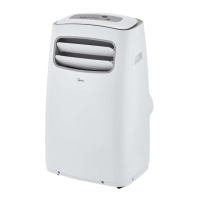
Midea MPN1-12CRN1-BH9 - User Manual

Midea MPN1-12CRN1-BH9
28 pages
Print Icon
To Next Page IconTo Next Page
Loading...
Website: www.mideaaircon.com
Service Manual
AIR CONDITIONER
Portable Type
N portable (AHAM
standard)
MPN-05CRN1-BH2(H)
US-KC15Y1/N1-N(H2H)
MPN-08CRN1-BH2(H)
US-KC23Y1/N1-N(H2H)
MPN-12CRN1-BH9(H)
US-KC35Y1/N1-N(H9H)
N portable (ASHRAE
standard)
MPN-05CRN1-BH9
US-KC15Y1/N1-N(H9)
MPN-08CRN1-BH9
US-KC23Y1/N1-N(H9)
MPN-085CRN1-BH9
US-KC25Y1/N1-N(H9)
MPN-10CRN1-BH9
US-KC30Y1/N1-N(H9)
MPN-12CRN1-BH9
US-KC35Y1/N1-N(H9)
MPN-14CRN1-BI6
US-KC41Y1/N1-N(I6)
N1 portable (AHAM
standard)
MPN1-08CRN1-BH2(H)
US-KC23Y1/N1-N1(H2H)
MPN1-09CRN1-BH2(H)
US-KC26Y1/N1-N1(H2H)
MPN1-10CRN1-BH2(H)
US-KC30Y1/N1-N1(H2H)
MPN1-12CRN1-BH9(H)
US-KC35Y1/N1-N1(H9H)
N1 portable (ARI
standard)
MPN1-08CRN1-BH9
US-KC23Y1/N1-N1(H9)
MPN1-10CRN1-BH9
US-KC30Y1/N1-N1(H9)
MPN1-12CRN1-BH9
US-KC35Y1/N1-N1(H9)
MPN1-14CRN1-BI6
US-KC41Y1/N1-N1(I6)
N series
N1 series
Question and Answer IconNeed help?

Do you have a question about the Midea MPN1-12CRN1-BH9 and is the answer not in the manual?

Summary

Safety Precautions

Installation Safety

Safety guidelines for installing the unit correctly.

Operational Cautions

Important warnings and precautions during product operation.

Usage Guidelines

Guidelines for safe and correct product usage.

Unit Dimensions

Display and Controls

Control Button Functions

Explains the function of various control buttons on the unit.

Display Indicators and Errors

Details display indicators, temperature settings, and common error codes.

Refrigerant System Diagram

Electrical Schematics

Product Specifications

Installation Guide

Installation Location Requirements

Specifies clearance and location requirements for proper installation.

Exhaust Hose Preparation

Details the initial steps for preparing the exhaust hose.

Double-Hung Window Installation

Window Seal Application

Instructions for cutting and applying foam seal to the window stool.

Window Panel Attachment

Steps to attach and secure the window panel.

Top Window Seal

Instructions for applying foam seal to the top of the window.

Double-Hung Window Installation (Continued)

Securing Window Sash

Securing the window sash after installation.

Sealing Window Gaps

Sealing open gaps between window sashes with foam seal.

Sliding Window Installation

Frame Seal Application

Applying foam seal to the window frame.

Sliding Panel Attachment

Steps to attach and secure the window panel for sliding windows.

Sliding Window Installation (Continued)

Top Window Seal Application

Applying foam seal to the top of the window.

Securing Sliding Sash

Securing the sliding window sash.

Sealing Sliding Gaps

Sealing gaps between window sashes with foam seal.

Key Features

Product Features Overview

Lists key features and design aspects of the portable air conditioner.

Compressor Testing

Defective Compressor Diagnosis

Procedures for identifying and testing compressor issues.

Wiring Continuity Test

Checks continuity of compressor terminals to detect open windings.

Ground Fault Test

Tests for grounding issues in the compressor.

Compressor Efficiency Check

Diagnoses compressor inefficiency by checking system pressures.

Terminal Overload Tests

Explains and tests external and internal overload protection.

Refrigerant System Service

Required Service Equipment

Lists necessary tools and equipment for repairs.

Equipment Capability Requirements

Specifies capabilities required for repair equipment.

Hermetic Compressor Replacement

Step-by-step guide for replacing a hermetic compressor.

Refrigerant System Service (Cont.)

Hermetic Compressor Replacement Steps

Completes the procedure for hermetic compressor replacement.

Compressor Burnout Procedure

Steps for handling compressor motor burnout.

Rotary Compressor Troubleshooting

Specific troubleshooting for rotary compressors.

Refrigerant Charging Guidelines

Procedures and notes for refrigerant charging.

Fan Motor Maintenance

Fan Motor Testing Procedure

Steps to test the fan motor's functionality and speed.

Capacitor Testing

Capacitor Diagnostic Test

Detailed instructions for testing capacitors using an ohmmeter.

Temperature Sensor Characteristics

Troubleshooting Guide

Power and Button Issues

Diagnoses and remedies for power or button issues.

Remote Control Malfunctions

Troubleshooting steps for remote control malfunctions.

Intermittent Fan Motor Operation

Possible causes and solutions when the fan motor runs intermittently.

Troubleshooting Guide (Cont.)

Fan Motor Failure to Run

Troubleshooting guide for when the fan motor fails to operate.

Fan Motor Noise Diagnosis

Identifies causes and solutions for abnormal fan motor noise.

Fan Runs, Compressor Off

Addresses issues where the fan runs but the compressor does not.

Unit Noise Issues

Explains causes and remedies for general excessive unit noise.

Water Full Alarm Troubleshooting

Troubleshooting the water full alarm indicator.

Poor Cooling;Heating Performance

Diagnoses performance issues related to cooling or heating.

Troubleshooting Guide (Cont.)

Unit Sizing Check

Checks if the unit's capacity matches the room size.

No Cooling or Heating

Troubleshooting steps when the unit fails to cool or heat.

Frequent Unit Cycling

Diagnoses and resolves frequent start/stop cycles.

Overview

This document provides a comprehensive service manual for Midea portable air conditioners, covering models in both the N and N1 series. It includes safety precautions, installation details, technical specifications, operational features, and troubleshooting procedures.

Function Description

The Midea portable air conditioner is designed to provide cooling, heating (for some models), dehumidification (dry mode), and fan-only operation. It is a consumer air conditioner, not a precision refrigerant system, and is intended for general room climate control. The unit operates by drawing in room air, processing it through a refrigeration cycle, and discharging conditioned air. It features a single louver for air direction and a straight condenser for efficient heat exchange. The unit is designed with a "no water tank" feature, implying an advanced shower system or self-evaporating mechanism for condensate management.

Important Technical Specifications

The manual details specifications for various models, including cooling capacity (Btu/H), Energy Efficiency Ratio (EER), current draw (Amps Cool), power consumption (Watts Cool), compressor type, refrigerant type (R410A), refrigerant amount (oz/g), design pressure (Psig), and air flow (M³/H(CFM)).

For example, the MPN-05CRN1-BH2(H) model has:

  • Cooling: 5000 Btu/H
  • EER: 8.2
  • Amps (Cool): 5.4 A
  • Watts (Cool): 600 W
  • Compressor: 39A121AA&54KA
  • Refrigerant: R410A, 10.2/290 oz/g
  • Design Pressure: 550/340 Psig
  • Air Flow: 360/310/270 M³/H(CFM)

Another example, the MPN1-12CRN1-BH9 model has:

  • Cooling: 12000 Btu/H
  • EER: 8.9
  • Amps (Cool): 11.9 A
  • Watts (Cool): 1340 W
  • Compressor: EA103M1C-1DZDU1
  • Refrigerant: R410A, 15.2/430 oz/g
  • Design Pressure: 550/340 Psig
  • Air Flow: 470/430/370 M³/H(CFM)

Compressors are single-phase, 115 or 230/208 volt, permanent split capacitor type, using a running capacitor across the start and run terminals. They are internally spring-mounted and externally mounted on rubber isolators.

Usage Features

The portable air conditioner offers several user-friendly features:

  • Mode Selection: Users can select from AUTO, COOL, DRY, FAN, and HEAT (for cooling-only models, HEAT is not available).
  • Timer Function: Allows setting AUTO ON start time and AUTO OFF stop time programs.
  • Temperature Adjustment: Temperature settings can be adjusted in 1°C/2°F increments within a range of 17℃ (62°F) to 30℃ (88℉). The timer setting can be adjusted from 0 to 24 hours. The display can switch between Fahrenheit and Celsius by pressing and holding the Up and Down buttons simultaneously for 3 seconds.
  • Fan Speed Control: Three fan speeds are available: LOW, MED, and HI.
  • Sleep Mode: Initiates a SLEEP operation for comfortable nighttime use.
  • ION Button (optional): Activates an ion generator to remove pollen and impurities from the air.
  • Swing Function (optional): Allows the louver to swing up to a 6° angle per press, or continuous auto-swing by pressing the button for more than 2 seconds.
  • Turbo Cooling Function: Provides rapid cooling.
  • Flexible Air Exhaust: Facilitates easy installation and exhaust hose management.
  • Advanced Shower System: Likely refers to an efficient condensate management system, possibly self-evaporating.
  • Follow Me Function: Allows the unit to sense the temperature at the remote control's location for more precise comfort.
  • 24-hour On/Off Timer: Provides flexibility in scheduling operation.
  • No Water Tank Design: Eliminates the need for manual condensate draining in most operating conditions.

Maintenance Features

The manual outlines several maintenance and troubleshooting procedures:

  • Safety Precautions: Emphasizes professional installation, avoiding self-repair, caution with sharp edges, ensuring proper power cable handling, and not operating with flammable gases nearby. It also advises disconnecting power during cleaning or prolonged non-use.
  • Installation: Requires a flat, spacious location with a minimum clearance of 30cm from walls or obstacles. The plug must be accessible, and wiring should comply with national rules. Detailed instructions are provided for installing the exhaust hose and window panel kits for both double-hung and sliding sash windows.
  • Cleaning: Recommends using a soft cloth for cleaning and avoiding harsh detergents. Air filters should be cleaned every two weeks or more often if necessary.
  • Compressor Testing: Procedures for checking compressor continuity (C-S, C-R, R-S terminals) and for ground faults using an ohmmeter. It also describes how to check for compressor inefficiency due to faulty valves by monitoring high and low side pressures and temperature difference across the coil.
  • Overload Protection: Explains external and internal overload mechanisms and how to test them for continuity.
  • Refrigerant System Repairs: Detailed steps for sealed refrigeration system repairs, including refrigerant recovery, component replacement (compressor, condenser, evaporator, capillary tube, filter drier), leak testing with dry nitrogen and halogen leak detectors, evacuation to a deep vacuum (200 microns or less), and precise refrigerant charging. It also covers special procedures for compressor motor burnout, including flushing the system.
  • Fan Motor Testing: Instructions for checking the fan motor capacitor and testing motor speeds by applying power to specific wires.
  • Capacitor Testing: Describes how to visually inspect capacitors for damage and how to test them using an ohmmeter for continuity and deflection. A table of temperature sensor resistance values (Temp.°C vs. Resistance KΩ) is provided for diagnostic purposes.
  • Troubleshooting Guide: A comprehensive table of common problems, possible causes, and remedies, covering issues like no power, remote control failure, fan motor not running or making noise, compressor not running, excessive noise, water full alarm, and poor cooling/heating performance. This includes checks for power supply, transformer, PCBs, batteries, fan motor bearings, wiring, temperature settings, and refrigerant levels.

Midea MPN1-12CRN1-BH9 Specifications

General IconGeneral
BrandMidea
ModelMPN1-12CRN1-BH9
CategoryAir Conditioner
LanguageEnglish

Related product manuals