
 Need help?
Do you have a question about the Mifare Classic and is the answer not in the manual?
Details weight per set and equipment class as per Directive 1999/5/EC.
Outlines HF radiation output, frequency band, battery type, operating temp, and humidity.
Specifies operating temperature range and relative humidity for operation.
Warns about lithium-ion battery disposal, short circuits, and fire risks.
Instructs to separate electronics and dispose of them according to local regulations.
Emphasizes user manual accessibility and adherence to accident prevention regulations.
Details battery replacement, polarity, and avoiding interference with data storage.
Warns against pre-stressing doors and using doors with rubber profiles to avoid malfunction.
Defines intended use with encoded chips and warns against misuse in explosive environments.
Prohibits modifications and recommends using only original or approved replacement parts.
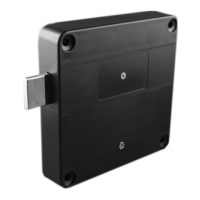
Describes the lock as a wireless furniture lock opened with a transponder.
Explains the contactless Mifare transponder wake-up and programming process.
Lists the included components: lock, closing part, battery, sticker, screws, and manual.
Guides on checking components, disposing of packaging, and inserting the battery correctly.
Provides a diagram of the lock, identifying screwing holes, programming button, and card reader panel.
Details steps for creating programming cards, adding transponders, and managing stored data.
Shows installation dimensions and provides important notes on RFID reading distance.
Lists directives and harmonised standards the Locker lock Freelocker complies with.
The Locker lock Freelocker is a compact, wireless furniture lock designed for cupboards, drawers, and other furniture applications. It operates using contactless identification at a 13.56 MHz frequency, compatible with Mifare Classic 1K and 4K (UID) transponders. This system allows for secure locking and unlocking of furniture without the need for a traditional key, providing a controlled and safe access solution.
The Freelocker system utilizes a contactless Mifare Classic identification transponder to "wake up" the system and close the lock. When the lock is closed, the transponder and the lock are automatically programmed. This programming ensures that the transponder cannot obstruct any other locks. Upon opening the latch, the programming is automatically deleted from the transponder, making it "neutral" and capable of locking any other Freelocker latch lock.
The lock is equipped with an electric motor that facilitates opening. When closed, the system automatically locks itself. The transponders, which serve as keys, can be used without pre-programming at each lock, offering a "free choice of locks" functionality. This means a single transponder can be used to lock and unlock various Freelocker units without specific prior assignment.
The system includes a 3V battery, which provides power for up to 15,000 openings. The battery level is continuously monitored, and a low battery condition is indicated by an audible signal. In some cases, this signal may persist for several days before the lock automatically unlocks itself to prevent complete power loss and ensure access.
The Locker lock Freelocker offers simple programming using a dedicated programming card. Up to three programming cards and one user transponder can be stored per lock. The programming process involves holding the programming button until a long beep sounds, indicating that the lock's memory has been cleared and it is ready for a new programming card. Once the programming card is held against the identification zone, a ticking sound confirms its storage. Additional programming cards can be added during this ticking phase.
To add a user transponder and lock the unit, the transponder is held against the card reader panel. An audible signal confirms the lock is engaged, and the transponder is stored. The transponder is automatically programmed by the lock, preventing it from blocking other latch locks. Unlocking is achieved by holding the transponder against the card reader panel again, which triggers a confirmation signal, retracts the latch, and opens the lock. The programming on the transponder is then removed, allowing it to be used with another Freelocker.
Emergency opening is possible with the programming card. By holding the programming card to the reader panel until the lock starts ticking, and then holding it twice against the reader (confirmed by two short beeps), the lock will open, and the latch will move to the open position.
The system also allows for the deletion of stored transponders and programming cards. To delete all stored transponders, the programming card is held against the reader panel until the lock ticks, then held four times against the panel. To delete all stored programming cards, the programming card is held against the reader panel until the lock ticks, then held six times against the panel. After deleting programming cards, new ones can be created.
The signal tone can be switched on or off by pressing the programming button for a maximum of one second. A "Segment Cleaner" accessory is available to clear information on transponders if needed.
The lock is designed for installation without requiring holes in the door panel, making it suitable for various furniture types. For metal doors, appropriate mounting hardware is available. Transponders can come in the form of cards (credit card format), key fobs, or wristbands.
The Locker lock Freelocker requires proper battery management. The electronics contain a lithium-ion battery, which must be disposed of according to national regulations. When disposing of partially discharged batteries, it is crucial to prevent accidental short circuits between the poles (e.g., from a key fob in a pocket) to avoid explosion and fire hazards. Partially discharged batteries should be secured for transport using non-conductive adhesive film to prevent short circuits.
For storage and transport, the battery should be removed from the device. When replacing the battery, it is important to wait at least 30 seconds after removing the old battery before inserting a new one to prevent malfunctions. Correct polarity (+/-) must be observed at both the battery compartment and the battery itself. Locks with an inserted battery should not be kept immediately adjacent to each other, nor should they be kept near data storage mediums, as this can cause the battery to discharge.
During installation, it is essential to ensure that the door is not pre-stressed and that no stresses are transferred to the locking system, as this could prevent the latch from opening. Doors pre-loaded with a rubber profile should be avoided. The lock assembly and the closing part must be mounted such that the door in the closed state has at least a 0.5 mm distance. This tolerance is necessary for emergency opening in case of low battery.
The user manual must be accessible to operators, and general and local regulations on accident prevention and environmental protection must be observed. Any type of modification or addition to the Locker lock Freelocker is not permitted, as it may impair the electromagnetic conduct. Only original parts or parts approved by the manufacturer should be used for replacements, as third-party parts may lead to dangers.
 General
| Frequency | 13.56 MHz |
|---|---|
| Data Retention | 10 years |
| Write Endurance | 100, 000 cycles |
| Read Range | Up to 10 cm (depending on reader and environment) |
| Type | Contactless smart card |
| Security | Crypto-1 (proprietary) |
| Operating Distance | Up to 10 cm |
| Compatibility | ISO/IEC 14443 A |
| Communication | RFID |

 To Next Page