CUddY^W 4__b 9^dUb\_S[ CgYdSXUc
@5<<5B9> =9<>?B 3?B@?B1D9?>
29B8#= ! @eR\YcXUT 2__[ c`USc 4QdUc* " # "!$ " # "!$ " # "!$ <Q^W* 5>7 ! 1``\YS* B8#
BTccX]V3^^a8]cTa[^RZBfXcRWTb
7^fCWT3^^a8]cTa[^RZBfXcRWTbF^aZ
30=64A ) 0\_dcPcX^] 7PiPaS
—Turning cylinder can twist off arms.
• Do not permit this machine to be operated unless door interlock switch SMD (Figure 1
item 3) is set according to these instructions.
• Do not operate this machine if a visual inspection of the unlocked door shows door lock
switch SMD touching the door lock slider, or if the machine operates with the door open.
• Verify that all components of this system are in good working order.
=^cT )
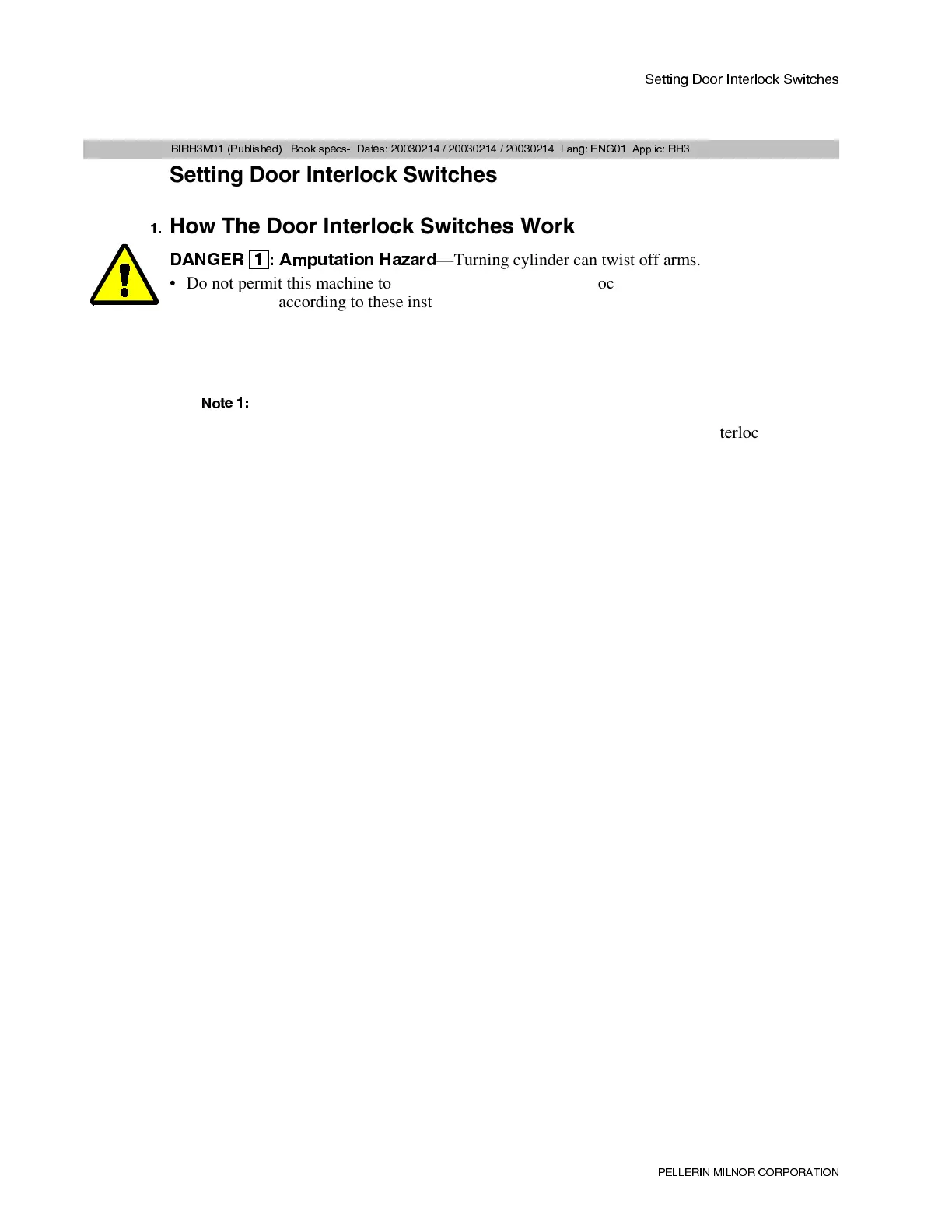
Study the illustrations in Figures 1 while reading the following explanation.
After the door is shut, the turning door catch (item 2) physically contacts door interlock switch
SMD (item 3). Actuating this switch tells the microprocessor that the door is closed. Note that the
door handle is not locked in place and the door can be opened if needed. The machine can be
programmed but cannot start the wash program or allow manual actuation of outputs.
Immediately after the start switch
:
is pushed, the microprocessor energizes solenoid EMDL
(item 4), pulling up the door lock slider. The raised door lock slider mechanically locks the door
handle in place and actuates door interlock switch SME (item 1). Actuating this interlock switch
confirms that the door is closed and locked, allowing the machine to start the wash program.
46


 To Next Page