12 13
Wire Wheel Brush
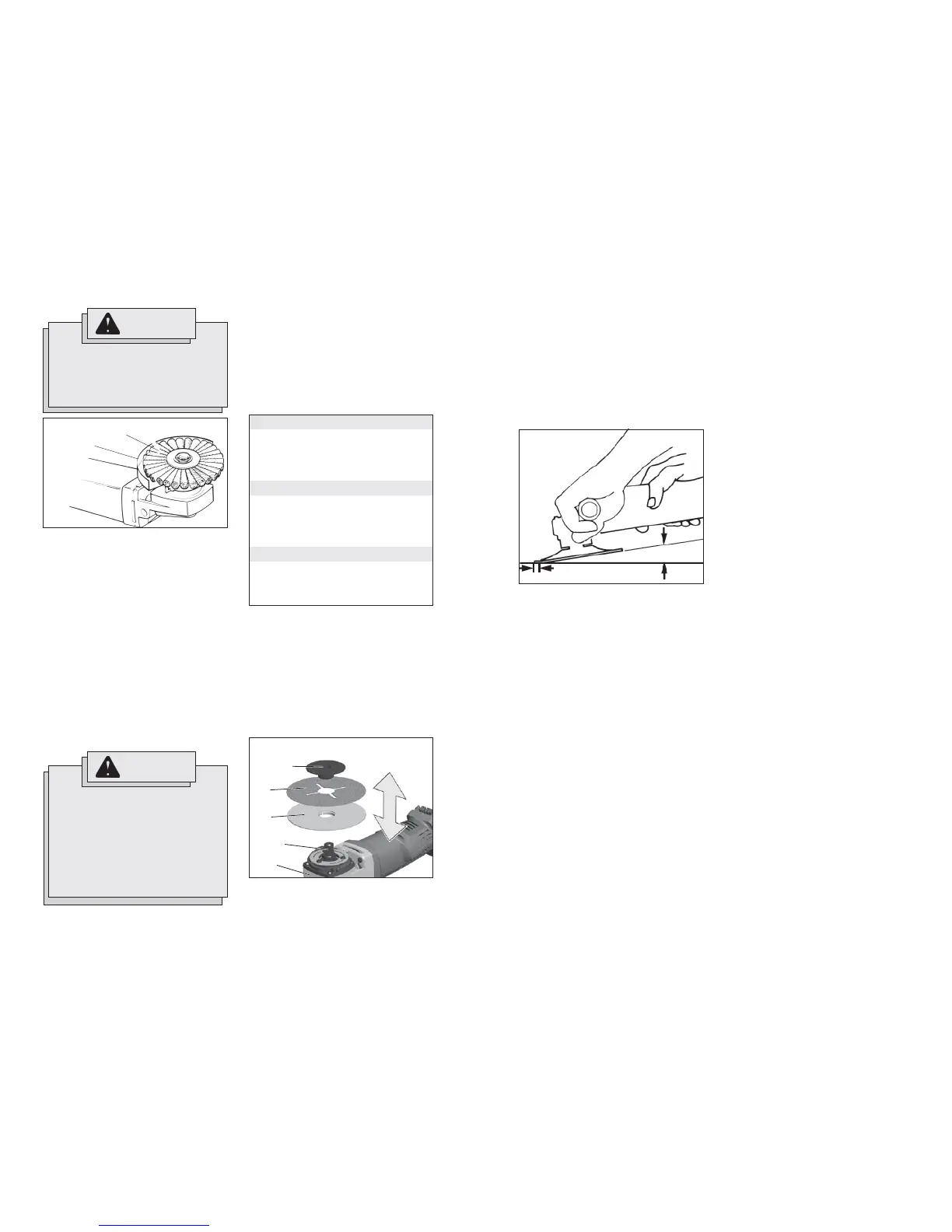
Fig. 9
Guard
Wire wheel brushes are useful for removing
rust, scale, burrs, weld slag, etc. A wide va-
riety of wire brushes are available for many
applications.
Test wire wheel brush for balance and loose
or damaged wires by running tool at no load
speed for at least one minute before apply-
ing it to your work. During this time, no one
should stand in front of or in line with it. When
applying brush to work, avoid using too much
pressure. This causes over-bending of wires
and heat build-up resulting in premature wire
breakage, rapid dulling and reduced brush
life. Instead of using more pressure, try a wire
wheel brush with more aggressive cutting
action (increased wire size, decreased wire
length or different brush type, i.e. knot type
instead of crimped wire type).
WARNING
Because the wires on wire wheel
brushes are directed towards the
operator, a guard must be used to
protect the operator when fatigued
wires break.
WARNING
Never exceed Maximum Safe Oper-
ating Speed of brush. Do not use
a damaged brush or one which is
functioning improperly (throwing
wires, out-of balance, etc.). these
conditions increase the possibility
of further brush failure and possible
injury. Discard and replace damaged
brushes immediately.
Using Wire Wheel Brushes
Aluminum Oxide
For fast cutting, general purpose discs for
most metal jobs. Best for cold-rolled steel,
stainless steel or metals requiring tough,
fast cutting, long lasting abrasives.
Aluminum Zirconia Bi-Cut
Unique grit pattern is arranged in clusters
for faster stock removal and cleaning. Ideal
for removing paint from cars, boats, etc.
without clogging.
Ceramic
Lasts up to 3 times longer than Aluminum
Oxide Discs. For general metal working.
Ideal for tough jobs.
Fig. 10
Gear
case
Spindle
Backing
pad
Disc nut
Sanding
disc
Selecting Sanding Discs & Grit
Refer to the table below to select the correct
type of sanding disc for your job. Generally,
use 24 or 36 grit for heavy stock removal;
50, 60, or 80 grit for medium stock removal
and 120 grit for finishing. Always begin
with a coarse grit, using successively fi ner
grits to obtain the desired fi nish. See your
MILWAUKEE Electric Tool Catalog for a
complete list of sanding discs.
Installing Backing Pad and Sanding Discs
1. Remove battery pack.
2. Place tool upside down on a level surface.
Remove any accessories from spindle.
3. Slip backing pad onto spindle with fl at side
away from gear case.
4. Place sanding disc on backing pad and
secure assembly to spindle with disc
nut.
5. To tighten, press the spindle lock button
while turning disc nut clockwise with the
spanner wrench provided.
6. To remove backing pad and sanding disc,
remove battery pack reverse procedure.
Fig. 11
For best result use
only this portion of disc
5° to 15° angle
Sanding
1. Use a clamp, vise or other practical
means to hold your work, freeing both
hands to control your tool.
2. Hold sander/grinder at 5° to 15° angle
(Fig. 11) to ensure proper sanding pres-
sure and control. Too great an angle
will result in too much pressure and
could cause excessive wear to the disc
and workpiece. Too small an angle will
reduce control.
3. To start the tool, grasp the handle and
side handle fi rmly and slide the switch
to ON.
4. Allow sanding disc to come to full speed
before beginning to sand. Use long,
sweeping, side to side strokes, ad-
vancing forward to produce the desired
fi nish.
5. To stop the tool, release the switch.
Make sure the tool comes to a complete
stop before laying the tool down.
6. To lock-on the switch, slide the switch
to ON and then press down on the front
of the switch. To stop the tool, press and
release the switch. Make sure the tool
comes to a complete stop before laying
the tool down.
Cross Sanding
When finishing a surface that has been
prepared by a coarse disc or wheel, sand
at right angles to the strokes made by the
coarser disc. Finishing marks left from pre-
vious sanding are easily seen and removed
for a uniform fi nish. Failure to cross sand
when changing from a coarse disc to a
fi nishing disc may result in deep scratches
and circular marks.
Removing Welds or Hammer Marks
When removing welds or hammer marks,
limit coarse sanding to the immediate area.
Use successively finer grits to smooth
surface.
Finishing Metal
Constantly move across the surface. Work
faster on curved surfaces where contact
areas are smaller and pressure is greater.
Flat areas may appear at the end of the
stroke when pressure is too heavy. Ease up
on pressure at end of each stroke and when
reversing strokes.
Troubleshooting
Deep scratches and circular marks can
result from:
• Using too coarse a grit
• Using a partially glazed disc
• Dirt or loose metal on the workpiece
• Failure to sand across the grain when
changing from coarse to fi nishing discs
• Failure to use closed coated discs to
reduce the problem of grains working
loose and scratching the workpiece
Bluish discoloration of metal surface indi-
cates:
• Excessive heat caused by circular mo-
tion in a small area
• Excessive pressure
• Use of worn out or glazed discs




 To Next Page