MindPrint-AN/DI PRO
5.A Bit of Theory
5.1 What Will 24 Bits Do for You?
When an analog signal is digitized, the level of the analog signal is measured at specific
intervals and represented numerically.The 16 bits of the CD format allow a representation
of 216, which translates to 65,536 individual or discrete increments.If the initial analog
signal lies between the discrete values of two of these steps,the converted signal will
contain an error. The size of this error varies with each sample and is perceived by your
ears as a type of interference called quantization noise.On the other hand, a digital word
length of 24 bits allows signals to be represented by more than 1.6 million steps,
resulting in a considerably more accurate approximation of the signal and much
less quantization noise.
Incidentally,the superior 24-bit quality of the AN/DI PRO is beneficial—some might call
it imperative—even if the final product of the recording is a CD with 16 bits.Why?
Because when you're recording with a 16-bit converter,in many cases only 14 bits are
actually used to represent the signal—the other two bits are reserved as a kind of
digital headroom.If the signal is compressed in the course of processing,quantization
noise—initially soft—becomes significantly more perceptible.Finally,during digital
post-processing, rounding errors are generated in calculation operations.These errors are
always apparent in the lowest bit. For these reasons,it's a good idea to work with 24 bits
and refrain from converting the signal down to the 16-bit CD format until you've executed
all processing operations in your recording system.In other words, conversion should
always be the final step.The great advantage here is that the potential of the CD format is
exploited fully,right down to the last bit.Your tracks thus end up with the best possible
dynamics,definition and fidelity.
5.2 What Will 96 kHz Do for You?
The sampling rate determines how often the level of the analog signal is measured per
second and converted into a digital number.The more often the signal is measured—i.e.,
"sampled”—the higher the frequencies that can be represented. Shannon's sampling
theorem states that the highest frequency contained in the audio signal may be equal to
no more than half of the sampling rate.Therefore,a maximum of 22.05 kHz can be
represented by the CD standard of 44.1 kHz.Frequencies above this value must be removed
from the signal by a so-called anti-aliasing filter before it is converted.
With a sampling rate of 96 kHz, the audio spectrum comprises frequencies up to 48 kHz.
Although the human ear is incapable of hearing frequencies higher than 22 kHz, the higher
sampling rate is justified.For example, during digital post-processing,equalizers sound
cleaner since band limiting—this is what the anti-aliasing filter does—at 22 kHz can
easily alter the filter response curves.
In digital signal chains it is often beneficial to add a slight amount of dither (or “dither
noise”) to the signal to minimize digital artifacts. Here, too, a 96-kHz sampling rate has a
distinct advantage, because the dither noise is spread out over twice as wide a frequency
range,but only half of it is audible. Using just the right kind of filtering (“noise shaping”),
it is possible to move most of the dither noise outside the range of human hearing, where
it has no adverse effects.And, finally, since a 96K system gives us a lot more room to
operate in the realm beyond human hearing – circa 20 kHz to 48 kHz – we're now free to
use familiar digital techniques such as anti-aliasing and oversampling filters in more
interesting ways, for example with filter slopes that can now be much more gradual and
can therefore yield a more natural-sounding (and musical!) result.
For all these reasons,the trend in digital recording systems is to go with higher sampling
rates, and your AN/DI PRO is ready to go with the (data-)flow!
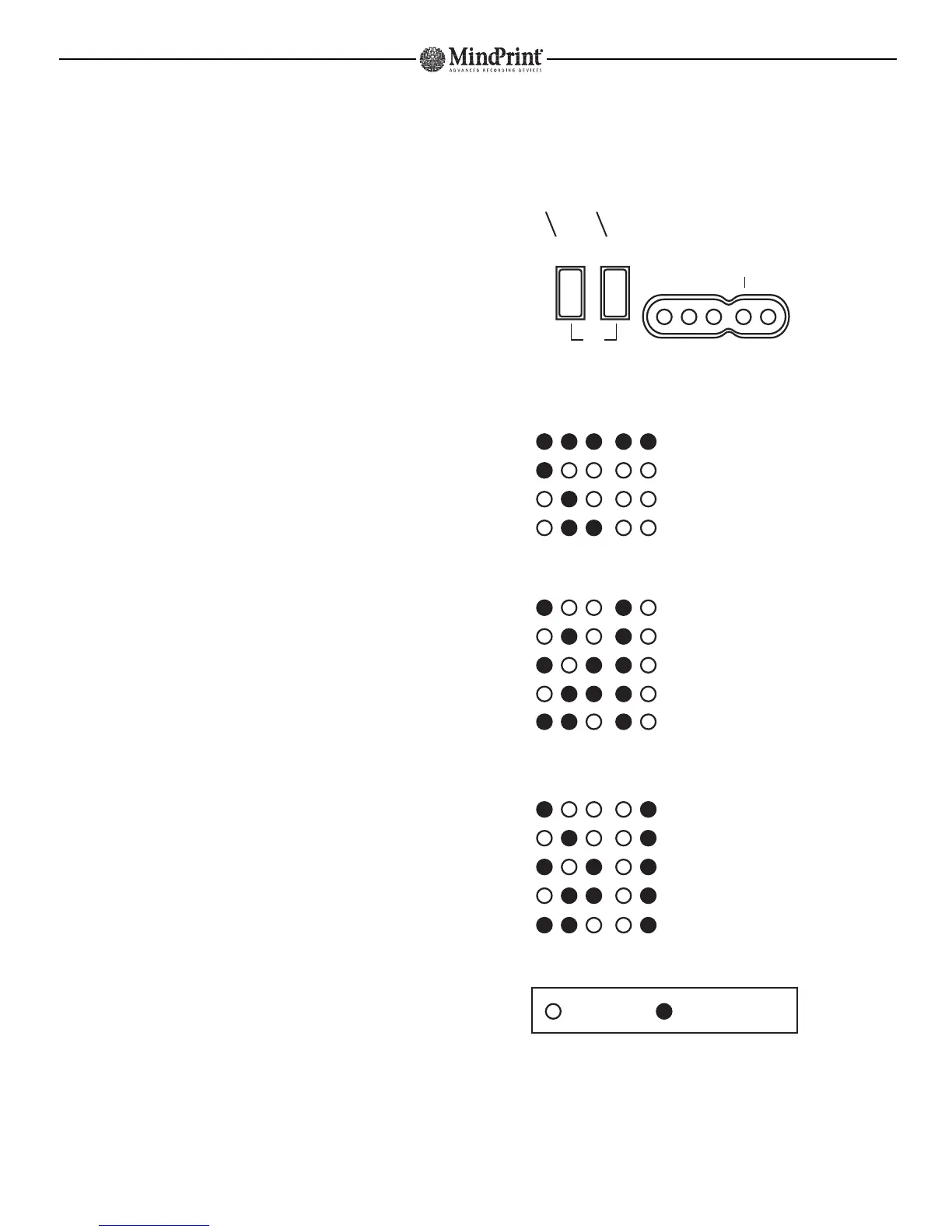
internal
external Wordclock
no switch pushed, no sync.
44,1 kHz internal, S1 pushed
48 kHz internal, S2 pushed
96 kHz internal, S1 + S2 pushed
44,1 kHz external, Wordclock
48 kHz external, Wordclock
88,2 kHz external, Wordclock
96 kHz external, Wordclock
32 kHz external, Wordclock
unlit lit
external AES
44,1 kHz external, AES
48 kHz external, AES
88,2 kHz external, AES
96 kHz external, AES
32 kHz external, AES
96
44.1 48
44.1
48 x2 WORD
AES - S/PDIF
SAMPLING FREQ.
S1 S2


 To Next Page
 Loading...