
 Need help?
Do you have a question about the MINN KOTA ENDURA MAX and is the answer not in the manual?
Indicator for monitoring the battery's remaining charge level.
Controls for motor operation: On/Off, speed, and direction.
Component for setting and securing the motor's immersion depth.
Knob to adjust the resistance for steering the motor.
Lever used for tilting the motor up or down.
Bracket with multiple positions for mounting the motor to a transom.
Screws used to secure the mounting bracket to the boat's transom.
Information regarding the product's warranty coverage.
Durable and flexible shaft material for the trolling motor.
The motor's propeller designed for efficient thrust.
Description of the motor's quiet and efficient operation.
Step-by-step instructions for assembling the motor's handle.
Procedure for securely mounting the trolling motor onto a boat's transom.
Guidelines for safe and compliant boat rigging and motor installation.
Chart for selecting appropriate wire gauge and circuit breaker sizes.
Recommendations for choosing and maintaining deep cycle marine batteries.
Instructions for safely connecting 12-volt battery systems to the motor.
Explanation of the battery meter's functionality and charge indicators.
Steps to set and secure the motor's immersion depth for optimal performance.
Guidance on adjusting steering tension for ease of use or preset positioning.
How to operate the twist tiller for variable speed and direction.
Methods for adjusting the mounting bracket for different water conditions.
Instructions for properly tilting and securing the motor for transport.
Detailed guide for safely replacing the trolling motor propeller.
Routine cleaning and upkeep for the motor and its components.
Troubleshooting steps for power issues: polarity, terminals, battery water.
Diagnosing power loss due to low battery charge and recharging.
Solutions for steering stiffness: tension knob and shaft lubrication.
Addressing propeller vibration by checking and rotating the prop.
Tips for resolving electronic interference with fishfinder devices.
Company's commitment to environmental regulations and WEEE compliance.
Information on the EU Waste Electrical and Electronic Equipment Directive.
Guidance on proper disposal of the motor and batteries.
Warning about chemicals causing cancer and reproductive toxicity.
Minn Kota chargers for battery maintenance and extending battery life.
Features and benefits of the Talon shallow water anchor system.
List of various accessories available for Minn Kota trolling motors.
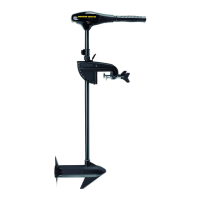
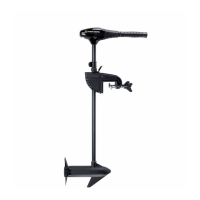
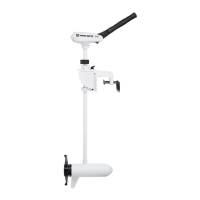
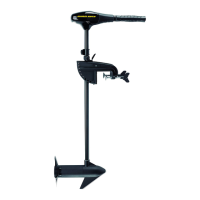
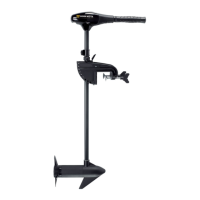
The device is a transom-mount trolling motor designed for marine use, offering a range of features for efficient and quiet operation, ease of use, and durability. It is specifically designed to provide propulsion and steering for boats, particularly for activities like fishing where precise control and quiet operation are beneficial.
The primary function of this device is to provide propulsion for a boat, allowing for controlled movement, especially at slower speeds, which is ideal for trolling. It operates by converting electrical energy from a battery into mechanical energy to spin a propeller, pushing the boat through the water. The motor is designed to be mounted on the transom of a boat, making it a versatile option for various boat types. Its variable speed control allows the user to precisely adjust the thrust, enabling fine-tuned maneuvering and speed regulation. The motor is also equipped with a battery meter to keep the user informed about the remaining charge, ensuring uninterrupted operation.
The trolling motor incorporates several features that enhance its usability and control on the water.
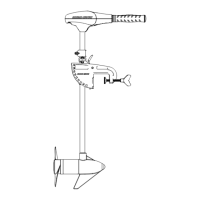
Adjustable Depth Collar: This feature allows the user to easily adjust the motor's depth in the water. Proper depth setting is crucial to ensure the propeller is fully submerged and to prevent churning or agitation of surface water, which can reduce efficiency and disturb fish. The collar can be loosened to slide the shaft to the desired depth and then tightened to secure it in place.
Steering Tension Knob: The steering tension knob provides control over the motor's steering resistance. Users can adjust it to allow the motor to turn freely for active steering or tighten it to hold the motor in a preset position, freeing up their hands for other tasks like fishing. This flexibility in steering control is a significant advantage for different fishing styles and boating conditions.
Quick Release Tilt Lever: This lever enables quick and easy tilting of the motor. It allows the user to lock the motor in a vertical position for normal operation, angle it for shallow water navigation, or tilt it completely out of the water for transport or when not in use. This quick-release mechanism simplifies deployment and retrieval of the motor.
Telescoping Handle Controls: The handle is designed to be telescoping, offering variable forward and reverse speeds. The speed control is integrated into the twist tiller, allowing users to increase reverse speed by turning it counterclockwise from the "OFF" position and increase forward speed by turning it clockwise from "OFF." Thrust decreases as the handle approaches the "OFF" position from either direction. This intuitive control system provides precise speed and direction adjustments.
10-Position Lever Lock Mounting Bracket: The mounting bracket features a 10-position lever lock, which allows for secure attachment to the boat's transom. This bracket ensures the motor remains firmly in place during operation and provides multiple tilt positions for versatility in various water conditions.
Transom Clamp Screws: These screws are used to secure the mounting bracket to the boat's transom. They should be tightened by hand to ensure a snug fit without over-tightening, which could damage the bracket or the boat.
Power Prop: The motor is equipped with a power prop, designed for efficient propulsion. The propeller's design aims to maximize thrust while minimizing weed entanglement, contributing to smooth and effective operation.
Battery Meter: A "push-to-test" battery meter is integrated into the motor's control head. This LED display provides an accurate indication of the remaining battery charge, but it is only accurate when the motor is off. The meter uses a series of lights to indicate charge levels: one light for recharge, two for low charge, three for good charge, and four for full charge. This helps users monitor battery status and plan for recharging.
Stowing the Motor: For transport or when not in use, the motor can be easily stowed. This involves adjusting the depth to fully raise the motor, pressing and holding the tilt lever, and then tilting the motor into the boat. It is recommended to tilt the motor and prop assembly completely out of the water and position it close to the lever lock bracket for secure transport.
Battery Connection: The motor operates with lead-acid, deep cycle marine 12-volt batteries. For 12-volt systems, the positive (+) red lead connects to the positive (+) battery terminal, and the negative (-) black lead connects to the negative (-) battery terminal. It is crucial to ensure the motor is switched off before connecting the battery and not to switch it on until the propeller is in the water.
Maintaining the trolling motor is straightforward, focusing on cleanliness, propeller care, and battery management to ensure longevity and optimal performance.
General Cleaning: After each use, especially in saltwater, the entire motor should be rinsed with freshwater. Following rinsing, it should be wiped down with a cloth dampened with an aqueous-based silicone spray. This helps protect the motor components from corrosion and wear.
Propeller Inspection and Cleaning: The propeller requires regular inspection and cleaning after every use. Weeds and fishing line can become entangled behind the prop, potentially damaging seals and allowing water to enter the motor. Removing these obstructions is vital for maintaining the motor's efficiency and preventing internal damage.
Prop Nut Security: Users should verify that the prop nut is secure each time the motor is used. A loose prop nut can lead to propeller inefficiency or loss.
Protection During Transport/Storage: To prevent accidental damage during transportation or prolonged storage, the battery should be disconnected whenever the motor is out of the water. For extended storage periods, lightly coating all metal parts with an aqueous-based silicone spray is recommended to prevent corrosion.
Battery Care: For maximum battery life and motor performance, batteries should be recharged as soon as possible after use and restored to full charge prior to each use. Keeping battery terminals clean with fine sandpaper or emery cloth is also important to ensure good electrical contact and prevent corrosion.
Propeller Blade Maintenance: The propeller is designed for weed-free operation and high efficiency. To maintain this top performance, the leading edge of the blades must be kept smooth. If the blades become rough or nicked from use, they should be smoothed by sanding with fine sandpaper.
Propeller Replacement: In case of damage or wear, the propeller can be replaced. This process involves disconnecting the motor from all power sources, holding the propeller, and loosening the prop nut with pliers or a wrench. If the drive pin is sheared, a screwdriver can be used to hold the shaft stationary. After removing the old prop, a new one can be aligned with the drive pin, and the prop washer and nut can be installed, tightening the nut appropriately without over-tightening.
Troubleshooting: The manual provides guidance for common issues such as the motor failing to run or lacking power (checking battery connections, terminals, and water level), losing power after a short running time (checking battery charge), difficulty in steering (loosening steering tension knob, lubricating composite shaft), and prop vibration (removing and rotating the prop 180 degrees).
These features and maintenance guidelines ensure that the transom-mount trolling motor remains a reliable and effective tool for boaters, offering a blend of performance, convenience, and durability.
 General
| Control | Tiller |
|---|---|
| Voltage | 12V |
| Speed Control | Variable |
| Battery Meter | Yes |
| Speed Settings | Variable |
| Warranty | 2-year limited warranty |
| Shaft Length | 36 inches |
| Mount Type | Transom |
| Battery Requirement | 12V |
| Thrust | 40 lbs |




 To Next Page