
 Need help?
Do you have a question about the MINN KOTA MK110P and is the answer not in the manual?
Manual contains important safety and operating instructions for safe and efficient use.
Batteries contain sulfuric acid and produce explosive gases. Follow instructions carefully.
Never alter the AC cord or plug; have a qualified electrician install a proper outlet.
Ensure charger is disconnected from AC power before connecting battery leads.
Explains the meaning of various indicator lights on the charger during operation.
Generators with modified square wave output can damage the charger; use sine wave output.
Do not perform any servicing other than outlined in operating instructions to avoid electric shock.
Instructions for obtaining warranty service in the U.S., including contact and shipping details.
No express warranties beyond the stated limited ones; implied warranties are limited.
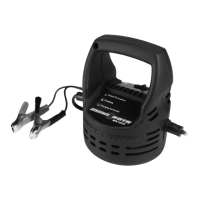
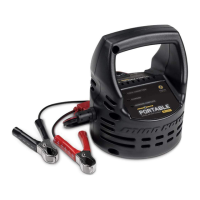
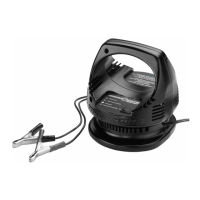
This document serves as the owner's manual for Minn Kota Portable Battery Chargers, specifically models MK110P and 210P, designed to provide reliable charging anywhere, anytime. The primary function of these devices is to charge and maintain 12-volt 6-cell lead-acid batteries, including FLOODED/WET CELL, MAINTENANCE FREE, and AGM/STARVED ELECTROLYTE types. They are not intended to power low voltage electrical systems other than for charging and maintaining batteries, nor should they be used for charging dry-cell batteries, which could lead to bursting and cause injury or property damage.
The Minn Kota portable battery charger is a powerful electrical device designed for safe and efficient battery charging. It operates by converting AC power into DC power suitable for recharging lead-acid batteries. The charger features indicator lights to communicate its status: a green power light indicates AC power is applied, a yellow light for each bank signifies that the battery is charging, and a green light for each bank confirms the battery is fully charged and in maintenance mode. A red light for each bank indicates a problem, such as no battery connection, battery voltage below 4.0 volts, or reverse polarity connection. The charger is designed to be temporarily connected to the battery using DC output leads, ensuring correct polarity with the red lead connected to the positive terminal and the black lead to the negative terminal. For two-channel models, if batteries are connected in series for 12/24 - 24V, the series connection wire should remain in place during charging.
Before using the charger, it is crucial to follow a series of preparatory steps to ensure safety and proper function. If removing a battery from a boat or vehicle for charging, always disconnect the grounded terminal first and ensure all accessories are off to prevent arcing. The charging area should be well-ventilated, and battery terminals should be cleaned carefully, avoiding contact with eyes. For batteries with removable cell caps, distilled water should be added to each cell to the manufacturer's specified level only after the battery has been charged, and cell caps must be replaced to prevent water evaporation. For batteries without removable cell caps, such as valve-regulated lead-acid batteries, the manufacturer's recharging instructions should be followed carefully. The battery fluid level should be checked every 30 days.
The charger's DC output leads are 6 feet long, and the input (AC) power cord is also 6 feet long. Users must ensure that all DC battery leads can reach the batteries and the AC power cord can reach the power source without splicing any leads, as this voids the warranty. The charger is not designed for wet conditions and is not water-resistant, so batteries from a boat should be removed and charged on land. For optimal performance, a minimum of 6 inches of unobstructed area should be allowed on all sides of the unit for proper air circulation and cooling.
To begin charging, connect the charger to AC power. If a red light illuminates, indicating a problem, immediately disconnect the AC power and address the issue based on the indicator information. If the situation cannot be remedied, contact Minn Kota Service Department for assistance. It is important to note that generators with a modified square wave output can damage this charger, while those with a sine wave output can be used. Before making any connections to batteries in a confined space, open the compartment door or hatch and allow it to air out for 15 minutes to allow any accumulated gasses to escape.
Regular maintenance is essential for the longevity and safe operation of the Minn Kota battery charger. Users should periodically check the battery charger for dirt, oil, and battery corrosion. Any corrosion can be cleaned using a solution of water and baking soda, followed by wiping clean with a dry cloth. Similarly, battery clips should be checked for dirt, oil, and corrosion, then disconnected from battery posts and cleaned with a water and baking soda solution before drying with a clean cloth. When the charger is not in use, the power cord should be coiled to prevent damage. If the power cord or plug becomes damaged, contact the Minn Kota Service Repair Department for service repair information, or dispose of the charger in compliance with local law, as damaged cords and plugs can cause electric shock or electrocution. The charger should be stored in a clean, dry area.
The manual also emphasizes several safety precautions. Working near a lead-acid battery is dangerous due to the presence of sulfuric acid and explosive gases. Always wear complete eye and clothing protection, and have fresh water and soap nearby in case of acid contact. Never smoke or allow sparks or flames near the battery. Exercise caution to avoid dropping metal tools onto the battery, which could cause sparks or short circuits. Remove personal metal items like rings, bracelets, necklaces, and watches when working with a lead-acid battery to prevent severe burns from short circuits. Never charge a frozen battery.
An extension cord should only be used if absolutely necessary, ensuring it is properly wired, in good electrical condition, and has pins of the same number, size, and shape as the charger's plug. The minimum recommended AWG wire size for extension cords varies with length: 16 AWG for 25 feet, 14 AWG for 50 feet, and 12 AWG for 100 feet. Do not operate the charger with a damaged cord or plug, or if it has received a sharp blow, been dropped, or otherwise damaged. Do not disassemble the charger, as incorrect reassembly can result in electric shock or fire. To reduce the risk of electric shock during maintenance or cleaning, unplug the charger from the outlet. Never touch the battery clips together while the charger is plugged into an outlet or extension cord to avoid shock or sparks. External connections to the battery charger must comply with all local, state, and federal regulations.
 General
| Model | MK110P |
|---|---|
| Output Voltage | 12V |
| Output Amperage per Bank | 10A |
| Number of Banks | 1 |
| Input Voltage | 120V AC |
| Automatic Shut-off | Yes |
| Cooling | Fan Cooled |
| Type | Battery Charger |
| Battery Type | Gel, AGM |
| Charging Stages/Modes | 3-Stage Charging |


 To Next Page