Dust Collector Manual
16
OPERATION/ MAINTENANCE
1.On most installations, the operation on the dust collector
is automatic. When the drill turns on, the appropriate
dust collection canister will automatically turn on and run
a timed reverse pulse cycle and turn back off when the drill
turns off. There is, however, a manual override switch that
will run the reverse pulse whenever the switch is activated.
This aids in the cleaning of the filters and should be done
whenever the filters are suspected of becoming clogged.
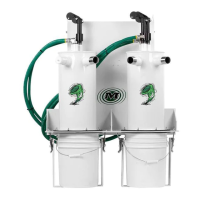
2. The dust collection bucks should be checked frequently
to make sure that they are emptied promptly when they
become full. If the buckets become over filled, the dust
will begin to accumulate around the filter cartridges,
which will cause damage to the collector. NOTE: The time
it takes to fill the buckets and the amount of dust collect
ed is dependent upon the diameter and depth of the
hole being drilled.
3. To empty buckets:
a. Make sure the dust collector is turned off.
b. Remove the lock pins from the pail re-
tainer.
c. Unlatch the catches to lower the bucket
and slide the bucket out from under the
dust collector.
d. Dispose the dust according to federal,
state,and local environmental regulations
and replace the bucket.
This procedure will result in employee expo-
sure to collected contaminant.
1. Make sure that the air supply is removed and trapped
air is exhausted before performing any service or Mainte
nance.
2. Check rod guide boot clearance to face of slab and ad
just to keep boots tight, replace as necessary.
3. Examine all suction hoses for wear or leaks. Also, make
sure dust particles do not clog hoses, especially at bends
or the base of inclines.
4. Periodically check filters to see that they are not clogged
or the filter media has not become torn.
5. To ensure optimum collector performance, always use
Minnich replacement parts.
Dust Collector Maintenance
Dust Collector Operation Procedure
Service
∆ Improper operation of a dust control system may
contribute to conditions in the work area or facility that
could result in severe personal injury and product or
property damage.
∆ Special care must be exercised in the operation and
use of all dust collection equipment where combustible
∆ DO NOT run the dust collector while you make
adjustments and repairs unless the procedure is
approved.
∆ Escaping fluid and air under pressure can have
sufficient force to penetrate the skin causing serious
personal injury. If injured by escaping fluid or air, see
a doctor at once. Serious infection or reaction can
develop if proper medical treatment is not adminis-
tered immediately.
∆ Before disconnecting lines, be sure to relieve all
pressure. Before applying pressure to the system,
be sure all connections are tight and that lines,
tubes and hoses are not damaged.
∆ DO NOT use your hand to search for leaks. Use a
piece of cardboard or wood to search for suspected
leaks.
∆ Tool service must be performed only by qualified
repair personnel.
∆ Service or maintenance performed by unqualified
personnel could result in a risk of injury.
∆ When servicing a tool, use only identical replace-
ment parts. Use of unauthorized parts or failure to
follow maintenance instructions may create a risk of
injury.
∆ Care should be taken when manually or hand clean-
ing the filter pack to prevent the tearing or punctur-
ing of the filter media.
∆ If collected material sticks to the filter packs, it may
require manual and hand cleaning.
∆ Manual or hand cleaning of the filter pack or col-
lector buckets will result in employee exposure to
collected contaminant.
∆ Proper employee procedures should be exercised
during this and other maintenance of the collector.
∆ For environmental compliance, it is highly recom-
mended to consult federal, state, and local environ-
mental protection agencies to determine proper
disposal of filters and collected materials.
and/or explosive materials are present. These mate-
rials may present a fire and/or explosive hazard.
∆ Minnich equipment does NOT contain fire or explo-
sive prevention equipment. A prudent user of dust
control equipment will consult with an expert in
explosion and fire control equipment, familiar with
their hazard and local codes for recommendations
on fire/explosion control equipment.
∆ Under no circumstances should anyone, including
the operator, allow any burning objects or lit cig-
arettes to enter the hood or ducting of any dust
control system


 To Next Page
 Loading...