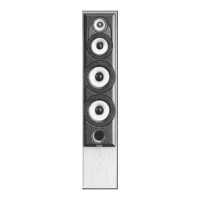
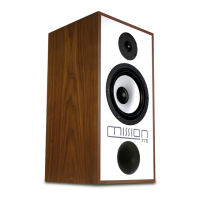
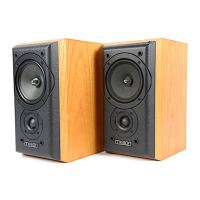
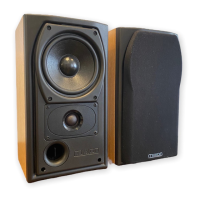
l Loudspeaker
Instruction
Manual
English
l
inexpensive ones) are
perfectly capable
of driving
your MISSION
player/turntable/arm and cartridge.
In the case of poor ‘front
ends‘
loudspeakers. If in doubt
consult your dealer.
a great deal
of unwanted low frequency energies
will be delivered
to your loudspeaker limiting
its general performance, especially
its
SENSITIVITY - the efficiency
of the loudspeaker
in
converting
power handling. As
for the amplifier, a lot depends
on its available
electrical energy into acoustical
output.
spare headroom
when amplifying sudden transients,
its ‘clipping'
MISSION maximises this
parameter in order
to attain
reproduction
Cggitsnaiggfg/a?12‘d|if?e‘y
Cfgi$gJig%nfiu,?trh
daefgg (gfogrxeggplféttg
of wide dynamic range musical
programme.
The obvious
benefit
of
D
h p 1 d -
- |
9 h-| ft’ k
f - n
- th t hi her
uam | r
O r d H
b can
damaget e753i riven at maximum vo ume,w is
we now
eciecyis aa g
q y, owe pwee
ampiiercan
e
I
- -
- --
used. But’ more important.
our
research
categorically
proves
that_it
TE; a
ti? "S c??al%%
of h3ndl:1n%ifh'§g'|
dyRlm“;|?sg;g::a:onJgster
Ewe
is impossible for
low efficiency systems
to reproduce
high
dynamic
Ls:mgé°?em)eraturewrat;iag
snd
)coo|ing sysmms
:r$§e}.|;Vr:
t'|
d 'tht 't'
l.H
th
'
.
-
'
ii?2ig6ihr2ai§3gs§§ak§$p§
V2 m$'2rf1i3|(f::ii?38?l%r::/lie
Ziiii,
§er§§§§"a'§
truly
exceptional power handling capabilities when
used correctly.
o timum level of power, will deteriorate
into
‘compression’
and .
. ..
sgvere distortion. In other words,
all else
being
equal,
it is
Fm? Dqm
‘Hg-he ab;m-V
of 3 system to
reproduce me
inaccurate
to think that a low efficiency
loudspeaker
with large
35"” y mso
emus c‘
amplifiers can
achieve the same
results
as a higher
efficiency
The time domain
is an immensely complex issue closely
related to
model with small
amplifiers.
smearing
effects produced by mechsanical hysteresis which are
evident
in a variet of components. uch components can
range
POWER
HANDLING - the ability
of the
loudspeaker
to
accept,
from
small capacitors setting-off in resonance through
to the
without distortion, large
electrical
inputs associated
with materials
used in loudspeaker diaphragms.
In the case of
transient impulses, or
to operate at
very high
sound
levels
loudspeaker-systems this is further aggravated by
issues involving
without thermal or mechanical
fatigue
or damage.
the loudspeaker/room interface. The measurernents
of
this
-
- - ~ - ~
-
phenomenon are extremely difficult and
are current y under further
I>T§is§§§<'§if'§ys?§;#n'i§°'iioi°'a
tshirenpltr-;u(<?>nepom€arr1ult‘aacrtS'r|e1r% $012
investigation at MISSION. The company will report on this
subject
figures of maximum
power handling under
different
definitions
and
m due Course
mostly for commercial reasons.
Very tew
of these
figures
are
Subjectively,
when a system is operating in
the correct time
meaningful in determining
a continuous
amount
of RMS
power
domain inter-transient
silence is greater,
individual instrument and
your loudspeaker can
sustain when
playing music.
As such
we
vocal decay is correctly controlled,
allowing the inner dynamics
of
have dropped maximum power
handling
figures
from
our
the music to be perceived and
experienced - rather than requiring
specifications and only
refer to recommended
amplifiers
both
in
the listener to decipher and
impose an apparent
set on the
terms of minimum and maximum
amplifier
ratings
permissible.
presented sonic image. Consequently,
the musicians
work
This will merely indicate
to you the
range of amplifiers
you can
use
together
to produce an "interactive" relationship,
resulting in the
with your
respective MISSION
loudspeaker
model.
listener's perception
of the emotions involved.
The real power
handling of your
loudspeaker
depends
on
the
model that
you own, but even
more important
is the
quality
of your
ancillary equipment,
especially
your
amplifier/compact
disc



 To Next Page
 Loading...