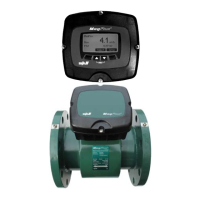
10GB MagFlux Manual 0812
Electromagnetic Flow Meter
Operating Principles
The electromagnetic flow meter is an instrument for measuring the flow
of conductive fluid using Faraday's electromagnetic induction law, and
consequently the fluid must be electrically conductive.
As illustrated below a magnetic field with density B - perpendicular to the
direction of flow - stretches across a fluid flowing within an electrically
isolated pipe.
The magnetic flux will induce a voltage difference (E) that can be measured
between two electrodes arranged perpendicular to the direction of flow
and the magnetic field. The voltage is proportional to the velocity (V) of the
fluid.
➀ E = B x D x V x k [Volt] where
E is the voltage that is induced between the two electrodes
B is the magnetic flux density
D is the distance between the two electrodes
V is the fluid velocity
k is a dimensionless constant
The flow of the fluid Q (m
3
/s) is given by the following formula:
➁ Q = π x D
2
x V / 4 => V = 4 / (π x D
2
) where
π : is the constant pi (= 22/7)
D: is the internal diameter
V: is the fluid velocity
The combination of above formulas ➀ and ➁ gives the following formula:
E = K x B x D x Q x 4 / (π x D x D) = 4 K x B x Q / (π x D)
Evidently the voltage E is proportional to the actual flow.


 To Next Page
 Loading...