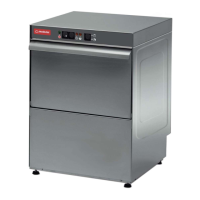
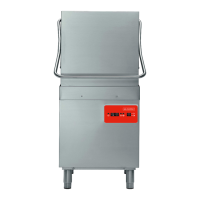
This document serves as a comprehensive manual for a range of industrial dishwashers, including models GWD 40 DT, GWD 41 DT, DWD 45 DT, DW 50 DT, DW 51 DT, and DWD 59 DT. It provides essential information regarding installation, operation, and maintenance to ensure safe and efficient use.
Function Description
The devices are industrial dishwashers designed for professional use. Their primary function is to wash and rinse dishes, cutlery, and glasses efficiently. The machines operate through various cycles, including short, medium, and long washes, with options for draining and resin regeneration. Atmospheric models feature a distinct loading and water heating process, while all models are equipped with a boiler for hot water generation. Detergent and rinse aid dispensers are integrated, with some models offering automatic dosing. Safety features include a manual reset safety thermostat and protection against accidental door openings.
Important Technical Specifications
The manual provides detailed technical specifications for each model, including:
- Dimensions (cm):
- GWD 40 DT: 62.5 (width) x 40.5 (depth) x 60 (height)
- GWD 41 DT: 62.5 (width) x 39 (depth) x 60 (height)
- DWD 45 DT: 52 (width) x 25 (depth) x 48 (height)
- DW 50 DT: 52 (width) x 33 (depth) x 48 (height)
- DW 51 DT: 60.3 (width) x 38.4 (depth) x 51 (height)
- DWD 59 DT: 62.5 (width) x 45.5 (depth) x 60 (height)
- Electrical Connection: All models require a flexible power cable with rubber insulation, not inferior to type H05 RN-F. They are designed for specific voltage and frequency, which must be checked against the appliance's data plate. A multi-pole disconnector with a contact opening distance allowing complete disconnection under overvoltage category III must be installed upstream.
- Water Connection:
- Gas connection: EN 10226-1 R 1/2; EN ISO 228-1 G 1/2 (DK)
- Water inlet: EN ISO 228-1 G 3/4
- Drain connection: EN ISO 228-1 G 1
- Minimum water supply pressure: 2 bar (flow pressure at the machine's water inlet during the final rinse).
- Maximum static pressure: 5 bar (a pressure reducer is recommended if static pressure exceeds 5 bar).
- Water supply flow rate: not less than 20 l/min.
- Temperatures:
- Wash water temperature: 55/60°C.
- Boiler temperature: 87-90°C.
- Materials: The appliance is manufactured with over 90% recyclable metals (stainless steel, aluminum sheet, copper, etc.).
- IP Rating: IP X4, meaning it is protected against splashing water from any direction.
Usage Features
The dishwashers are designed for professional use and must be operated by trained personnel. Key usage features include:
- Rack Preparation: Dishes should be pre-scraped to remove solid residues. Racks should be filled without overloading or overlapping. Empty containers should be placed upside down. Plates and similar items should be placed in the sloping rack with the inner surface facing upwards. Cutlery can be placed with handles up or horizontally. Silver and stainless steel cutlery should not be mixed to prevent tarnishing and corrosion. Dishes should be washed immediately after use to prevent food residues from hardening. Only dishwasher-safe dishes should be used.
- Commissioning: The machine enters a standby state upon power-up, indicated by decimal points on the control board display. The water tap must be open, and filters/overflow must be in place. Closing the door and pressing button P6 for at least 2 seconds switches the machine to operating mode, initiating water and detergent loading. A green "status LED" indicates readiness. Heating elements for the boiler (to 85°C) and wash tank (to 55°C) activate automatically.
- Detergent and Rinse Aid Dosing: The manual emphasizes the importance of correct detergent and rinse aid dosing for optimal washing results and appliance longevity. Automatic liquid detergent dispensers are recommended. The dosing amount is linked to the water consumed during each rinse cycle. For powder detergents, uniform distribution in the wash tank is crucial to prevent dark spots. Gradual adjustment of the dispenser timer (from fully off counter-clockwise to fully on clockwise) allows for fine-tuning.
- Functional Checks: Before practical use, the machine should undergo checks for water level (stopping 1 cm below overflow, reactivating 2 cm above heating element during draining), rinse arm rotation and sprayer function, wash water distribution and pressure, and temperature levels.
- Prolonged Disuse: For extended periods of inactivity, the machine should be thoroughly cleaned, drained of water from the boiler and pump, and stainless steel surfaces should be lubricated with vaseline oil. Before resuming operation, the machine should be checked and run at minimum temperature for at least 60 minutes.
Maintenance Features
Regular maintenance is crucial for the longevity and performance of the dishwasher. The manual outlines several maintenance aspects:
- General Maintenance: The appliance should be serviced at least twice a year by authorized technicians. A service contract is recommended.
- Cleaning:
- External Cleaning: Daily cleaning of external polished stainless steel surfaces, wash tanks, and cooking plates is recommended using non-abrasive products. Direct water jets or high-pressure cleaning should be avoided.
- Internal Cleaning: Internal parts should be checked for dirt and cleaned regularly. Wash arms should be disassembled every 2-3 days to check for solid foreign bodies or incrustations; slits should be cleaned. Rinse arms should rotate freely. Nozzle holes obstructed by solid particles should be cleared gently with a thin point. Internal surfaces should be washed with plain water. Descaling of the wash tank should only be performed by a specialized technician.
- Troubleshooting: A detailed troubleshooting guide is provided for various alarms and malfunctions, including:
- Alarms (AL 1-12): These are "blocking" alarms, meaning the machine stops operation until the alarm is cleared (by turning off, entering standby, or starting a new cycle). Examples include "Time-out loading" (AL 1), "Time-out draining" (AL 2), "Time-out boiler heating" (AL 3), "Time-out bowl heating" (AL 4), "Overtemperature boiler" (AL 5), "Overtemperature bowl" (AL 6), "Bowl overflow" (AL 7), "Bowl temp. probe not connected" (AL 8), "Bowl temp. probe in short circuit" (AL 9), "Boiler temp. probe not connected" (AL 10), "Boiler temp. probe in short circuit" (AL 11), and "Cold rinse" (AL 12).
- Common Malfunctions: Issues like the machine not starting, water not entering/continuously entering the dishwasher, water not heating up, water overheating, washing pump not working, machine not rinsing, continuous rinsing, unsatisfactory wash results, and dispenser malfunctions are addressed with possible causes and solutions.
- Component Replacement: Before any maintenance or component replacement, the machine must be completely drained, power disconnected, and the external water valve closed. After replacing an electrical circuit component, its correct connection to the wiring must be verified. Main components include the electric pump, wash and rinse arms, boiler, wash tank heating elements, boiler heating elements, and electrical wiring.
- Resin Regeneration (for models with water softener): For models equipped with a water softener, resin regeneration is performed at regular intervals (e.g., every 60 wash cycles) depending on water hardness. This involves turning off the machine, draining the tank, adding 1 kg of coarse salt to the bottom of the tank, closing the door, and pressing button P5 to start the regeneration cycle. The L5 indicator light blinks during regeneration and turns off when complete. Regeneration should ideally be performed during periods of disuse.

 Need help?
 General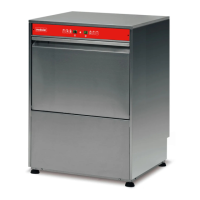

 To Next Page