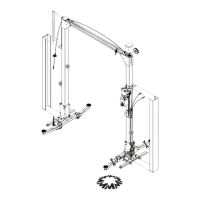
The Molnar SM Series FOUR POST HOIST is an electro-hydraulic vehicle lift designed for professional use in workshops and garages. This installation manual covers the 4, 5, and 6 Tonne models, providing comprehensive instructions for safe and efficient operation, installation, and maintenance.
Function Description
The Molnar SM Series FOUR POST HOIST is primarily used for lifting vehicles to facilitate various maintenance, repair, and inspection tasks. Its four-post design provides stable and secure support for vehicles, making it suitable for a wide range of automotive services, including oil changes, tire rotations, exhaust system repairs, and undercarriage inspections. The electro-hydraulic system ensures smooth and controlled lifting and lowering operations. The hoist is designed to be installed on a hard and flat floor made with reinforced concrete, with specific requirements for concrete strength (32MPa grade) and thickness (100mm minimum). Anchor bolts (M16 x 140mm tru-bolt) are used to secure the hoist to the floor, with 16 anchor bolts required for installation.
Important Technical Specifications
The Molnar SM Series hoists come in various capacities: 4 Tonne (SM440), 5 Tonne (SM450), and 6 Tonne (SM460). These models share common electrical and environmental specifications.
Electrical Specifications:
- Supply Voltage: 0.9 - 1.1 nominal supply voltage.
- Source Frequency: 0.99 - 1.01 nominal frequency.
- Input Voltage Tolerance: Should be ±10%.
- Frequency Tolerance: Should be ±1%.
- Power Supply Cable: Must be a 10A over current protector installed in the input power line.
- Diameter of Power Supply Cable: 2.5 mm².
- Wiring: Requires 3 active and earth wires.
- Control Voltage: 24V transformer for low voltage control.
Environmental Specifications:
- Ambient Temperature: 5°C - 40°C.
- Altitude: Shall be at altitudes up to 1000m above mean sea level.
- Relative Humidity: Not to exceed 50% at 40°C.
- Atmosphere: Free from excessive dust, acid fume, corrosive gases, and salt.
- Exposure to Direct Sunlight or Heat Rays: Avoid exposing the hoist to direct sunlight or heat rays, which can change the environmental temperature.
- Vibration: Avoid exposing to abnormal vibration.
- Electrical Equipment Storage: Electrical equipment shall withstand the effects of transportation and storage temperature within a range of -25°C to 55°C and for short periods not exceeding 24 hours at up to +70°C.
Hydraulic System:
- Hydraulic Oil: 46 Weight AWH Hydraulic Oil.
- Oil Capacity: 10L for SM440/SM450 and 12L for SM460.
- Power Pack: The hoist is equipped with a power pack that includes a motor and rubber mounts. The hydraulic hose connects the power pack to the hoist.
Dimensions (Layout Drawings):
- SM440-S & SM440-A:
- Overall Length: 5595 mm
- Platform Length: 4775 mm
- Platform Width: 4095 mm
- Post Inside: 2734 mm
- Overall Width (including posts): 3095 mm
- Ramp Length: 820 mm
- SM450-A:
- Overall Length: 4600 mm (platform length)
- Platform Length: 4875 mm
- Post Inside: 2734 mm
- Overall Width (including posts): 3095 mm
- Ramp Length: 1069 mm
- SM460-S & SM460-A:
- Overall Length: 5446 mm (platform length)
- Platform Length: 5241 mm
- Platform Width: 5796 mm
- Post Inside: 3010 mm
- Overall Width (including posts): 3416 mm
- Ramp Length: 1069 mm
Usage Features
The Molnar SM Series hoists are designed for ease of use and safety.
Maintenance Features
Regular maintenance is critical for the longevity and safe operation of the Molnar SM Series hoists.
- Greasing: The pulley pins require greasing. Refer to page 15 of the manual for detailed instructions.
- Cable Lubrication: Lubricate the cylinder rod.
- Cable Adjustment: To avoid cable clamps rubbing the cables, adjust and angle the cable clamps as shown below and keep separated by approx. 10cm.
- Pre-Operation Checks: Before commencing operation, inspect system components, control, emergency stop, and safety equipment for condition and correct function.
- Periodic Checks:
- Legal Clearances: Ensure legal clearances around the hoist are maintained.
- Floor Suitability: Verify that the floor is suitable and within manufactures specifications.
- Cables, Pulleys, and Hoses: Check for any damage.
- Pulleys/Pins: All pulleys/pins must be greased. (Transverse beam and platform pulleys).
- Safety Devices: Limit switches and controls must be checked for correct operation.
- Hydraulic System: Check for leaks and ensure it is free at time of installation.
- Load Testing: Hoist must be tested without and with load as per manufactures specifications.
- Lubrication: Hoist must have been lubricated and adjusted as per manufactures specifications.
- Log Book: Log book use has been explained to owner/operator and initial details completed.
- Client Representative: The client representative must have been shown and instructed in the correct operation and maintenance of the hoist.
- Grease Application: By this stage of the installation, ensure that grease has been applied to all pulleys on the hoist. This includes the four transverse beam pulleys as well as the front and rear pairs of pulleys under the platform. (Pulley pins are supplied with grease nipples for easy greasing). This should be performed every 6 months.
- Tightening Cables: Turn on the hoist and raise up the hoist and press the locking switch to tighten the cable. (Raise the hoist to the position comfortable to work under the platform). Fasten the cable clamp on the cylinder fixing cable and the drive plate. Clamps must be tight, retighten again at the end of the installation.
The Molnar SM Series FOUR POST HOIST is a robust and reliable lifting solution, provided that all installation, operation, and maintenance guidelines are strictly followed. The detailed manual ensures that users have all the necessary information to safely and effectively utilize this equipment.

 Need help?
 General

 To Next Page