EasyManua.ls Logo

Monarch 6 Series - Apron Control Lead Screw Reverse

Default Icon
16 pages
Print Icon
To Next Page IconTo Next Page
To Previous Page IconTo Previous Page
Loading...
6
0 P E R A T O R S
MANUAL
where
a
similar
lever
is
attached
to
the
control
rod.
(E)
is
the
carriage
power
feed
and
traverse
control
lever
which, when
pushed
downward,
causes
the
carriage
to
move
at
the
preselected
feed
either
toward
the
headstock
or
the
tailstock
.
Lever
movement
to
the
left
gives
traverse
to-
ward
the
headstock
and to
the
right
traverse
to-
ward
the
tail
stock.
Cross
slide
power
feed
and
traverse
control
lever
(F)
when
pushed
down-
ward
,
causes
th
e
cross
slide
to
move
at
the
preselected
feed
either
toward
or
away
from
the
operator.
Lever
movement
to
the
right
gives
traverse
in
and
to
th
e
left
traverse
out.
NOTE: When
using
levers
(E)
and
(F)
it
is
un-
necessary
to
apply
a
great
amount
of
pressure.
If
they do not
engage
about
half way down, they
are
in
need
of
ad-
justment.
Feed
directional
knob (G),
has
three
positions.
In
the
in
position
the
c
arriage
feeds
toward
the
tails
tock
and
the
cross
slide
feeds
in.
When in
the
out
position
,
the
carriage
feeds
toward
the
headstock
and
the
cross
slide
feeds
out
.
In
neu-
tral,
the
feed
directional
knob
permits
engage-
ment
of
the
half-nut.
If
threads
are
to
be
ch
ased
,
the
carriage
is
en-
gaged
to
the
leadscrew
by
means
of
half-nut
con-
trol
lever,
(H).
It
is
illustrated
in
its
disengag-
ed
position
and
should
be
straight
down
for
full
engagement.
Always
have
knob (G) in
its
neutral
position
before
attempting
to
engage
lever
(H).
When
lever
(H)
is
partly
or
fully
engaged,
lever
(E)
cannot
be
engaged.
This
is
a
safety
feature
intended
to
prevent
damage
to
the
lathe
should
the
operator
inadvertently
attempt
to
engage
lever
(F)
while
lever
(H)
is
also
engaged.
Thread
chasing
dial
(J),
which
has
four
gradua-
tions
90 °
apart,
is
used
for
determining
when
to
engage
the
half nut
during
thread
chasing
opera-
tions
. On any
even
thread
where
the
lead
being
chased
is
divisible
by
four
the
half
nut
may
be
engaged
at
any
point
without
reference
to
the
dial.
For
any
full
number
of
threads
such
as
18 , 22, 23
and
so
on (not
divisible
by
four)
the
half
nut
may
be
engaged
at
any
one
of
the
four
graduations.
When
chasing
half
threads
such
as
5-1
/ 2,
6-1
/
2,
13-1
/ 2
the
half
nut
may
be
en-
gaged
at
any two
opposite
graduations
--
No. 1
and No. 3
or
No. 2
and
No.
4.
The
chasing
of
quarter
threads
such
as
2-1
/
4,
3-1/4,
5-3
/ 4
requires
that
the
half
nut
be
engaged
at
the
same
graduation
each
time.
(K)
is
the
carriage
locking
stud,
used
to
lock
the
carriage
to
the
bedways
when
cutting
with
the
cross
slide.
Tailstock
pickup
plunger
(M)
engages
a bushing
on
the
tailstock
base
and
allows
positioning
of
the
tailstock
by
means
of
the
apron
power
rapid
traverse.
A
safety
clutch
(L)
is
provided
in
the
power
rap-
id
traverse
mechanism
to
prevent
damage
should
the
carriage
or
cross
slide
be
locked
in
position.
To
adjust
the
safety
clutch
,
loosen
set
screw
locking
outer
collar
and
rotate
clockwise
to
tighten.
Adjus
t
tight
enough
to
ratchet
when
c
arriage
is
clamped.
Depressing
button
(N)
frees
the
direct
length
reading
dial
(O)
so
th
at
it
may
be
set
to
zero
.
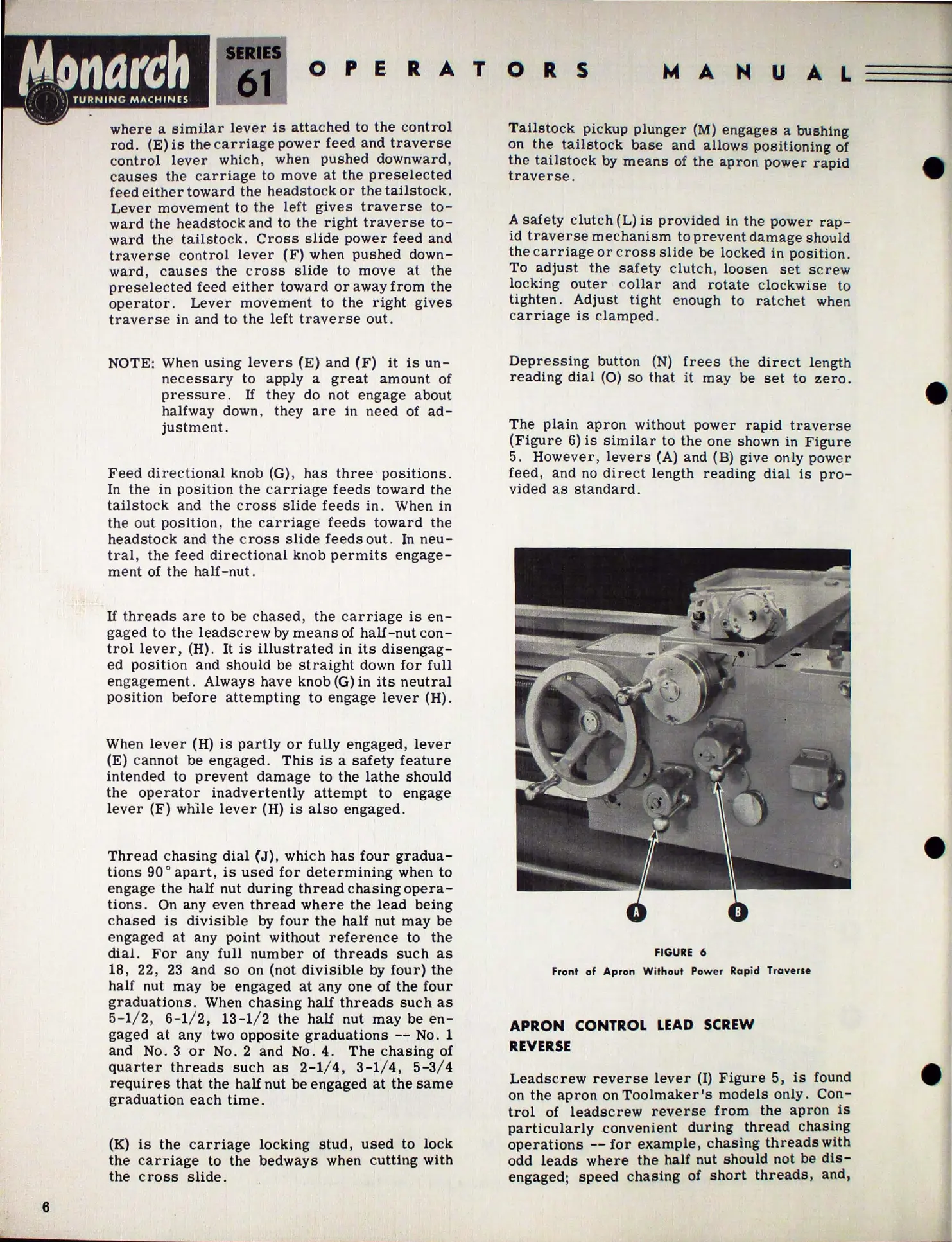
The
plain
apron
without
power
rapid
traverse
(Figure
6)
is
similar
to
the
one shown in
Figure
5.
However
,
levers
(A)
and
(B)
give
only
power
feed,
and
no
direct
length
reading
dial
is
pro-
vided
as
standard.
FIGURE 6
Front
of
Apron Without Power Rapid Traverse
APRON
CONTROL
LEAD SCREW
REVERSE
Leadscrew
reverse
lever
(I)
Figure
5,
is
found
on
the
apron
on
Toolmaker's
models
only.
Con-
trol
of
leadscrew
reverse
from
the
apron
is
particularly
.
convenient
during
thread
chasing
operations
--
for
example,
chasing
threads
with
odd
leads
where
the
half nut
should
not
be
dis-
engaged
;
speed
chasing
of
short
threads,
and,
-
-
-
-