EasyManua.ls Logo

Monarch 6 Series - Page 7

Default Icon
16 pages
Print Icon
To Next Page IconTo Next Page
To Previous Page IconTo Previous Page
Loading...
-
-
-
-
in connection with the
automatic
length
stop,
chasing threads up
to
a
shoulder
or
in a blind
hole.
On an engine
lathe
the
leadscrew
reverse
lever
is
found on the
front
of
the
headstock
dire
c
tly
above
the
gear
box.
Figure
7
shows
the
automatic
length
stop
and
adjusting
c
ollar
at
the
left
hand
side
of
the
apron.
This
stop
is
a
time
saver
not only when
chasing
threads
but
also
for
ordinary
turning
operations.
A si
milar
stop
on
the
right
hand end of
the
lead-
screw
reverse
c
ontrol
rod
provides
an
automat-
ic stop with
the
carriage
moving
toward
the
tail-
stock
. To
set
stop
(A),
position
the
threading
or
turning
tool
to
the
required
point
on
the
work
;
then with
the
leadscrew
reverse
lever
in
neutral
position
,
pla
ce
stop
(
A)
against
adjusting
collar
(B) and
tighten
stud
(C).
Collar
(B)
is
for
the
final
close
adjustme
nt and
is
locked
in
place
with nut (D) .
FIGURE
7
Automatic Length Stop
at
Left
Hand
Side
of
Apron
CROSS
FEED
DIAL
AND
THREAD
CHASING
STOP
\
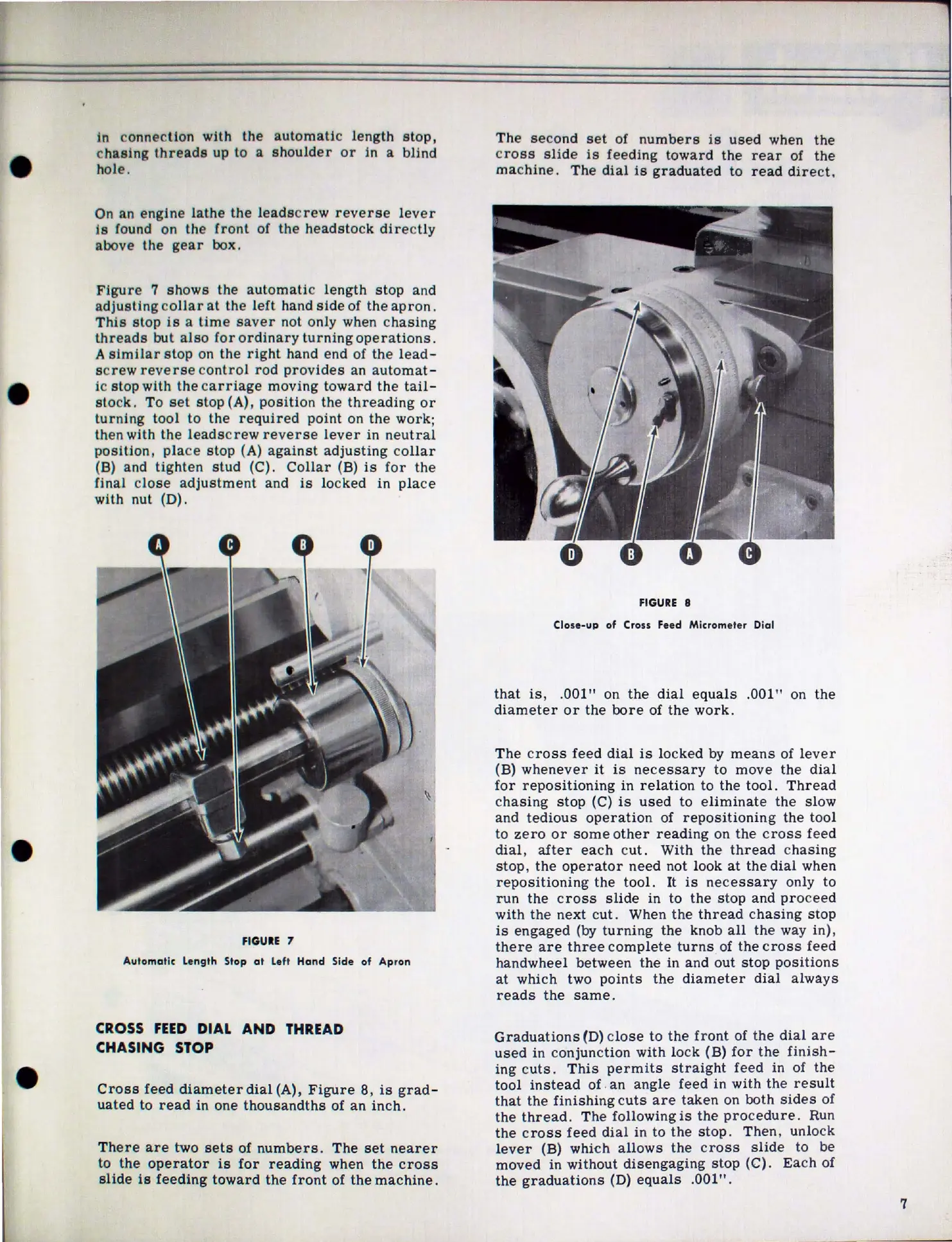
Cross
feed
diameter
dial
(A),
Figure
8,
is
grad-
uated
to
read
in one
thousandths
of
an
inch.
There
are
two
sets
of
numbers.
The
set
nearer
to
the
operator
is
for
reading
when
the
cross
slide
is
feeding
toward
the
front
of
the
machine.
The
second
set
of
numbers
is
used
when
the
c
ross
slide
is
feeding
toward
the
rear
of
the
machine
.
The
dial
is
graduated
to
read
direct,
FIGURE
8
Close-up
of
Cros
s Feed M icrometer Dial
that
is
, .001" on
the
dial
equals
.001" on
the
diameter
or
the
bore
of
the
work.
The
cross
feed
dial
is
locked by
means
of
lever
(B)
whenever
it
is
necessary
to
move
the
dial
for
repositioning
in
relation
to
the
tool.
Thread
chasing
stop
(C)
is
used
to
eliminate
the
slow
and
tedious
operation
of
repositioning
the
tool
to
zero
or
some
other
reading
on
the
cross
feed
dial
,
after
each
cut.
With
the
thread
c
hasing
stop,
the
operator
need
not look
at
the
dial
when
repositioning
the
tool
.
It
is
necessary
only
to
run
the
c
ross
slide
in
to
the
stop
and
proceed
with
the
next
cut.
When
the
thread
chasing
stop
is
engaged
(by
turning
the
knob
all
the
way in),
there
are
three
complete
turns
. of
the
cross
feed
handwheel
between
the
in and
out
stop
positions
at
which two
points
the
diameter
dial
always
reads
the
same.
Graduations
(D) c
lose
to
the
front
of
the
dial
ar e
used
in conjunction
with
lock
{B)
for
the
finish-
ing
cuts
.
This
permits
straight
feed
in of the
tool
instead
of.
an
angle
feed
in
with
th
e
result
that
the
finishing
cuts
are
taken
on both
sides
of
the
thread.
The
following
is
the
pro
c
edure
. Run
the
cross
feed
dial
in
to
the
stop.
Then
, unlock
lever
(B) which
allows
the
cr
oss
slide
to
be
moved
in
without
disengaging
stop
(C) .
Each
of
the
graduations
(D)
equals
.001".
7