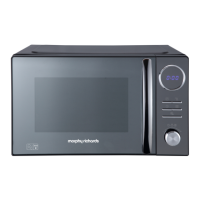
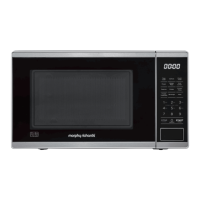
This document provides installation and user instructions for a Morphy Richards microwave oven, model MM820C2LP(F)-PM. It covers safety information, installation guidelines, parts and assembly, control panel operation, usage features, cleaning, suitable materials for use, general cooking advice, troubleshooting, technical specifications, recycling information, plug rewiring advice, and a product guarantee.
Function Description
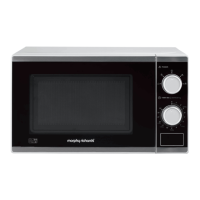
The Morphy Richards microwave oven is designed for heating food and beverages using microwave energy. It operates as a free-standing appliance and is not intended for built-in installation. The oven features a manual control panel for selecting power levels and setting cooking or defrosting times. It offers various power settings, allowing users to adjust the intensity of microwave heating. The defrost function is controlled by a timer dial, which can be set based on either time or the weight of the food to be defrosted.
Usage Features
Installation:
The microwave oven must be placed on a level surface, away from televisions, cookers, and other heat-producing appliances. Adequate ventilation is crucial, requiring a clearance of 20cm on each side, 30cm above, and 10cm at the rear of the oven. The minimum installation height is 85cm. The power cable should be positioned to avoid sharp or hot surfaces and trip hazards. The appliance is designed to be free-standing and should not be placed in a cabinet.
Operation:
To use the oven, first ensure the cable is fully unwound, plugged in, and switched on. Food should be placed in a suitable microwave-safe container, covered, and positioned in the center of the glass turntable after opening the door with the release button. The door must be securely closed before operation.
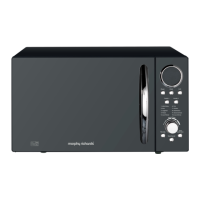
The control panel features two main dials:
- Power Knob: This knob allows selection of different power levels, ranging from 17% to 100% of the microwave's output. The power levels are indicated by symbols on the dial.
- Timer Knob: This dial is used to set the cooking time in minutes or the defrost weight in kilograms. For cooking, times up to 35 minutes can be selected. For defrosting, specific weight settings (e.g., 0.2kg, 0.4kg, 0.6kg, 0.8kg, 1.0kg) are provided, corresponding to specific defrosting times.
To set a cooking time below 2 minutes, the user should turn the timer past 2 minutes and then back to the desired time. For defrosting, the power level should be set to the defrost symbol, and then the timer dial used to select either the defrost time or the corresponding weight. The microwave starts automatically once the timer is set. Cooking or defrosting can be paused by opening the door, and settings will be retained when the door is closed, allowing the process to restart. A bell will sound when the cooking time is complete, and the microwave will automatically turn off. Food should be allowed to stand for 30 seconds to one minute after cooking or defrosting before stirring or serving. The microwave can be stopped at any time by turning the timer to '0' or by opening the door.
General Cooking Advice:
- Cooking times vary with microwave wattage; users should always check the MAFF rating/wattage of the appliance and follow corresponding cooking advice from recipes or food packaging.
- Beverages can experience delayed eruptive boiling, so care must be taken when handling containers.
- Lids should be removed from containers, and plastic films pierced before microwaving to prevent explosions. Sealed or restricted openings on vessels should be avoided.
- Food items with skin or membranes (e.g., potatoes, apples, fish, chicken, eggs) should be pierced in several places before cooking. Whole hard-boiled eggs or eggs in their shell should never be cooked or heated in the microwave, as they may explode.
- For even cooking, food items should be similar in size and density. Larger, denser items require longer cooking times.
- Food quantity affects cooking time; more food requires a longer cooking duration.
- The shape of food influences cooking time; the thickest part of the food should be placed on the outside of the plate.
- Allowing food to stand briefly after cooking or defrosting helps to equalize the temperature.
Suitable Materials:
- Plastics containers: Microwave-safe plastic only. Avoid melamine dishes and high-fat or high-sugar content foods.
- Plastic wrap: Microwave-safe plastic only for covering food.
- Glass: Heat-resistant glass only for cooking vessels.
- Ceramic ware: Heat-resistant cookware only, with no metallic decoration.
- Paper: For reheating only; do not leave unattended.
- Browning dishes: Place an upturned plate on the glass turntable before cooking to prevent heat stress.
- Disposable containers (paper plates/cups, thin plastic, roasting bags): For reheating only, or as per manufacturer's instructions for roasting bags.
- DO NOT USE: Metallic containers, aluminum foil, or any metal-trimmed packaging.
Maintenance Features
Cleaning:
Regular cleaning of the oven and its seals is essential, ideally on a weekly basis or more frequently if needed, to remove food debris. Failure to maintain cleanliness can lead to deterioration of surfaces and seals, shortening the oven's life and potentially creating hazardous situations due to microwave energy release.
To clean the oven:
- Switch off and unplug the oven, then allow it to cool completely.
- Wipe surfaces and seals with a soft, damp (not wet) cloth. Avoid strong detergents or abrasives, as these can scratch or dull the surface. Do not immerse the appliance in water or use a steam cleaner.
- The glass turntable and turntable roller can be washed in hot water with a small amount of washing-up liquid. These parts are NOT suitable for dishwashers.
- Ensure all surfaces are fully dry before using the oven again.
Troubleshooting:
The manual provides a troubleshooting guide for common issues:
- Oven will not start: Check if the plug is fully inserted and switched on, if the door is closed, if the operation is incorrect, or if there's a power cut.
- Arcing or sparking: This usually indicates unsuitable materials are being used, the oven is operated empty, or there are spilled food remains in the cavity.
- Unevenly cooked food: Possible causes include unsuitable materials, food not fully defrosted, incorrect power settings, food not being turned or stirred, or unevenly sized food.
- Overcooked food: May be due to incorrect power settings or a cooking period that is too long.
- Undercooked food: Could be caused by food not being fully defrosted, unsuitable materials, restricted ventilation ports, or incorrect power settings.
- Incomplete defrosting: Reasons include incorrect power settings, unsuitable materials for defrosting, defrost time too short, food not turned or stirred, or unevenly sized food.
- Noisy turntable: This can be due to food residue between the turntable roller and the cavity base, or the glass turntable not being correctly positioned on the roller.
- Oven light does not illuminate: The bulb may have burnt out or the timer knob has not been set.
Safety Information:
The manual emphasizes several safety warnings:
- Only a competent person should perform service or repair operations involving removal of covers that protect against microwave energy exposure.
- Do not operate the oven if the door or door seals are damaged.
- Keep the appliance and its cord out of reach of children under 8 years old.
- Children aged 8 and above, and persons with reduced physical, sensory, or mental capabilities, can use the appliance with supervision and instruction. Children should not play with the appliance or perform cleaning/maintenance without supervision.
- Always switch off and unplug the appliance before cleaning or servicing.
- Keep the microwave, cable, and plug dry and away from splashed areas. Never immerse in water or clean with a steam cleaner.
- Do not pull on the cable to disconnect it from the mains supply.
- The oven must be positioned so the plug is accessible and the socket is within reach of the power cord.
- If the supply cord is damaged, it must be replaced by a qualified service engineer.
- Do not place items with naked flames or containers with liquids on the appliance.
- The mains plug must be connected to a mains socket outlet with a protective earth connection.
- Pacemaker wearers should maintain a minimum distance of 20-30 cm from an operating microwave oven.
- Stir or shake baby food/liquids and check temperature before consumption.
- Do not heat liquids or other foods in sealed containers.
- Microwave heating of beverages can cause delayed eruptive boiling; handle with care.
- Never cook or heat eggs in their shell or whole hard-boiled eggs.
- Do not operate the oven when empty or leave it unattended.
- Ensure adequate ventilation and do not cover the appliance.
- Surfaces and containers inside the oven become hot; use oven gloves.
- Regularly check plastic or paper containers during cooking to prevent ignition.
- If smoke is emitted, switch off and keep the door closed.
- Do not use the oven on, near, or under flammable or heat-sensitive items.
- Do not place foil-wrapped food, metal containers, or containers with metal parts/trim in the microwave.
- Do not use with a cracked or missing turntable or without the turntable ring.
- Drying clothing or heating warming items (buttons, slippers, sponges, damp cloth) can lead to injury, ignition, or fire.
- Always check container and utensil suitability.
- Do not cook raw meat or shellfish in a microwave due to uneven heating.
- Do not use the microwave for home canning or bottling.
- Always check food temperature before serving.



 To Next Page
 General