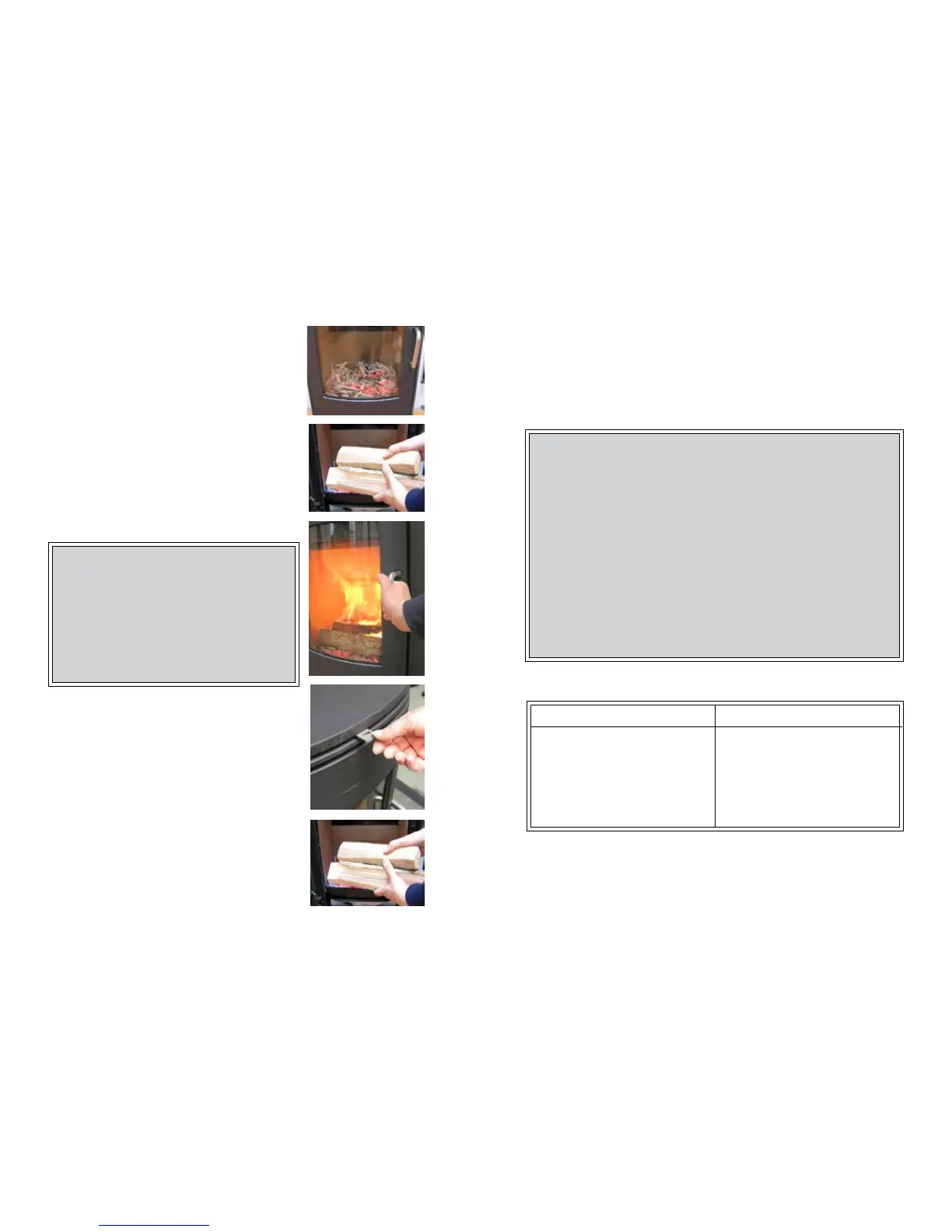
5. Re-stoking should normally be carried out while embers still
remain. Distribute the embers in the bottom, ensuring that
most of them are at the front of the stove.
6. Place 2 pieces of wood of approx. 0.7 kg each and approx. 25-30
cm long over the embers in a single layer, with a distance of
approx. 1 cm.
7. Open the air supply to maximum and close the door; the fresh
wood will then ignite within a couple of minutes.
8. Reduce the amount of combustion air to the desired position,
and optimal combustion will continue until there are glowing
embers in the bed.
Make sure that there is always enough air (oxygen) to
maintain clear, lasting flames when, and after, reducing the
amount of combustion air.
During the nominal test, the stoking interval was 60-70 mi-
nutes.
9. A new portion of wood can be added by repeating steps
5 & 6.
Comparison between firing with wood and oil:
Type of wood (moisture content 20%) No. of cubic metres per 1000 l oil
Oak 7.0
Beech 7.0
Ash 7.2
Sycamore 7.5
Birch 8.0
Elm 8.9
Common spruce 10.4
Silver fir 10.9
The stove door should normally be opened gently the first 2-3 cm, then you should wait un-
til the pressure has equalised before opening the door all the way. This technique will prevent
smoke from getting out, particularly when there is a poor draugt.
The stove door should never be opened when the stove is being fired vigorously.
Once the wood has burned out, it becomes glowing charcoall. If a good layer of embers has al-
ready formed on top of a sufficient layer of ash, the stove can keep warm for a very long time,
not least due to the favourable qualities of the cast iron.
We would strongly recommend that you do not leave your stove alit at night. It
harms the environment and constitutes very poor use of the wood as the gases
in the wood do not ignite at the low temperature, but settle as soot (unburned ga-
ses) in the chimney and stove. Extreme conditions, such as poor draught in the
chimney, large quantities of wood or wet wood, may in the worst-case scenario
cause an explosive ignition.
When firing in the summer period, when there is minimal need for heat, the
combustion will be poor. The stove provides too much heat so the combusti-
on should be reduced. But always remember to make sure that there are lasting
flames until the wood becomes charcoal. If you want a weaker fire, stoke up using
less wood.
If you fire the stove using wet wood, a lot of the fuel’s thermal energy will be
spent forcing the water out of the wood, without releasing any heat to the stove.
This incomplete combustion results in a layer of soot being left in the stove, pipe
and chimney.
Important!
It is important that the fresh quantity of wood starts
to burn quickly. To ensure the fuel lights quickly, open
the combustion air to max. or leave the door ajar to
allow in the amount of air needed to light the wood.
If, however, the wood only smoulders, there will be a
strong build-up of smoke, which at worst can cause
an explosive ignition of the flue gases with the risk of
material damage and personal injury.


 To Next Page