To Next PageTo Next Page
 Need help?
Do you have a question about the Motorola PTP 600 Series and is the answer not in the manual?
 General
| Max Throughput | Up to 300 Mbps |
|---|---|
| Modulation | OFDM |
| Frequency Bands | 5.4 GHz, 5.8 GHz |
| Ethernet Ports | 1 x 10/100/1000 Mbps |
| Security | AES Encryption |
| Channel Bandwidth | 5 MHz, 10 MHz, 20 MHz, 40 MHz |
| Encryption | AES 128-bit |
Details the document's issue status and version changes over time.
Provides general details about the purpose and structure of the user guide.
Defines conventions used for keyboard input, output text, and special key sequences.
Provides a high-level description of the PTP 600 product, function, variants, and deployment.
Highlights the PTP 600 Series' operational capabilities, connectivity, and security features.
Details the PTP 600 Series frequency variants and their operating bands.
Lists the components that make up each end of the PTP 600 link.
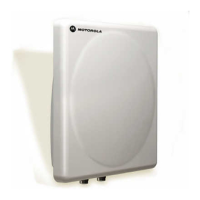
Describes the ODU as a self-contained unit housing radio and networking electronics.
Describes the PIDU Plus's function in generating ODU supply voltage and its connection via CAT5e cable.
Lists the components for cabling and lightning protection in a PTP 600 installation.
Introduces the PTP-SYNC unit as an optional component for TDD synchronization.
Explains the wireless operation of PTP 600 series links using Time Division Duplexing (TDD).
Describes how spectrum management monitors wireless spectrum and directs link ends for minimal interference.
Details PTP 600 Series support for optional AES encryption and its algorithm.
Describes the Ethernet service provided by PTP 600 Series between Ethernet ports at local and remote ODUs.
Details PTP 600 link's native support for E1 or T1 links, relaying data and providing timing transfer.
Describes how PTP 600 equipment is managed through an embedded management agent.
Explains how the management agent supports software upgrades via web-based or SNMP interfaces.
Details the PTP 600 recovery mode for recovering from configuration errors or software image corruption.
Describes the optional secure cryptographic mode of operation validated to Level 2 of Federal Information Processing Standards.
Covers specific licensing restrictions affecting frequency range, radar avoidance, and channel bandwidth usage.
Guides ODU and PIDU Plus site selection, considering factors like antenna path, lightning, and cable runs.
Emphasizes the importance of considering range, obstructions, and path loss for successful link installation.
Details requirements for protecting structures, equipment, and people from power surges and lightning.
Describes different configuration options for implementing TDD synchronization in PTP 600 Series.
Covers decisions on management mode, VLAN membership, and priority for management traffic.
Outlines planning steps for HTTPS/TLS operation, FIPS 140-2 operation, and SNMP agent setup.
Presents the terms and conditions for licensing Motorola's proprietary software and documentation.
Outlines strict prohibitions and requirements for using the Software and Documentation.
Covers transfer of possession, copyrights, modifications, proprietary notices, and export restrictions.
Disclaims all warranties, express or implied, including merchantability and fitness for a particular purpose.
Limits Motorola's total liability for damages to the amount paid for the licensed product.
Lists components required for standard PTP 600 bridge installations and main installation options.
Contains specifications for the outdoor unit (ODU) supplied by Motorola for PTP 600 installations.
Provides specifications for the powered indoor unit (PIDU Plus) supplied by Motorola for PTP 600 installations.
Details specifications for CAT5e cables, connectors, and glands required for PTP 600 installations.
Lists specifications for antennas approved by the FCC for use with connectorized PTP 54600 and PTP 58600.
Contains specifications for the PTP-SYNC unit supplied by Motorola for TDD synchronization.
Provides general wireless specifications for PTP 25600 RF, including band, channel selection, and modulation.
Details specifications for the PTP 600 Ethernet ports, including bridging and telecoms interface parameters.
Covers SNMPv3 default configuration, VACM default configuration, and RADIUS protocols and attributes.
Outlines electrical safety compliance specifications for PTP 600 hardware in different regions.
Details EMC immunity and emissions compliance, including type approvals for PTP 600 variants.
Specifies regulatory compliance notifications for PTP 25600, PTP 49600, PTP 54600, and PTP 58600.
Provides instructions, tables, and graphs for calculating data rate capacity of PTP 600 configurations.
Guides checks for link plan availability, component availability, package contents, installer qualifications, and safety precautions.
Describes procedures for preparing outdoor CAT5e cable with connectors and glands, including safety precautions.
Provides instructions for installing the ODU and top Lightning Protection Unit (LPU) on the supporting structure.
Instructs on installing the drop cable connection to PIDU Plus and providing grounding and lightning protection.
Covers the installation of the PIDU Plus and its connection to ODU and network cables.
Guides the installation of a connectorized ODU with a separate antenna, including preparation and checks.
Guides the installation of the UltraSync receiver for TDD synchronization, covering preparation and connection.
Guides the installation of a PTP-SYNC unit for TDD synchronization, including preparation and powering up.
Guides the installation of a GPS receiver for PTP-SYNC timing reference, covering preparation and mounting.
Covers the installation of optional E1 or T1 interfaces, including preparation, LPU mounting, and cable connections.
Guides the configuration of the local management PC to communicate with the PTP 600, including IP interface setup.
Covers checking licensed capabilities, generating new license keys, and entering them to activate features.
Guides checking installed software, saving system configuration, and upgrading to a new software version.
Covers configuring AES encryption and HTTPS/TLS security, including FIPS 140-2 requirements.
Guides configuring password complexity rules for the web-based management interface and user account options.
Covers creating or updating identity-based user accounts and changing user passwords.
Guides updating system configuration to meet network requirements, including IP, Ethernet, and wireless settings.
Covers tasks related to aligning antennas, including starting units, using graphical options, and tones.
Guides the process of disarming units after alignment, including turning off audible aid and enabling adaptive modulation.
Covers adjusting power settings and checking link performance parameters.
Guides connecting the PTP 600 link to the network and setting the real-time clock.
Covers configuring RADIUS authentication for PTP 600 links requiring it, including server settings.
Guides setting up the SNMP agent for generating SNMPv3 or SNMPv1/2c notifications and traps.
Covers configuring generation of diagnostic alarms and email messages.
Guides configuring system logging (syslog) for event notification messages.
Guides configuring HTTP, Telnet, and TFTP access for remote management.
Describes the layout and main menu options of the PTP 600 web-based management interface.
Describes configuring spectrum management features and interpreting graphical plots for channel usage.
Describes upgrading PTP 600 software remotely using Trivial FTP (TFTP) triggered by SNMP.
Covers procedures for exiting FIPS 140-2 mode and zeroizing critical security parameters (CSPs).
Guides managing PTP 600 link performance by checking system statistics, counters, and detailed counters.
Details rebooting the ODU or viewing a list of previous reboot reasons via the System, Reboot menu.
Guides testing link end hardware, checking outdoor drop cables and following flowcharts for LED status.
Provides tests for troubleshooting non-working, unreliable, or low data throughput radio links.
Outlines procedures for testing a link end after it has been struck by lightning.
Provides guidance on troubleshooting PTP-SYNC unit issues, including LED status and communication problems.
Explains how to enter and use recovery mode to recover a unit from configuration errors or software corruption.
Guides restoring the operational configuration of a unit by uploading a saved configuration file.