EasyManua.ls Logo

Motorola T900 - User Manual

Motorola T900
4 pages
Print Icon
To Next Page IconTo Next Page
Loading...
Motorola T900
Quick Start Guide
TURNING PAGER ON
Open the flip and press any key to turn your pager
on. The pager emits a 4-second power-up alert,
and the Status screen displays.
TURNING PAGER OFF
From the Main menu, press or to
highlight POWER OFF and press
ENTER
.
Highlight YES and press
ENTER
.
READING MESSAGES
To read a message, (while previewing) press
or to highlight the desired message and
press
ENTER
.
Press or to scroll through the text of a
message or press
ENTER
to page through the
message.
COMPOSING AND SENDING A MESSAGE
From the Send Message menu, press or
to highlight WRITE MESSAGE and press
ENTER
.
After you finish composing the message, press
ENTER
.
To send, return to the Send Message menu, press
or to highlight SEND MESSAGE and
press
ENTER
.
All manuals and user guides at all-guides.com
all-guides.com

Other manuals for Motorola T900

Question and Answer IconNeed help?

Do you have a question about the Motorola T900 and is the answer not in the manual?

Summary

Turning Pager On

Turning Pager Off

Reading Messages

Composing and Sending a Message

Deleting a Message

Setting the Date and Time

Setting the Alarm

Private Time

Summary

Turning Pager On

Turning Pager Off

Reading Messages

Composing and Sending a Message

Deleting a Message

Setting the Date and Time

Setting the Alarm

Private Time

Overview

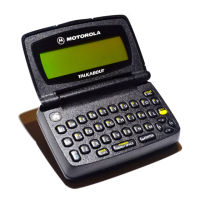
The Motorola T900 is a pager, a compact communication device designed for receiving messages and managing various alerts and settings. This quick start guide outlines its core functionalities, from basic operation like turning the device on and off to more advanced features such as composing messages, setting alarms, and managing personal preferences.

Function Description:

The primary function of the Motorola T900 is to receive and display messages. It supports various types of messages, including standard inbox messages, news/info messages, and messages within a personal folder. Users can read messages, scroll through their content, and page through longer messages. The device also allows for message composition and sending, indicating a two-way communication capability, likely through predefined replies or short custom messages.

Beyond messaging, the T900 incorporates several utility features:

  • Alerts and Alarms: Users can set alarms, configure alert volumes, and manage reminder alerts. The device supports different alert types, including audible, vibrate, and quiet modes, allowing for customization based on user preference or environment.
  • Date and Time Management: The pager allows users to set and adjust the current date and time, which is crucial for accurate message timestamps and alarm functions.
  • Preferences and Customization: A "Preferences" menu provides access to various settings, including "Private Time" mode, which likely silences alerts or restricts notifications during specified periods. Other preferences might include settings for inbox history, auto-preview for news, and signature management for outgoing messages.
  • Message Management: The device offers robust message management capabilities, including deleting messages or entire inboxes, moving messages to personal folders, and tracking message status (read/unread, successful/unsuccessful send/reply).

Usage Features:

The Motorola T900 features a straightforward interface, primarily navigated using "up" and "down" arrow keys and an "ENTER" button.

  • Turning On/Off: To turn the pager on, users open the flip and press any key. A 4-second power-up alert confirms activation, and the Status screen displays. To turn it off, users navigate to the Main menu, highlight "POWER OFF," and press "ENTER."
  • Reading Messages: From the Main menu, users can access messages. While previewing, the "up" or "down" arrows highlight desired messages, and "ENTER" selects them. Within a message, "up" or "down" scrolls through text, and "ENTER" pages through longer content.
  • Composing and Sending Messages: From the "Send Message" menu, users select "WRITE MESSAGE" and press "ENTER." After composing, pressing "ENTER" again finalizes the message. To send, they return to the "Send Message" menu, highlight "SEND MESSAGE," and press "ENTER."
  • Deleting Messages: From the Main menu, users select the inbox containing messages to delete and press "ENTER."
  • Setting Date and Time: Users navigate to "PREFERENCES" from the Main menu, then select "SET TIME & DATE." Arrow keys adjust hours, minutes, and date, while "up" or "down" moves between fields. "ENTER" saves changes.
  • Setting Alarms: Similar to date/time, alarms are set via "PREFERENCES." Users select the alarm setting, use arrow keys to adjust values, and "up" or "down" to move between fields. "ENTER" saves changes, or another specified button exits without saving.
  • Private Time Mode: This feature is activated from "PREFERENCES" by selecting "PRIVATE TIME" and pressing "ENTER."
  • Navigation Icons: The device uses a comprehensive set of icons to represent various states and functions:
    • Power on (M): Indicates the device is active.
    • MailBox (envelope): Represents the main message storage.
    • News/Info InBox (newspaper): For informational messages.
    • Send Message (paper airplane): For composing and sending.
    • Info-On-Demand (i with arrow): Likely for requesting specific information.
    • Address Book (open book): For contact management.
    • Personal Folder/Move message to folder (folder with arrow): For organizing messages.
    • Preferences (wrench): For device settings.
    • Vital Signs (heartbeat): Potentially for health-related alerts or monitoring, if applicable to the device's capabilities.
    • Power Off (power symbol): To shut down the device.
    • Message has been read (open envelope): Indicates a message has been viewed.
    • Message reply (curved arrow): For replying to messages.
    • Reply in progress (curved arrow with dots): Indicates a reply is being drafted or sent.
    • Delete Message/Inbox (X): For removing messages or entire inboxes.
    • Successful Reply/Send (checkmark): Confirmation of successful transmission.
    • Unsuccessful Reply/Send (X with arrow): Indication of a failed transmission.
    • Message contains custom reply choices (question mark with speech bubble): Suggests predefined reply options.
    • InBox (inbox symbol): General inbox icon.
    • InBox - messages read (inbox with open envelope): Specifically for read messages in the inbox.
    • InBox alert selected (bell in inbox): Indicates an alert setting for the inbox.
    • Out of Range (antenna with X): Device is outside network coverage.
    • Low Battery (battery with minus): Battery charge is low.
    • Audible Alert/Alarm (speaker): Sound alerts are active.
    • Vibrate Alert/Quiet Mode (vibration symbol): Vibration or silent alerts are active.
    • Private Time (moon): Private Time mode is engaged.
    • Signature (quill pen): For managing message signatures.
    • MailBox Alert, News/Info Alert (bell with mailbox/newspaper): Specific alerts for these message types.
    • Alarm/Set Alarm (alarm clock): For setting alarms.
    • Set Time & Date (clock with calendar): For adjusting time and date.
    • Alert Volume/Key Click, Reminder Alert (speaker with arrows/bell): For sound and reminder settings.
    • Transmitter Off (antenna with X): Transmitter is disabled.
    • Next/higher value (up arrow): For increasing values or moving to the next item.
    • Preceding/lower value (down arrow): For decreasing values or moving to the previous item.
    • Previous item (left arrow): For navigating back.
    • Next item (right arrow): For navigating forward.
    • Move InBox Up/Down (up/down arrows with inbox): For navigating through inbox items.
    • Battery Gauge (battery icon): Displays battery level.
    • Message Memory (chip): Indicates memory status for messages.
    • About Screen (i in circle): For device information.
    • Back/Escape (curved arrow): To go back or exit a menu.
    • Yes/On (checkmark): Confirmation or activation.
    • No/Off (X): Denial or deactivation.
    • News AutoPreview (newspaper with eye): For automatic preview of news messages.
    • Set InBox History (inbox with clock): For managing inbox history.
    • Next Message (envelope with arrow): To move to the next message.
    • CAPS (not locked) (A): Caps lock is off.
    • CAPS Lock on (A with lock): Caps lock is active.
    • Alt (not locked) (Alt): Alt key is not active.
    • Alt Lock On (Alt with lock): Alt key is locked.

A flashing icon indicates unread messages or a function currently in process.

Maintenance Features:

While the guide doesn't explicitly detail maintenance, the presence of a "Battery Gauge" icon suggests that battery monitoring is a key aspect of device upkeep. Users would need to charge or replace the battery as indicated by the gauge and "Low Battery" alert. The "Message Memory" icon also implies that users might need to manage message storage to prevent memory overflow, possibly by deleting old messages. The "Transmitter Off" option could be a power-saving feature or for use in environments where transmission is restricted.
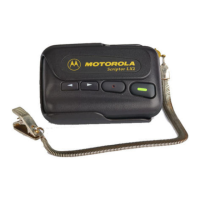
Motorola T900 Specifications

General IconGeneral
BrandMotorola
ModelT900
CategoryPager
LanguageEnglish

Related product manuals