EasyManua.ls Logo

Mover-Technology CT 1500 - Mounting the Camper Trolley; Clamp Bolt on Stabilization Pipe; Weight Transfer to Camper Trolley; Safety and Operation Guidelines

Mover-Technology CT 1500
Print Icon
To Next Page IconTo Next Page
To Previous Page IconTo Previous Page
Loading...
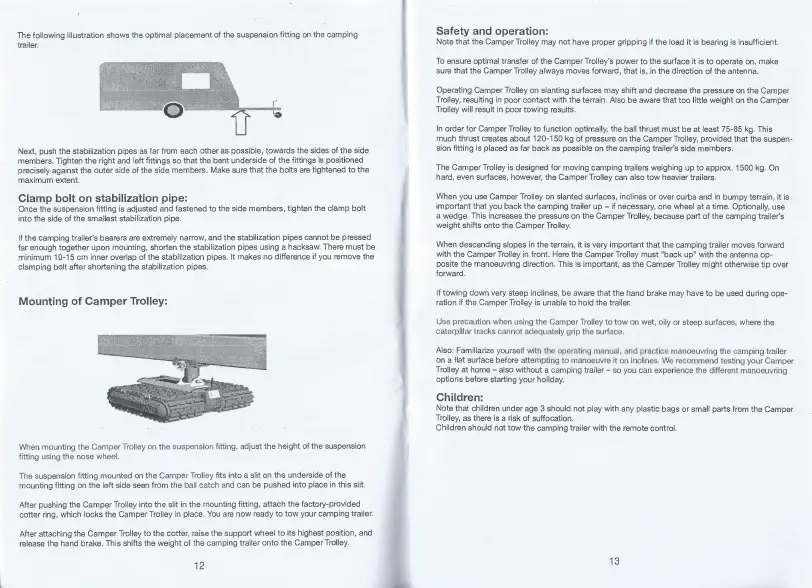
The
following
illustration
shows
the
optimal
placement
of
the
suspension
fitting
on
the
camping
trailer.
Next,
push
the
stabilization
pipes
as
far
from
each
other
as
possible,
towards
the
sides
of
the
side
members.
Tighten
the
right
and
left
fittings
so
that
the.bent
underside
of
the
fittings
is
positioned
precisely
against
the
outer
side
of
the
side
members.
Make
sure
that
the
bolts
are
tightened
to
the
maximum
extent.
Clamp
bolt
on
stabilization
pipe:
Once
the
suspension
fitting
is
adjusted
and
fastened
to
the
side
members,
tighten
the
clamp
bolt
into
the
side
of
the
smallest
stabilization
pipe.
If
the
camping
trailer’s
bearers
are
extremely
narrow,
and
the
stabilization
pipes
cannot
be
pressed
far
enough
together
upon
mounting,
shorten
the
stabilization
pipes
using
a
hacksaw.
There
must
be
minimum
10-15
cm
inner
overlap
of
the
stabilization
pipes.
It
makes
no
difference
if
you
remove
the
clamping
bolt
after
shortening
the
stabilization
pipes.
Mounting
of
Camper
Trolley:
When
mounting
the
Camper
Trolley
on
the
suspension
fitting,
adjust
the
height
of
the
suspension
fitting
using
the
nose
wheel.
The
suspension
fitting
mounted
on
the
Camper
Trolley
fits
into
a
slit
on
the
underside
of
the
mounting
fitting
on
the
left
side
seen
from
the
ball
catch
and
can
be
pushed
into
place
in
this
slit.
After
pushing
the
Camper
Trolley
into
the
slit
in
the
mounting
fitting,
attach
the
factory-provided
cotter
ring,
which
locks
the
Camper
Trolley
in
place.
You
are
now
ready
to
tow
your
camping
trailer.
After
attaching
the
Camper
Trolley
to
the
cotter,
raise
the
support
wheel
to
its
highest
position,
and
release
the
hand
brake.
This
shifts
the
weight
of
the
camping
trailer
onto
the
Camper
Trolley.
12
Safety
and
operation:
Note
that
the
Camper
Trolley
may
not
have
proper
gripping
if
the
load
it
is
bearing
is
insufficient.
To
ensure
optimal
transfer
of
the
Camper
Trolley's
power
to
the
surface
it
is
to
operate
on,
make
sure
that
the
Camper
Trolley
always
moves
forward,
that
is,
in
the
direction
of
the
antenna.
Operating
Camper
Trolley
on
slanting
surfaces
may
shift
and
decrease
the
pressure
on
the
Camper
Trolley,
resulting
in
poor
contact
with
the
terrain.
Also
be
aware
that
too
little
weight
on
the
Camper
Trolley
will
result
in
poor
towing
results.
In
order
for
Camper
Trolley
to
function
optimally,
the
ball
thrust
must
be
at
least
75-85
kg.
This
much
thrust
creates
about
120-150
kg
of
pressure
on
the
Camper
Trolley,
provided
that
the
suspen¬
sion
fitting
is
placed
as
far
back
as
possible
on
the
camping
trailer’s
side
members.
The
Camper
Trolley
is
designed
for
moving
camping
trailers
weighing
up
to
approx.
1500
kg.
On
hard,
even
surfaces,
however,
the
Camper
Trolley
can
also
tow
heavier
trailers.
When
you
use
Camper
Trolley
on
slanted
surfaces,
inclines
or
over
curbs
and
in
bumpy
terrain,
it
is
important
that
you
back
the
camping
trailer
up
-
if
necessary,
one
wheel
at
a
time.
Optionally,
use
a
wedge.
This
increases
the
pressure
on
the
Camper
Trolley,
because
part
of
the
camping
trailer’s
weight
shifts
onto
the
Camper
Trolley.
When
descending
slopes
in
the
terrain,
it
is
very
important
that
the
camping
trailer
moves
forward
with
the
Camper
Trolley
in
front.
Here
the
Camper
Trolley
must
“back
up"
with
the
antenna
op¬
posite
the
manoeuvring
direction.
This
is
important,
as
the
Camper
Trolley
might
otherwise
tip
over
forward.
If
towing
down
very
steep
inclines,
be
aware
that
the
hand
brake
may
have
to
be
used
during
ope¬
ration
if
the
Camper
Trolley
is
unable
to
hold
the
trailer.
Use
precaution
when
using
the
Camper
Trolley
to
tow
on
wet,
oily
or
steep
surfaces,
where
the
caterpillar
tracks
cannot
adequately
grip
the
surface.
Also:
Familiarize
yourself
with
the
operating
manual,
and
practice
manoeuvring
the
camping
trailer
on
a
flat
surface
before
attempting
to
manoeuvre
it
on
inclines.
We
recommend
testing
your
Camper
Trolley
at
home
-
also
without
a
camping
trailer
-
so
you
can
experience
the
different
manoeuvring
options
before
starting
your
holiday.
Children:
Note
that
children
under
age
3
should
not
play
with
any
plastic
bags
or
small
parts
from
the
Camper
Trolley,
as
there
is
a
risk
of
suffocation.
Children
should
not
tow
the
camping
trailer
with
the
remote
control.
13

Related product manuals