EasyManua.ls Logo

MTD 504 - Page 13

MTD 504
36 pages
Print Icon
To Next Page IconTo Next Page
To Previous Page IconTo Previous Page
Loading...
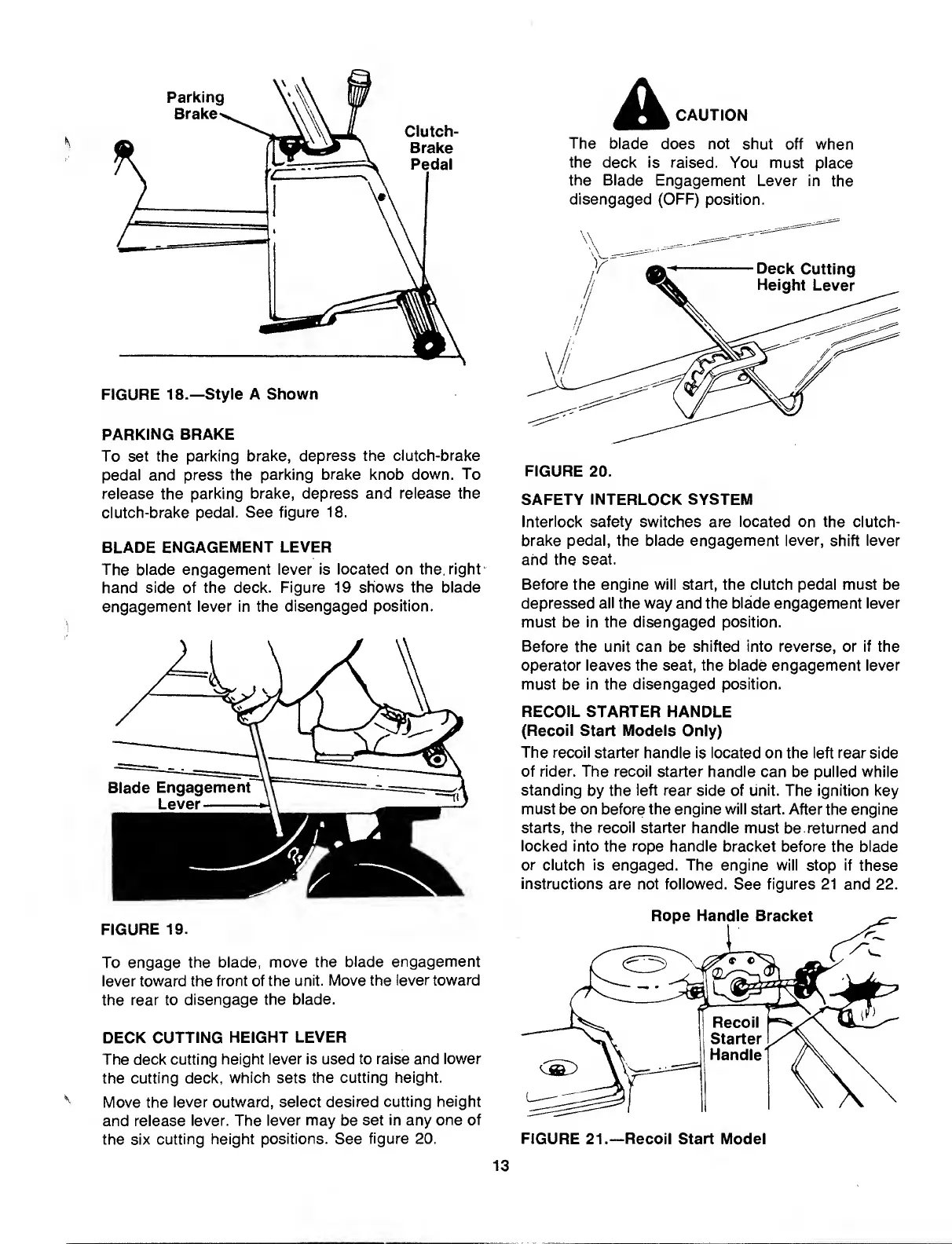
PARKING
BRAKE
To
set
the
parking
brake,
depress
the
clutch-brake
pedal
and
press
the
parking
brake
knob
down.
To
release
the
parking
brake,
depress
and
release
the
clutch-brake
pedal.
See
figure
18.
BLADE
ENGAGEMENT
LEVER
The
blade
engagement
lever
is
located
on
the.
right
hand
side
of
the
deck.
Figure
19
shows
the
blade
engagement
lever
in
the
disengaged
position.
FIGURE
19.
To
engage
the
blade,
move
the
blade
engagement
lever
toward
the
front
of
the
unit.
Move
the
lever
toward
the
rear
to
disengage
the
blade.
DECK
CUTTING
HEIGHT
LEVER
The
deck
cutting
height
lever
is
used
to
raise
and
lower
the
cutting
deck,
which
sets
the
cutting
height.
Move
the
lever
outward,
select
desired
cutting
height
and
release
lever.
The
lever
may
be
set
in
any
one
of
the
six
cutting
height
positions.
See
figure
20.
A
CAUTION
The
blade
does
not
shut
off
when
the
deck
is
raised.
You
must
place
the
Blade
Engagement
Lever
in
the
disengaged
(OFF)
position.
FIGURE
20.
SAFETY
INTERLOCK
SYSTEM
Interlock
safety
switches
are
located
on
the
clutch-
brake
pedal,
the
blade
engagement
lever,
shift
lever
and
the
seat.
Before
the
engine
will
start,
the
clutch
pedal
must
be
depressed
all
the
way
and
the
blade
engagement
lever
must
be
in
the
disengaged
position.
Before
the
unit
can
be
shifted
into
reverse,
or
if
the
operator
leaves
the
seat,
the
blade
engagement
lever
must
be
in
the
disengaged
position.
RECOIL
STARTER
HANDLE
(Recoil
Start
Models
Only)
The
recoil
starter
handle
is
located
on
the
left
rear
side
of
rider.
The
recoil
starter
handle
can
be
pulled
while
standing
by
the
left
rear
side
of
unit.
The
ignition
key
must
be
on
before
the
engine
will
start.
After
the
engine
starts,
the
recoil
starter
handle
must
be
returned
and
locked
into
the
rope
handle
bracket
before
the
blade
or
clutch
is
engaged.
The
engine
will
stop
if
these
instructions
are
not
followed.
See
figures
21
and
22.
13

Related product manuals