1.
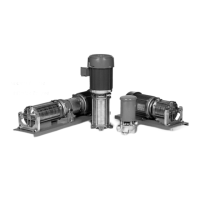
VERTICAL CLOSE COUPLED PUMPS
HORIZONTAL FLEXIBLE COUPLED
Placing Stored Pumps Into Service
Application Considerations
When properly installed and given
reasonable care and maintenance,
regenerative turbine pumps should
operate satisfactorily for many years.
Because of the high differential
pressures expected in a regenerative
turbine pump, close running clearances
are used to reduce internal losses.
Abrasive particles, even microscopic
ones, in high enough concentrations,
can open up the close clearances
between internal components. For
critical services it is recommended that
you keep an identical pump for stand-
1A Inspection of Equipment
Immediately upon receipt of the
shipment, inspect the equipment for
damage or missing components.
Check the shipping manifest and
report any damage or shortage to the
Transportation Company’s local agent.
Inspect the crate and any wrapping
material before discarding. Parts or
accessories are sometimes wrapped
individually or fastened to the skid.
Put the instructions that came with the
shipment in a safe place where they
will be available to those who will be
using them for installation and service.
If the pump is to be stored before use,
it should be inspected as described
in 1A, recrated and stored in a dry
location. Standard shipping containers
are not suitable for outdoor storage.
In some areas, it may be necessary
to cover the pump’s exterior surface
with oil or other rust inhibiting coating.
All units are tested at the factory with
a water/corrosion inhibitor solution,
some of which will remain inside the
pump upon receipt. If units are fl ushed
out prior to storage, this inhibitor will
be removed and proper care must be
taken to prevent product deterioration
For storage beyond 30 days, a
corrosion inhibiting protective fl uid
should be added to the internal pump
cavities. Fluids used in the pump
should be selected for compatibility
with pump materials. This is very
important when optional seal and
gasket materials have been used.
Protective caps on the inlet and outlets
should also be used. Caps alone are
not suffi cient protection
1C Placing Stored Pumps Into
Special care must be taken when
placing stored pumps into service.
First clean the outside and fl ush out
the inside with a process compatible
fl uid. Try to turn the pump using the
coupling or shaft. On close-coupled
units, access to the shaft is between
the pump and motor. A vise grip or
other plier type gripping device may
be used directly on the shaft. Applying
torque to the motor fan blades is not
recommended. If the impeller does not
break loose immediately, fi ll the pump
with a process compatible fl uid and try
If this fails, read the disassembly-
reassembly instructions. With an
understanding of which are the bolts
used to clamp the entire assembly
together, loosen each of them exactly
three full turns. After fi lling the pump
with water again, up to 50 foot pounds
of torque may be applied to the
coupling or shaft without fear of ruining
the impeller vanes. It should begin to
turn well before this force is reached.
Continue turning the pump while the
various fasteners are returned to their
If the unit still won’t turn over, DO
NOT apply further force. Refer to the
Disassembly/Reassembly Instructions
in Section 5 to determine the cause of
1D Application Considerations
All electrical equipment and wiring
should conform to local and National
Electrical Codes. Use the motor
manufacturer’s instructions for
connecting the motor. Note the correct
rotation and wiring diagrams on the
assembly. Make sure the motor
rotation and speed matches that
1D2 Construction Materials
While it is reasonable to assume that
good judgement has been used in
selecting all the materials in the pump
for compatibility with process fl uids,
actual conditions sometimes vary
from original specifi cations. Also,
typical material selection charts do not
consider all the temperature, pressure,
and fl uid variables. The customer’s
engineer should be consulted for fi nal
judgement on the best materials for
critical process applications.
The fi rst valve to be considered
for a regenerative turbine pumping
system might be a pressure relief
valve. Because this type of pump
has a horsepower requirement similar
to that of a positive displacement
pump (constantly rising hp along with
pressure increases) a relief valve can
be effectively used to limit horsepower.
This is helpful when a non-overloading
motor is specifi ed. It can be of
critical importance if the system
fl ow rate can vary widely. There
are almost no circumstances where
a fl ow modulating valve will work
successfully in a regenerative turbine
pumping system. The steep pumping
characteristic, typical of these pumps,
produces very large pressure changes
with small variations in fl ow rate. As
a result, the modulating fl ow from the
valve introduces sharp pressure shock
waves that shorten pump life and
may cause damage to other pieces of
A swing check valve is recommended
in the suction line even when the
pump inlet is only slightly higher than
the fl uid source. It should be the same
size as the pump inlet or sized based
on reasonable fl uid friction losses.
A foot valve is recommended when
lifting fl uid from a sump. This will
save wear and tear on any pump,
even those equipped with self priming
A Y-Strainer is recommended
immediately ahead of the pump on
any newly constructed system. This
is advisable due to the probability
that foreign material large enough to
damage pump clearances may remain
even though the piping has been


 To Next Page
 Loading...