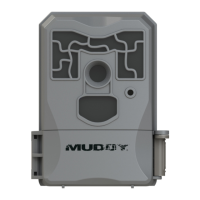
The Muddy Pro-Cam 16 (Model MUD-MTC200) is a trail camera designed for outdoor surveillance and wildlife monitoring. It captures still images and videos, offering a range of customizable settings to suit various user needs.
Function Description:
The Pro-Cam 16 is primarily used for capturing images and videos of wildlife or for security purposes in remote outdoor locations. It features an infrared flash for night vision, a fast trigger speed to minimize missed shots, and a wide detection range. The camera is designed for easy setup and operation, with a user-friendly interface and robust construction suitable for outdoor environments. It can operate on AA batteries or an external 12V DC power source, providing flexibility in deployment. The camera records data onto an SDHC storage card, which can then be reviewed on a computer.
Important Technical Specifications:
- Image Resolution: 16 MP
- Image Detail: Color (Day), B/W (Night)
- Video Mode: Standard VGA (32 FPS)
- Video Length Options: 10 - 60 seconds
- Illumination: 18 LEDs with Infrared Flash
- Detection Range: 70 Feet
- Trigger Speed: 1.5 Seconds
- Flash Range: 50+ Feet
- Image Data: Camera ID, Date, Time, Temp, & Moon Phase
- Burst Interval: 2 Seconds
- Field of View: 3 Zone + 50° Detection Angle
- Photo Burst Options: 2-6 Photos
- Trigger Delay Options: 7 Options: 10 sec-30 Min
- Dimensions: 4.75" H x 4.25" W x 2.5" D
- Material: Molded ABS
- Finish: Non-reflective Brown
- Housing: Waterproof
- Settings Screen: LCD Screen
- Mounting Options: Adjustable Strap with Buckle, 1/4" - 20 Alt. Mounting
- Theft Deterrence: Cable Lock and Padlock Ready
- Battery Life: Up to 10,000 Images
- Battery Requirement: 6 AA
- Memory Card: Secure Digital Up to 32 GB
- Alt. Power: 12V DC
- Operating Temp.: -10° F to 140° F
- Product Warranty: 1 Year
Usage Features:
- Quick-Start Presets: The camera comes with standard default settings for immediate use, including Camera Mode (Camera), Burst Mode (3 Photos), Image Quality (High), Picture Delay (10 Sec), Video Length (10 Sec), Flash Mode (Auto), Camera ID (My Camera), Temperature Unit (Fahrenheit), and Picture Info Bar (On). Users are advised to set the current Date and Time.
- Advanced Settings: Users can customize various parameters via an LCD screen and navigation buttons.
- Time and Date: Set the date, year, and time for imprinting on photos.
- Camera Mode: Choose between "Camera" (still photos) or "Video" mode. Recommended settings for each mode are provided.
- Burst Mode: Configure the number of photos taken in a sequence (2-6 photos or OFF) before the trigger delay, with a 2-second interval between burst photos.
- Image Quality: Select "High," "Medium," or "Low" quality to balance image detail and storage space.
- Picture Delay: Set the interval between triggers (10 sec, 20 sec, 30 sec, 1 min, 5 min, 10 min, 30 min). Lower settings result in more frequent triggers.
- Video Length: Determine the duration of daytime videos (10 sec, 20 sec, 30 sec, 1 min). Night videos are fixed at 10 seconds for battery life.
- Flash Mode: Choose "AUTO" for automatic infrared flash use or "OFF" to only trigger photos during hunting hours, conserving battery and storage.
- FW Version: Displays the camera's firmware version.
- Motion Test: A feature to test detection distance and aim. A red LED lights up when motion is detected, and the camera arms after 30 seconds of no motion.
- Default Setting: Resets all menu settings to factory defaults.
- Format SDHC Card: Allows formatting the SDHC card to clear file system corruption and erase data. Recommended before each use or if problems occur.
- Camera ID: Assign a name to the camera, which will be imprinted on photo files.
- Temperature Unit: Select Fahrenheit or Celsius for temperature imprinting on photo files.
- Picture Info Bar: Enable or disable the display of information (Moon Phase, Burst, Temp, Date, Time, Camera ID) on photos.
- Battery Installation: Supports 6-AA cell alkaline batteries. The battery compartment is accessed by pressing and sliding an eject button. Proper battery orientation is crucial to prevent leakage or damage.
- 12V DC Power Source: An alternative power option. The rubber port cap at the bottom of the camera is removed, and a universal 12V DC cord is plugged in. A hook behind the camera door's hinge supports the cord.
- Memory Card Installation: Requires an SDHC storage card (up to 32GB, Class 10 recommended). The card is inserted into a slot behind a locking latch. It clicks into place when properly inserted.
- Arming the Camera: The camera automatically arms after 30 seconds of no button activity on the home screen, or 90 seconds in the camera menu. It can also be quickly activated by pressing the RIGHT arrow from the main startup screen, initiating a 3-second delay before arming.
- Reviewing Images: Images are reviewed by inserting the SDHC card into a computer with an SDHC slot or using an external SDHC card reader.
Maintenance Features:
- Moisture Prevention: The camera has a durable waterproof membrane, but care should be taken to prevent water damage. Avoid mounting upside down, leaving the case open, or changing batteries/settings/SDHC cards in heavy rain. If water enters, remove batteries immediately and allow the camera to dry for several days.
- Vibration Protection: As an electronic device, it's sensitive to vibration. Avoid dropping the camera on hard surfaces and transport it in a way that prevents bouncing or vibration.
- Temperature Management: Recommended operating temperature is -10°F to 140°F. Avoid storing in extreme cold/warm temperatures or contained environments like vehicles with high temperatures, as this can affect battery life and functions.
- Troubleshooting:
- Camera Not Responding: If the camera is locked up, remove the AA battery compartment (or disconnect alternate power) for 10 seconds to reset.
- Bad SDHC Card: If the camera doesn't acknowledge the SDHC card, try a new card or one from a known working Muddy camera. Full formatting on a PC is recommended for cards used in other cameras.
- Image Quality Issues: Blurry images due to fast-moving animals or insufficient light are a natural part of photography and may occur occasionally.

 Need help?
 General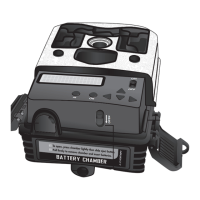

 To Next Page