Need help?
Do you have a question about the NAD 6155 and is the answer not in the manual?
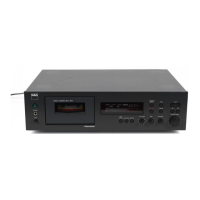
The NAD 6155 is a semi-professional cassette deck, manufactured between January 1985 and June 1988. It is designed to deliver outstanding performance in both recording and playback, aiming to rival higher-priced cassette decks by focusing its engineering budget solely on aspects that affect audible performance, rather than cosmetic features.
The NAD 6155's primary function is to record and play back audio on cassette tapes. It incorporates several advanced features to ensure high-fidelity sound reproduction, addressing common challenges in cassette recording and playback.
Play Trim (A First from NAD): This innovative circuit, developed in collaboration with Dolby Laboratories, is designed to correct high-frequency aberrations that often limit the fidelity of cassette recordings, especially when tapes recorded on one machine are played on another. These aberrations can arise from tape saturation, mismatched biasing during recording, and differences in equalization and head azimuth between recorders. Play Trim is a special high-frequency playback equalization circuit located ahead of the Dolby NR circuit. This strategic placement allows it to restore accurate playback response before Dolby NR decoding occurs, preventing mistracking of the noise-reduction circuits and resulting in a more accurate and brilliant sound. The Play Trim control is a narrow-band equalizer operating in the top two octaves of the audio spectrum, providing an adjustable boost or cut of up to ±3 dB at 10 kHz and ±6 dB at 20 kHz. It allows users to adjust tonal balance during playback to remove false brightening or dulling of the sound.
Dolby HX Pro Headroom Extension: This circuit addresses the problem of high-frequency rolloff and tape saturation at high recording levels, which typically results in a dull sound. The Dolby HX Pro system constantly monitors the level and frequency content of the input signal during recording. It automatically varies the amount of ultrasonic bias to ensure that the total effective bias (including the effect of high audio frequencies) is always optimal. When recording a strong low-frequency signal, the bias level increases to an unusually high value, leading to remarkably low distortion at high recording levels. Conversely, when the input signal has strong highs, the bias decreases, dramatically improving the high-frequency saturation level and preventing dulling of the highs. This feature enhances the useful dynamic range of the 6155, making it comparable to or better than many decks using costly metal tape, even with ferric and chrome tapes. The operation of Dolby HX Pro is fully automatic and works only during recording, meaning the superior quality of the resultant recording will be evident on any playback device (e.g., in a car, a portable player, or the 6155 itself).
Amorphous Head: The 6155 features a costly amorphous record/play head. This type of head is remarkably resistant to flux saturation, even at the highest recording levels. In many cassette recorders, the head can saturate before the tape does, limiting the useful dynamic range. The amorphous head allows for recording musical peaks at levels substantially higher than 0 dB (Dolby NR reference level) without distortion. This capability is particularly important for high-bias (chrome) and metal-particle tape formulations, which excel in high-frequency dynamic range. It enables the capture of the full brilliance and power of cymbals, bells, brass, and synthesizers with clear, airy sound.
The NAD 6155 is designed for ease of use despite its advanced features. The Play Trim control is adjusted during playback to achieve musically correct tonal balance. The Dolby HX Pro circuit operates automatically during recording, requiring no user intervention. While the 6155 is a mid-priced machine, it is engineered to perform optimally with premium-quality tapes, producing first-class recordings. Its wide-range response, low flutter, and quiet electronics also make it an excellent playback environment for high-quality pre-recorded music cassettes.
The document does not explicitly detail maintenance features. However, as with any cassette deck, regular cleaning of the tape heads, capstan, and pinch roller is generally recommended to ensure optimal performance and longevity. The robust design, focusing on core audio performance, suggests a reliable unit.
 General
| Brand | NAD |
|---|---|
| Model | 6155 |
| Category | Cassette Player |
| Language | English |

 To Next Page