Need help?
Do you have a question about the NAD 613 and is the answer not in the manual?
Precautions to follow before performing adjustment procedures.
List of necessary test equipment and tools for adjustments.
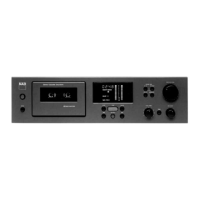
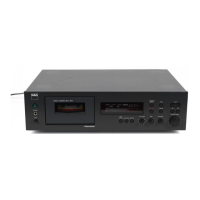
The NAD 613 is a high-fidelity cassette tape deck designed for audio recording and playback. It is part of NAD's commitment to delivering quality sound reproduction and user-friendly operation in a home audio system. The device is built with a focus on reliable performance and ease of integration into existing setups.
The primary function of the NAD 613 is to record and play back audio on standard compact cassettes. It features a two-channel, four-track format, utilizing AC erase for efficient tape clearing. The deck supports various tape types, including normal, high (CrO2), and metal, allowing users to choose the appropriate tape for optimal recording quality.
For recording, the NAD 613 offers comprehensive control over the audio input. Users can adjust the record level and balance to ensure proper signal strength and channel separation. The deck incorporates a bias adjustment feature, which allows for fine-tuning the recording bias current to match the specific characteristics of different tape formulations, thereby optimizing frequency response and minimizing distortion. An MPX filter is included to remove unwanted pilot tones during FM stereo recording, preventing interference with the Dolby Noise Reduction system. The deck also features a "HX Pro" (Headroom Extension) system, which dynamically adjusts the recording bias to extend high-frequency headroom, resulting in improved high-frequency response and reduced distortion, especially with high-level signals.
Playback is enhanced by the inclusion of Dolby B and Dolby C Noise Reduction systems. These systems effectively reduce tape hiss, improving the signal-to-noise ratio and delivering a cleaner, more dynamic sound. Users can select the appropriate Dolby NR setting based on how the tape was recorded. A "Play Trim" control is also provided, allowing for subtle adjustments to the high-frequency response during playback, which can compensate for minor recording discrepancies or tape wear.
The NAD 613 features a fluorescent indicator tube display that provides visual feedback on various operational parameters. This includes a counter for tracking tape position, level meters for monitoring audio input/output, and indicators for selected functions such as Dolby NR, tape type, and playback/record status. The display helps users monitor the deck's operation and make precise adjustments.
The deck is equipped with standard RCA line input and output jacks for connecting to other audio components, such as amplifiers, receivers, or other source devices. A headphone jack is also provided on the front panel, allowing for private listening and monitoring of recordings or playback.
The transport mechanism is controlled by a microprocessor, which manages various functions like play, stop, pause, fast forward, and rewind. This ensures precise and reliable tape handling. The deck also includes a repeat function, allowing for continuous playback of a cassette.
The NAD 613 is designed for intuitive operation, with clearly labeled controls on the front panel. The power button, headphone jack, and cassette compartment door are easily accessible. The main transport controls (stop, play, pause, rewind, fast forward, record) are prominently located for quick access.
Recording level and balance controls are provided, allowing users to manually set the input levels for optimal recording. The bias adjustment and play trim controls offer advanced users the ability to fine-tune audio characteristics for personalized sound.
The display provides essential information at a glance, including a tape counter that can be reset, and indicators for various settings like Dolby NR (B or C), MPX filter, and tape type (normal, high, metal). This visual feedback helps users confirm their selections and monitor the deck's status.
The NAD Link feature allows for integrated control with other compatible NAD components, simplifying system operation.
The service manual provides detailed instructions for the maintenance and adjustment of the NAD 613, ensuring its long-term performance and reliability.
Regular maintenance includes cleaning critical parts such as the record/playback head, pinch roller, capstan, and erase head with an alcohol-moistened swab. This prevents the buildup of tape residue that can degrade sound quality and affect tape transport. Demagnetizing the record/playback head with a head demagnetizer is also recommended to prevent magnetization that can cause hiss and high-frequency loss.
The manual outlines a series of adjustment procedures that can be performed by qualified service personnel. These include:
The manual also emphasizes safety precautions, such as using exact replacement parts for critical locations and re-installing protective covers. It details leakage tests (both "cold" and "live") to ensure the unit is safe from electric shock hazards before being returned to a customer. These tests involve measuring insulation impedance or leakage current to ensure they fall within specified limits.
Detailed exploded views and parts lists are provided for the chassis, tape mechanism, and various printed circuit boards, facilitating component identification and replacement. Wiring diagrams and schematic diagrams are also included, offering a comprehensive understanding of the device's internal connections and electronic circuitry, which is invaluable for troubleshooting and repair.
The NAD 613 is designed to be a durable and serviceable component, with provisions for detailed adjustments and repairs to maintain its performance over time.
 General
| speed accuracy | ± 1% |
|---|---|
| wow and flutter | <0.07% JIS wtd. RMS |
| frequency response | 30Hz - 18kHz ±3dB |
| harmonic distortion | <0.3% at -10dB |
| signal-to-noise ratio | 58dB (Dolby NR off) |
| channel separation | 40dB @ 1kHz |
| erase | >70dB @ 1kHz |
| input sensitivity / impedance | 80mV/50k |
| maximum input level | 25V |
| output level @ 0dB | 500mV |
| output impedance | 600 |
 Weight and Dimensions
| dimensions | 435 x 125 x 311mm |
|---|---|
| net weight | 5.0kg |
| shipping weight | 6.6kg |

 To Next Page