Need help?
Do you have a question about the NAD C556 and is the answer not in the manual?
Guidelines to prevent fire and shock hazards during servicing, including component positioning and protective device checks.
Information regarding X-radiation, primarily from picture tubes, and precautions for servicing high voltage circuits.
Safety measures for handling picture tubes, emphasizing care to avoid damage and using recommended replacement tubes.
Advice on installing the product in suitable environments and avoiding conditions that could cause damage or hazards.
General safety advice for servicing the device, including power disconnection and cleaning procedures.
Details the process for checking the insulation resistance of the unit to prevent electrical shock.
Guidelines for handling sensitive electronic components to prevent damage from static electricity.
Provides general specifications for the turntable, including drive system, motor, speed, and suspension.
Details specifications related to the tonearm, such as length, effective mass, and overhang.
Lists technical specifications for the Ortofon OM5E cartridge, including transducer and electrical characteristics.
Outlines electrical properties like load resistance, capacitance, inductance, and impedance.
Specifies mechanical properties such as cartridge weight, tracking weight, and stylus unit.
Covers physical dimensions, net weight, and shipping weight of the unit.
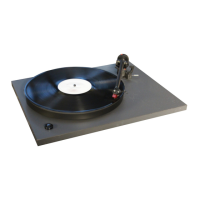
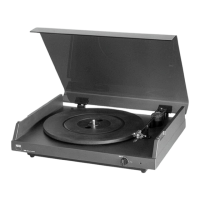
Illustrates the top and side views of the turntable, identifying key components with numerical labels.
Provides a step-by-step guide for cleaning and lubricating the turntable's hub and bearing assembly.
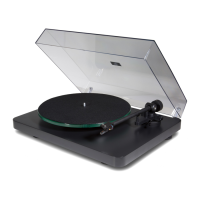
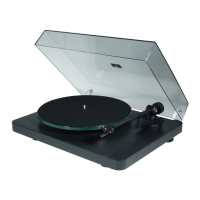
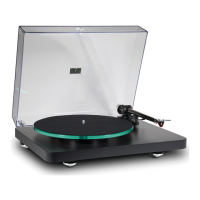
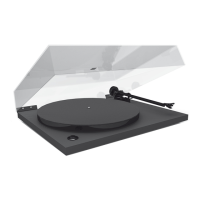
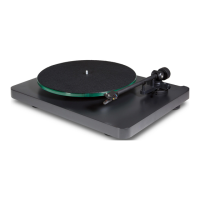
The NAD C556 is a high-fidelity turntable designed for the playback of vinyl records. Its primary function is to convert the mechanical information stored in the grooves of a record into an electrical audio signal, which can then be amplified and played through a sound system. This device is engineered to provide a pure and accurate sonic reproduction, emphasizing the nuances and warmth inherent in analog audio.
At its core, the C556 employs a belt-drive system, a design choice favored for its ability to isolate the motor's vibrations from the platter, thereby minimizing unwanted noise and ensuring stable rotational speed. The motor itself is a high-torque synchronous type, selected for its precision and consistency, crucial for maintaining accurate playback speed at both 33.3 and 45.1 revolutions per minute. The turntable's stability is further enhanced by three energy-absorbent synthetic rubber feet, which serve to dampen external vibrations and provide a stable platform for the delicate process of record playback.
The tonearm, a critical component in any turntable, is designed for manual operation, allowing the user direct control over its placement on the record. This manual approach is often preferred by audiophiles for its precision and the tactile engagement it offers. The tonearm is equipped with a counterweight, which is essential for setting the correct tracking force of the cartridge. Proper adjustment of the counterweight ensures that the stylus applies the optimal pressure to the record groove, preventing damage to both the record and the stylus, and maximizing sound quality.
Another key feature of the tonearm is the bias adjustment mechanism. This mechanism counteracts the inward force that pulls the tonearm towards the center of the record due a phenomenon known as skating force. By applying an equal and opposite outward force, the bias adjustment ensures that the stylus tracks both walls of the record groove evenly, leading to improved stereo imaging and reduced wear on the stylus and record. The tonearm also includes a lift/lower mechanism, which provides a gentle and controlled way to raise and lower the stylus onto and off the record, protecting both the stylus and the record from accidental damage. An arm clip is present to secure the tonearm when not in use, preventing it from moving freely and potentially causing damage.
The C556 comes equipped with an Ortofon OM5E cartridge, a popular choice known for its balanced sound and elliptical stylus. The elliptical stylus shape is designed to make more contact with the groove walls, allowing for a more detailed and accurate retrieval of information compared to spherical styli. The cartridge's output voltage, frequency response, and channel separation are carefully matched to deliver a clear and dynamic audio experience. The recommended tracking force range and vertical tracking angle are specified to ensure optimal performance and longevity of the stylus and records.
For connectivity, the turntable includes a phonograph cable, which is used to connect the C556 to a phono preamplifier or an amplifier with a dedicated phono input. This cable is designed to transmit the delicate analog signal from the cartridge with minimal interference.
Maintenance of the C556 is straightforward but requires attention to detail to ensure continued optimal performance. A crucial aspect of maintenance involves cleaning the hub and bearing assembly. This process begins by carefully removing the hub nut and washer, then gently extracting the hub/bearing assembly from the turntable plinth. It's important to do this slowly to avoid inadvertently losing the ball bearing. Once removed, both the hub spindle and the inside of the brass bearing bush must be thoroughly cleaned and degreased. A solvent cleaner, such as 1.1.1. trichloroethane, is recommended for this task. After cleaning, the ball bearing is reinserted, and the hub is fitted back into the bearing bush. The assembly should spin freely, indicating proper cleaning and reassembly.
Following the cleaning, lubrication is essential. Two drops of a recommended hypoid oil, such as Comma Hypoid EP80, Castrol EPX80w/90, or Shell Spirax EP90, should be applied to the bearing bush. The hub is then slid back into the bearing bush without twisting to ensure proper oil distribution and to prevent air from being trapped. Finally, the hub is spun to evenly distribute the oil, and the washer and nut are replaced and tightened to approximately 5Nm. This meticulous cleaning and lubrication process is vital for maintaining the smooth, low-friction operation of the platter, which directly impacts speed stability and sound quality.
Another maintenance procedure outlined is the replacement of the tonearm. This involves several careful steps. First, with the arm secured in the arm clip, the counterweight is slid off. The arm is then gently moved to expose three cosmetic screws, which must be removed using a "Pozidriv®" number 2 screwdriver or bit to avoid damaging them. Once the screws are out, the tonearm assembly can be carefully removed and replaced with a new one, which typically comes with RCA cables attached. The installation process is the reverse of removal, ensuring the screw holes are precisely aligned. After the new tonearm is installed, the counterweight is re-slid into place, and the bias adjustment slider is set to match the desired tracking weight, for example, 1.5g tracking weight corresponds to 1.5g on the bias slider.
Safety precautions are emphasized throughout the manual, particularly regarding servicing. Users are warned against modifying the product or performing unauthorized installations, as this can void the warranty and pose safety risks. When servicing, an isolation transformer is recommended to protect against AC line shock. Checks for fire and shock hazards include ensuring components are positioned to avoid shorts, all protective devices are reinstalled, solder joints are clean, and there is no physical damage to parts or insulation. Critical components must be replaced with exact factory types. An AC leakage test is also recommended after reassembly to ensure electrical safety.
The manual also highlights the importance of handling Electrostatically Sensitive (ES) devices with care to prevent damage from static electricity. This includes draining static charge from the body before handling components, placing ES-equipped assemblies on conductive surfaces, using grounded-tip soldering irons, and anti-static solder removal devices. It also advises against using freon-propelled chemicals and removing replacement ES devices from their protective packaging until immediately before installation. Minimizing bodily motions when handling unpackaged ES devices is also recommended to prevent static charge generation.
Overall, the NAD C556 is presented as a precision instrument designed for dedicated vinyl enthusiasts. Its features and recommended maintenance procedures underscore a commitment to delivering high-quality audio reproduction and ensuring the longevity of both the device and the user's record collection.
 General
| Type | Belt Drive |
|---|---|
| Output | RCA |
| Speeds | 45 RPM |
| Platter | Aluminum |
| Tonearm | Straight |
| Weight | 6.5 kg |
| Wow and Flutter | <0.1% |
| Rumble | <-65dB |

 To Next Page