1.4 POWER SUPPLY
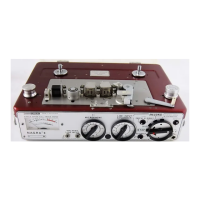
All models of the Nagra 4.2 may be powered either by an external power supply (ATN–3) or alternatively by inter-
nal batteries. The 4.2 will accept voltages ranging from –11 V to –30 V with peaks of up to –35 V. The batter-
ies are placed in the bottom of the machine and the polarity is marked inside the battery compartment. It is
opened by turning the two fasteners with a screwdriver or a small coin. All the batteries MUST be orientated in
the same direction as indicated on the base of the battery compartment.
The Nagra 4.2 houses twelve "D" type 1.5 V cells having a maximum diameter of 33.5 mm and a length of
between 59.5 and 62.5 mm. It is important to remember that corrosive material can leak out of flat batteries,
causing severe damage to the recorder, and therefore it is recommended not to leave batteries in the machine
during periods of storage.
If leakage occurs as a result of leaving flat batteries in the machine, then wash the affected area with fresh
water. The machine will suffer much less from the water than the electrolyte from the batteries. The external
supply is fed into the machine via connector marked "POWER PACK" (48) on the right side of the machine.
Rechargeable batteries may also be used and can be charged using the ATN–3C (order no 14376) which
includes the charger circuitry.
The 4.2 will function when the power is as low as 12 V (at 15 ips – 38 cm/s) and down to as low as 10.5 V at
the lower speeds. (These figures correspond to a machine in perfect condition and working at room temperature).
When using an external supply, selector switch (3) must be in the "EXTERNAL" position. It must be in the "BAT-
TERIES" position when internal batteries are in use. It is not necessary to remove the batteries when working
with an external supply (and vice versa).
Danger of Reversed Polarization
A reversed polarization of the power supply (negative to ground) could cause serious damage to the unprotected
early versions of the Nagra 4.2. Since then, three 2.5 A fuses have been added in the battery compartment which
protect the Nagra when batteries or accumulators are used. A fourth fuse mounted in parallel in the wiring fur-
ther protects the machine when powered by batteries as well as when powered by an external supply.
Measuring Battery Condition and Power Supply Voltage
Battery Reserve
When the Meter Switch is put into the "BATT. RESERVE" position the meter will indicate the difference between
the power voltage available and the power which the Nagra needs. Often the two voltages will fluctuate. The
device will take into consideration the lowest instantaneous voltage and memorize this. This detail is important,
for the average voltage of a power supply can be sufficient but momentary drops in the voltage can happen and
drop lower than the required minimum.
New batteries will give about 18 V whereas the Nagra can be powered by up to 30 V. This explains why, with new
batteries, the needle of the meter will only indicate about 40% full scale, when it is switched to "BATT. RESERVE".
Volt / Cell
The meter switch in this position works as a simple voltmeter. The centre scale is graduated from 0 to 1.6 V, it
indicates 1/12 of the total voltage or the average voltage of 1 cell.


 To Next Page