Need help?
Do you have a question about the Nanni Q2400 Series and is the answer not in the manual?
Explains manual's content, purpose, and recommended usage for safe operation.
Outlines the manual's structure and notes that Nanni may update information without notice.
Explains hazard signal words (Danger, Warning, Caution) and their corresponding symbols.
Covers essential safety practices like ventilation, waste disposal, and avoiding unwanted engine starts.
Details safety measures for maintenance, including work area, clothing, tools, and lifting.
Addresses noise, electrical, mechanical, fuel pressure, and welding hazards.
Covers safe handling of fuel, batteries, starting fluid and emergency readiness.
Emphasizes ensuring safety systems are in place and preventing accidents before use.
Discusses diesel fuel types, storage, handling, and cold weather considerations.
Details engine oil, filter service intervals, and lubricant storage.
Explains recommended coolants, water quality, and freeze protection.
Provides guidance on the proper and environmentally responsible disposal of waste fluids.
Explains how to locate and interpret identification plates for warranty and service.
Covers homologation, emissions standards, and conditions that void the warranty.
Addresses California Proposition 65 and EPA/CARB warranty regulations.
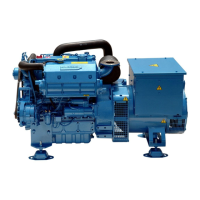
Lists and identifies the primary components of the generator set.
Provides visual diagrams (View N°1, N°2, N°3) of the generator set components.
Details the SI-2 control panel functions, buttons, indicators, and screen navigation.
Outlines essential checks for fuel, raw water, and electrical systems before starting.
Explains starting procedures, cold climate operation, and running anomalies.
Covers proper shutdown procedures and checks after the generator stops.
Introduces maintenance principles, intervals, and general safety warnings.
Covers engine oil checks, replacement, and filter servicing.
Details coolant replacement, hoses, thermostat, and heat exchanger servicing.
Explains replacement procedures for raw water pumps and alternator belts.
Outlines procedures for checking battery voltage, specific gravity, and electrical diagrams.
Explains marking data, nameplate interpretation, and technical specifications.
Provides a general description of the alternator and its safety devices and tags.
Details electrical connection procedures and terminal board configurations.
Covers routine maintenance tasks like cleaning, inspection, and tightening torques.
Lists common alternator defects and their remedies.
Outlines the steps required to prepare and protect the engine and alternator for storage.
Provides detailed procedures for long-term storage and engine restart.
Advises on proper handling and storage of batteries during unit inactivity.
Identifies causes and solutions for starting difficulties and low power output.
Covers troubleshooting for sudden engine stops, unusual noises, and black exhaust smoke.
Addresses engine overheating, coolant issues, and faulty sensors.
 General
| Fuel | Diesel |
|---|---|
| Noise Level | 65 dB(A) at 7 meters |
| Engine Type | 4-stroke |
| Power Output | 2.4 kVA |
| Voltage | 230V |
| Frequency | 50Hz |


 To Next Page