EasyManua.ls Logo

NARDI COMPRESSORI PACIFIC E35 - User Manual

Default Icon
58 pages
Print Icon
To Next Page IconTo Next Page
Loading...
PACIFIC E35 – EG35
1 |
P a g e
PACIFIC E35 - EG35
Nardi Compressori www.nardicompressori.com
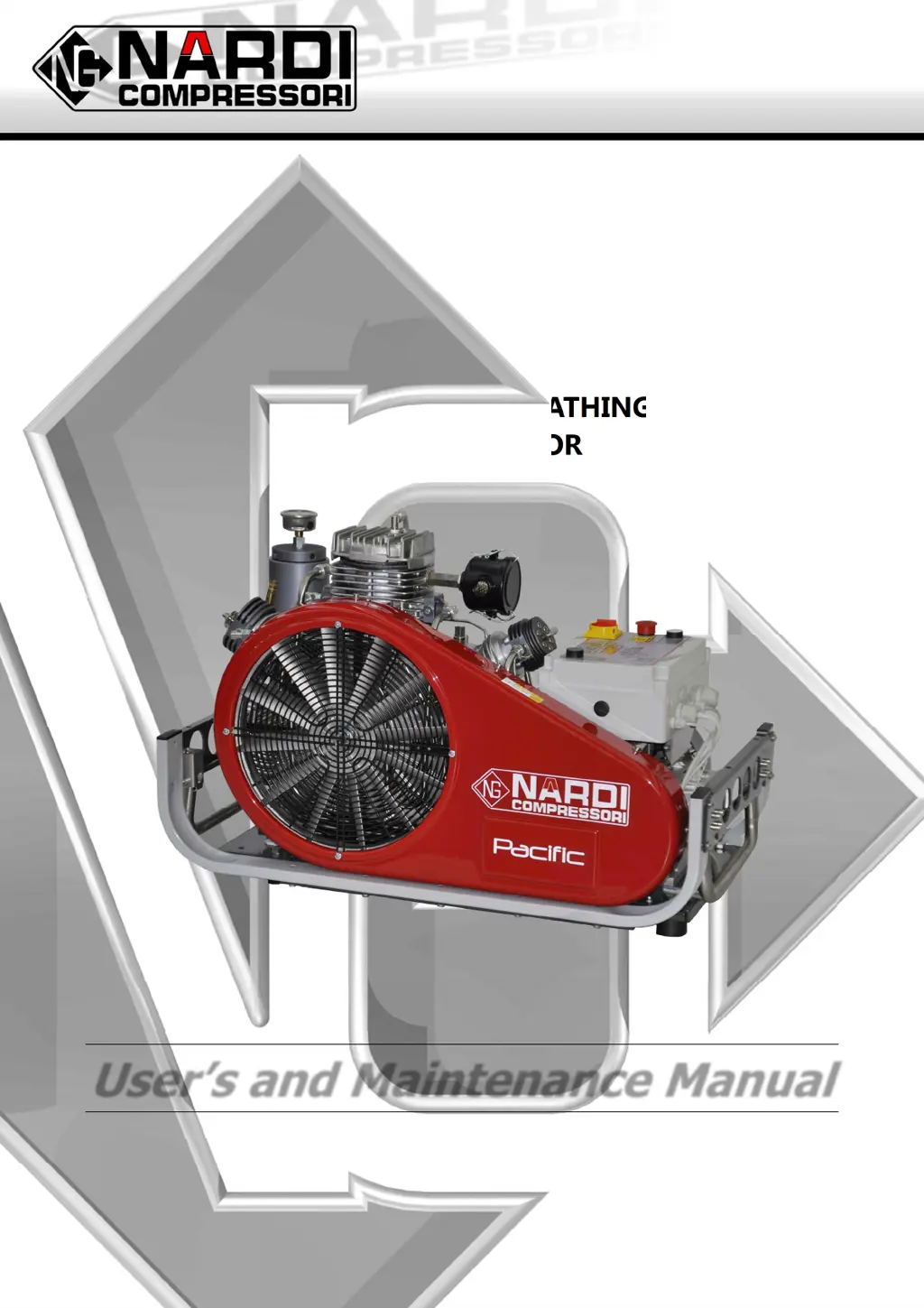
PACIFIC E35
PACIFIC EG35
HIGH PRESSURE BREATHING
AIR COMPRESSOR
User’s and Maintenance Manual

Questions and Answers

  • B
    Bryan MortonAug 17, 2025
    Why won't my NARDI COMPRESSORI PACIFIC E35 Air Compressor start?
    • M
      mullinsnicoleAug 17, 2025
      Your NARDI COMPRESSORI Air Compressor might not start due to several reasons: there could be no electric current, in which case you should check the electric line. Alternatively, a fuse might be bad, requiring replacement. Also, the electric current might be too low, so check the electric line.
  • T
    Tyrone SmithAug 20, 2025
    Why is my NARDI COMPRESSORI Air Compressor overheating?
    • L
      Leslie ColeAug 20, 2025
      Your NARDI COMPRESSORI Air Compressor may be overheating due to several reasons. The sense of rotation of the motor might be wrong, in which case you should invert the phase of the electric motor. Poor air intake could also be the cause, so increase air intake in the room. Additionally, the valves might not be closed properly; check, clean, and replace the valve if necessary. Finally, the ambient temperature may be too high ( +45 °C Max).
  • B
    Brian BarnesAug 22, 2025
    What to do if the air delivery decreases in my NARDI COMPRESSORI PACIFIC E35 Air Compressor?
    • T
      Timothy SilvaAug 22, 2025
      If the air delivery decreases in your NARDI COMPRESSORI Air Compressor (without lowering the rotation speed), check for loose fittings and tighten them. Also, worn gaskets can cause this issue, so replace the gaskets. A clogged intake filter can also reduce air delivery, so replace or clean the filter. Consider replacing worn piston rings, checking the intake extension tube for clogs, and replacing or cleaning valves if they are not working properly.
  • V
    Victoria FergusonAug 26, 2025
    Why is my NARDI COMPRESSORI PACIFIC E35 Air Compressor using too much oil?
    • B
      Brandon GuerreroAug 26, 2025
      Excessive oil consumption in your NARDI COMPRESSORI Air Compressor can be attributed to several factors. Worn piston rings are a common cause, so replace them. Excessively worn pistons can also lead to this issue, so replace the worn piston. Check if the intake filter is clogged; clean or replace it as needed.
  • J
    Jasmin WhiteAug 28, 2025
    Why my NARDI COMPRESSORI PACIFIC E35 Air Compressor doesn't reach maximum pressure?
    • L
      Laurie BrooksAug 28, 2025
      If your NARDI COMPRESSORI Air Compressor isn't reaching maximum pressure, it could be due to worn piston rings, so replace worn piston rings. Excessively worn pistons can also cause this, so replace worn pistons. Another possibility is the premature opening of the safety valve; in this case, clean the safety valve. You may also need to check and correct the calibration of the safety valve or replace the safety valve.
  • D
    debra42Aug 30, 2025
    Why are the rotation speed and air delivery decreasing in my NARDI COMPRESSORI PACIFIC E35 Air Compressor?
    • B
      Betty DavidsonAug 30, 2025
      If the rotation speed and air delivery are decreasing in your NARDI COMPRESSORI Air Compressor, it could be due to insufficient electric current reaching the motor; ensure there is enough electric current. You may also need to check the electric motor. Another cause could be a slipping belt; check the tension of the belt and replace the belt if necessary.
  • S
    Sheila DavisSep 2, 2025
    Why does the motor thermal protection keep activating on my NARDI COMPRESSORI Air Compressor?
    • F
      Felicia BuchananSep 2, 2025
      The motor thermal protection might be activating on your NARDI COMPRESSORI Air Compressor because the current consumption is too high, so check the pumping unit. It's also possible that the thermal protection setting is too low; correct the thermal protection setting.
  • C
    castanedataraSep 5, 2025
    What to do if the electric motor does not work in NARDI COMPRESSORI PACIFIC E35?
    • M
      mcdowellsharonSep 5, 2025
      If the electric motor of your NARDI COMPRESSORI Air Compressor does not work, invert the phase leads of the motor to address potential problems with the electric circuits. Also, check the fuses, ensure there is enough electric current, and verify that the electric current reaches the motor.
  • M
    Mary DiazSep 7, 2025
    What to do if my NARDI COMPRESSORI Air Compressor does not switch off automatically?
    • K
      Kimberly NielsenSep 7, 2025
      If your NARDI COMPRESSORI Air Compressor does not switch off automatically, it might be due to a solenoid valve calibration that is too high, so correct the calibration of the solenoid valve. It could also be caused by a safety valve of last stage not working, so clean the safety valve. You may also need to perform calibration of the safety valve or replace safety valve.
  • K
    Kelly LevySep 12, 2025
    Why is the safety valve of an intermediate stage leaking in my NARDI COMPRESSORI Air Compressor?
    • L
      laura58Sep 12, 2025
      If the safety valve of an intermediate stage is leaking in your NARDI COMPRESSORI Air Compressor, it could be because the stage pressure is too high, indicating pressure problems in the next stage. It might also be due to premature opening of the safety valve, so clean the safety valve. Additionally, check and correct the calibration of the safety valve or replace the safety valve.

Summary

Basic Information

Warning Symbol Explained

Explains warning symbols for user safety and proper operation.

Precautions for Operation

Lists essential precautions for safe and efficient compressor operation.

Brief Introduction to Compressor

Overview of the compressor, its applications, and key features.

Compressor Block Description

Details compressor block construction, stages, and lubrication system.

Pacific E35-EG35 Description

Describes overall structure, features, and main components of the compressor.

Technical Datasheet

Presents detailed technical specifications and performance data.

Safety Regulations for Compressor Use

Operator Safety Regulations Identification

Explains warning labels and safety components on the machine for operator awareness.

Operator Safety and Proper Use

Outlines essential safety rules and operational guidelines for the compressor.

General Safety Essentials

Covers critical safety practices for filling, placement, and general operation.

General Safety Considerations

Provides comprehensive safety advice, including protective gear and electrical safety.

Warranty and Assistance

Compressor Warranty Details

Details warranty terms, conditions, exclusions, and coverage for the compressor.

Maintenance and Service Assistance

Guides on ordering spare parts and contacting for service or technical assistance.

Installation Procedures

Unpacking and Handling Instructions

Instructs on safe procedures for unpacking, inspecting, and handling the compressor.

Open Air Placement Guidelines

Recommends ideal locations for compressor placement for optimal air intake.

Closed Room Installation Requirements

Specifies indoor installation requirements, including ventilation and environmental conditions.

Artificial Ventilation Requirements

Details requirements and procedures for installing artificial ventilation systems.

Intake Pipe Installation

Provides guidance on connecting and installing an external intake pipe.

Electric Line Connection Procedure

Explains correct procedures for electrical connection, including safety checks.

Quick Starting Guide

Getting Started Steps

Step-by-step guide to prepare and start the compressor for operation.

Petrol Engine Start-up Preparation

Specific instructions for preparing a petrol engine compressor for starting.

Operation and Use

Preparing to Start the Compressor

Essential pre-start checks and safety steps before operation.

Starting the Compressor

Detailed instructions for starting both electric and gasoline compressor models.

Using Filling Valves Safely

Instructions and safety precautions for using filling valves to connect cylinders.

Maintenance and Service

Maintenance Operations Overview

Outlines importance of regular maintenance and need for qualified technicians.

Lubrication System Explanation

Explains the two types of lubrication systems: splash and force-feed.

Oil Requirements and Characteristics

Discusses importance of correct oil type and characteristics for compressor longevity.

Oil Change Procedure

Provides step-by-step instructions for performing an oil change.

Changing Oil Type Procedure

Details procedure for safely changing the type of oil used in the compressor.

Oil Filter Replacement

Explains how to replace the oil filter, performed during oil changes.

Oil Level Alarm and Action

Describes oil level alarm system and steps to address low oil level.

Intake Filter Replacement

Instructs on replacement procedure for intake filter to maintain air quality.

Intermediate Separator Maintenance

Guides on maintaining and replacing filtering elements.

Carbon Filter for Breathing Air

Explains function and maintenance intervals for the carbon filter.

Carbon Filter Cartridge Replacement

Details replacement procedure for carbon filter cartridges and storage.

Pressure Maintaining Valve Function

Explains function and setting of the pressure maintaining valve.

Heads and Compression Valves Maintenance

Details types and maintenance procedures for heads and compression valves.

Valve Replacement - First Stage

Provides specific instructions for replacing first stage valves.

Valve Replacement - Second Stage

Guides on replacing valves in the second stage.

Valve Replacement - Third Stage

Details procedure for replacing third stage valves.

Valve Replacement - Fourth Stage

Instructions for replacing fourth stage valves.

Safety Valves Function and Calibration

Explains critical role of safety valves and their calibration.

Filling Valves and Hoses Maintenance

Covers maintenance and replacement of filling valves and hoses.

Automatic Condensate Drain System

Explains function and settings of the automatic condensate drain system.

Automatic Stop System and Safety

Details automatic stop system and emergency procedures for safety.

Using the Electronic Control Panel

Explains how to use and interpret the electronic control panel.

LED Indicators and Alarms

Describes LED indicators for compressor status and alarms.

Parameter Setting and Adjustment

Guides on configuring system parameters via the electronic control panel.

Minimum Pressure Setting Adjustment

Explains how to adjust the minimum pressure setting for automatic mode.

Maintenance Service Alerts

Details service time alerts and when to contact a technician.

Motor Operation Monitoring

Information on monitoring voltage and current for proper motor functioning.

Compressor Temperature Monitoring

Explains temperature monitoring and alarm indications.

Visible Alarms and Corrective Actions

Lists all possible alarms and recommended actions.

Special Waste Disposal Guidelines

Provides guidance on proper disposal of compressor components and waste.

Trouble-Shooting Common Problems

Offers solutions for common compressor operational problems.

Spare Parts Identification

Driving Gear Exploded View

Detailed diagram and parts list for the driving gear assembly.

Driving Gear Exploded View (Part 2)

Second part of the driving gear exploded view with components.

Crankcase with Accessories Exploded View

Exploded diagram of the crankcase and its associated accessories.

Crankcase and Accessories Exploded View (Part 2)

Continued illustration of crankcase components and accessories.

First and Second Stage Exploded View

Exploded view of the first and second stage compressor components.

Third Stage Exploded View

Detailed diagram of the third stage compressor parts.

Fourth Stage Exploded View

Exploded view illustrating the components of the fourth stage compressor.

Filter Separator Exploded View

Diagram and parts list for the filter separator assembly.

Filter Separator Exploded View (Part 2)

Second part of the filter separator exploded view.

Filter Separator Exploded View (Part 3)

Third part of the filter separator exploded view.

Cooling System Exploded View

Exploded diagram showing the compressor's cooling system components.

Filter Housing PAC FILTER 1 Exploded View

Diagram and parts list for PAC FILTER 1 filter housing.

Filter Housing PAC FILTER 2 Exploded View

Exploded view of the filter housing for PAC FILTER 2.

Filter Housing PAC FILTER 3 Exploded View

Diagram and parts list for PAC FILTER 3 filter housing.

Filling Valve 300 Bar Exploded View

Exploded view of the 300 Bar filling valve components.

Filling Valve 200 Bar Exploded View

Diagram and parts list for the 200 Bar filling valve.

Filling Devices with Connections Exploded View

Exploded diagram of filling devices and their connections.

Automatic Condensate Drain Exploded View

Exploded view of the automatic condensate drain system.

Maintenance Schedule Table

25-Hour Maintenance Schedule

Tasks and log for maintenance every 25 operating hours.

50-Hour Maintenance Schedule

Tasks and log for maintenance every 50 operating hours.

250-Hour Maintenance Schedule

Tasks and log for maintenance every 250 operating hours.

500-Hour;Annual Maintenance Schedule

Tasks and log for maintenance every 500 hours or annually.

1,000-Hour Maintenance Schedule

Tasks and log for maintenance every 1,000 operating hours.

Annual;As Requested Maintenance

Tasks for annual checks or as requested, including air quality testing.

Post-Repair Maintenance Checks

Maintenance checks required after repairs are completed.

Post-Inactivity Maintenance Checks

Checks required after the compressor has been inactive for a long period.

NARDI COMPRESSORI PACIFIC E35 Specifications

General IconGeneral
BrandNARDI COMPRESSORI
ModelPACIFIC E35
CategoryAir Compressor
LanguageEnglish

Related product manuals