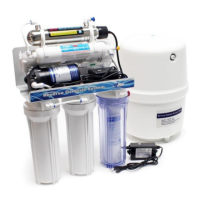
The Naturewater Reverse Osmosis (RO) System, encompassing models such as NW-RO50-C1/C1-1/G1/G1-1/A2UV/A1/NP35/H/E2/D1 and others (50808, 50809, 50915, 51078, 51079, 51080–51085, 51110, 51783), is designed to provide pure drinking water through a multi-stage filtration process. This automatic system leverages U.S. high-tech reverse osmosis technology to remove impurities, bacteria, and viruses, ensuring a high quality of water for consumption.
Function Description
The RO system operates through a series of filtration stages, typically five or six, to progressively purify raw water.
- First Stage (PPF cartridge): This stage removes suspended substances and particles larger than 5 microns, such as sand, silt, and rust.
- Second Stage (Granular activated carbon cartridge): Activated carbon adheres to and removes chlorine, organic fertilizers, agricultural chemicals, and insecticides, as well as odors.
- Third Stage (High density activated carbon cartridge): Similar to the second stage, this block carbon filter provides further refinement, removing remaining odors and chlorine.
- Fourth Stage (RO membrane): This is the core of the system, utilizing a high-pressure pump to force water through a reverse osmosis membrane with an aperture of only 0.0001 μ. This fine filtration effectively blocks super fine impurities, harmful soluble solids, bacteria, and viruses. The RO membrane can reduce bacteria size by 4000 times and filterable viruses by over 200 times. Contaminants are automatically flushed out via a waste water outlet. The purified water then enters a pressure tank for storage.
- Fifth Stage (Post positive bacteriostatic activated carbon filtration): When the user opens the goose-neck water tap, stored water passes through this stage, which adsorbs any remaining odor and taste, making the water delicious.
- Sixth Stage (UV light or Mineral ball filter): Depending on the model, this stage either uses UV light to kill bacteria and viruses or mineral balls to re-introduce beneficial minerals into the water.
The system features automatic control, stopping purification when raw water pressure is too low or the storage tank is full, and restarting when conditions normalize. This ensures continuous availability of purified water.
Important Technical Specifications
The Naturewater RO system offers varying capacities and performance characteristics:
- Purified water output: Models like RO-50-XX / RO-BX-XX produce 500 gpd (gallons per day) or 190 l/day at 25°C, while RO-400-XX models yield 400 gpd or 1500 l/day at 25°C.
- Tank capacity: Typically 3 gallons.
- Raw water temperature: Operates within a range of 4–42°C.
- Raw water pressure: Requires 1–3.5 bar (0.1–0.35 MPa). For systems without a pump, input water pressure should exceed 85 psi if a pressure tank is used.
- Clean water content relative to raw water: Achieves 15–20% clean water.
- Water supply: Designed for tap water or ground water with a Total Dissolved Solids (TDS) level of less than 1000 ppm.
- Power supply: Equipped with a transformer for single-phase 220 V power (check transformer voltage for specific requirements).
The system includes a micro-computer controller with a digital display for various operating states:
- Digit diode (1): Indicates control beeps ("E") or silent mode ("P"), switchable by pressing the "STRONG WASHING" button for 2 seconds.
- Digit diodes (2), (3), (4): Show the TDS value. During flushing, they display remaining seconds for rinsing.
- Digit diode (5): Shows the system's operating state (e.g., SUPPLY, FLUSH, FULL, WATER LACK, OVERHAUL).
- Button (6) "Strong Washing": Initiates a 30-second flush.
The controller also indicates:
- WASHING (1): System is flushing (30 seconds upon startup, after two hours of cleaning, or when manually initiated).
- SOURCE (5): System is producing pure water.
- FULL (2): Pressure tank is full, and the system stops.
- LACK (3): Water supply is low or pressure is insufficient, accompanied by a warning buzzer.
- CHECK (4): System has worked unusually long and stopped automatically, with a warning buzz, indicating maintenance mode.
The TDS value is a critical indicator, with a normal range of 10-20 ppm. An error message appears if TDS exceeds 100 ppm, indicating potential issues with filtration or installation.
Usage Features
The RO system is designed for user-friendly operation and installation, with flexible placement options:
- Installation: Can be installed on the countertop, under the countertop, or mounted on a wall using M6 swelling screws or concrete steel nails.
- Initial Setup: After installation, a crucial washing process is required. This involves turning on the water-tap tubing ball valve (B), turning off the tank valve (M), opening the goose-neck water-tap (Q), and opening the flush valve (L1). The high-pressure pump (H) will start, draining dirt water and washing the filters.
- First Use: After the initial washing, turn on the tank valve (M) and turn off the goose-neck water-tap (Q) to allow the RO membrane to purify water. For the first use, it is recommended to let the purified water flow out from a full tank twice before drinking. Black water may initially flow from the tap during the first drain, which should be allowed to clear. TDS readings may be high initially and will normalize after continued washing.
- Automatic Operation: Once set up, the system automatically produces purified water, filling the storage tank and stopping when full. Purified water is accessed by turning on the goose-neck water-tap.
- Hose Connections: Plastic hoses are connected using hexagon nuts or quick fittings. For quick fittings, simply insert the hose deeply. To disconnect, remove the small part, press the round part until it touches the main body, and pull the hose.
Maintenance Features
Regular maintenance, particularly filter replacement, is essential for optimal performance and water quality:
- Filter Replacement: It is highly recommended to replace filters periodically. The lifespan of filters depends on raw water quality and impurity levels.
- 1st, 2nd, 3rd stages (PPF, Activated Carbon, Block Carbon): Approximately 10 months.
- 4th stage (RO membrane): Approximately 2 years.
- 5th stage (In-line carbon): Approximately 1 year.
- 6th Stage (UV light): Approximately 1 year.
- 7th Stage (Mineral ball): Approximately 10 months.
- RO Membrane Rinsing: The RO membrane automatically washes itself. Manual flushing can be performed by turning on the flush valve (L1) for 2–3 minutes once a week to clean impurities and bacteria from the membrane surface.
- Warning for First Use: Do not drink the water from the first two tank contents after installation; drain or use for other purposes. Test the RO unit for about 2 hours to ensure normal operation and no leakage.
- System Care:
- Do not disassemble system parts to avoid damage or leakage.
- Do not use the system to purify hot water.
- Do not place air valves on the pressure tank.
- Ensure proper power supply voltage.
- Keep the RO unit away from direct sunlight.
- If not used for a long time, turn off power and shut off the ball valve.
- Follow initial operation steps before reusing after a long period of non-use.
- Troubleshooting: The manual provides a comprehensive troubleshooting guide for common issues such as pump non-operation, no water purification, lack of purified water outlet, continuous dirt water discharge, and low purified water volume. Solutions often involve checking pressure switches, valves, filter blockages, membrane condition, and air in the tank. High TDS values may indicate incorrect RO membrane installation, dirty TDS controller, or insufficient rinsing after reinstallation.


 To Next Page
 General