TG110DL User’s Manual
4 | P a g e NDT Systems, Inc. 5542 Buckingham Drive, Huntington Beach, CA 92649, PH: 714-893-2438
3. PRINCIPLE OF OPERATION
The TG110DL operates on a principle similar to sonar, but at much higher frequencies and electronic speeds.
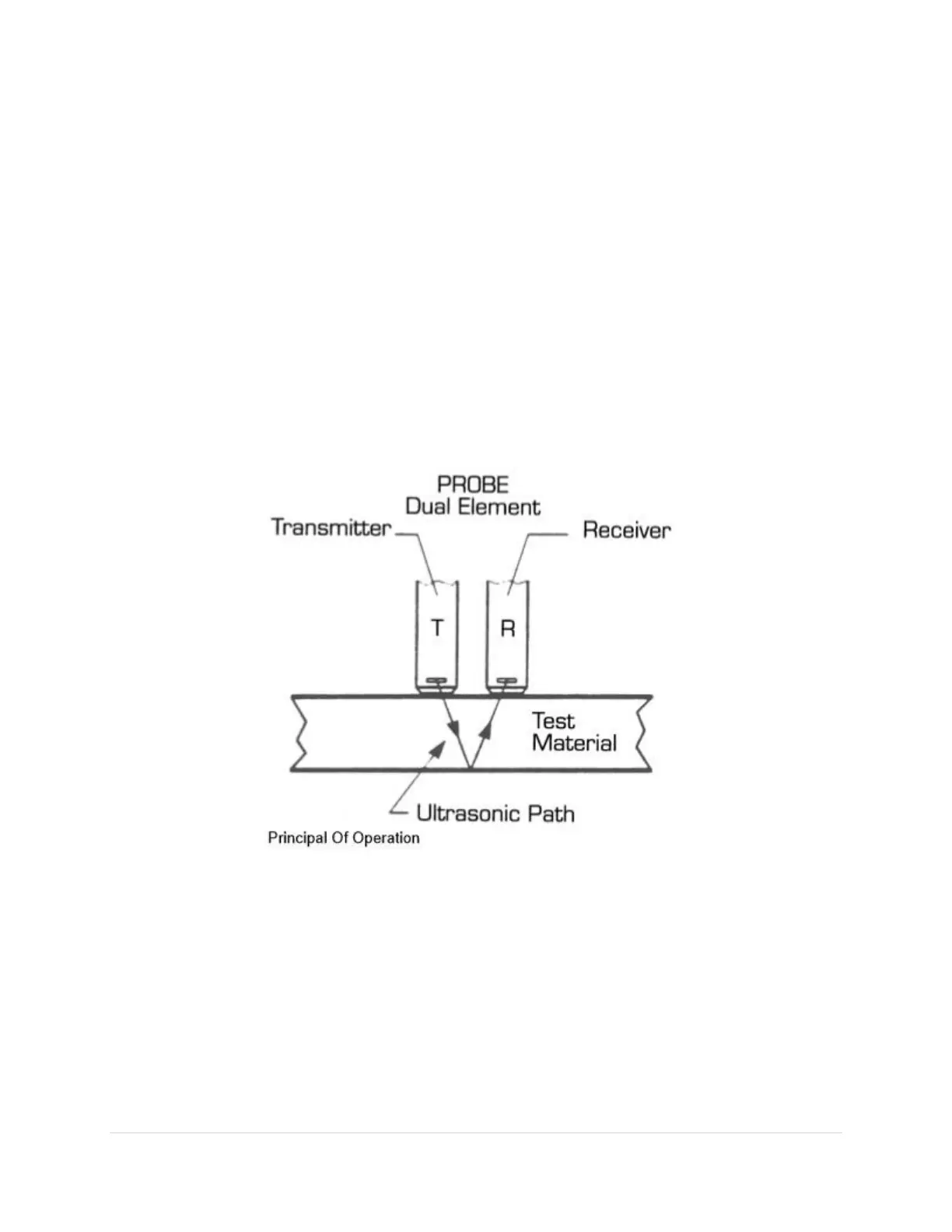
The figure below explains the ultrasonic pulse-echo principle that the TG110DL and its dual element probe
(transducer) employ. The probe's transmitter element (T) sends a short ultrasonic pulse into the material. The
pulse, reflected as an echo from the opposite, parallel surface of the material, subsequently returns to the probe's
receiver element (R).
The time it takes for the sound wave to travel from the transmitter to the back wall of the test material, and then
to the receiver is called the “round-trip time” or “Time of Flight” (ToF). The thickness of a test material is
determined by halving the round-trip time and multiplying the result by the material’s characteristic sound
velocity. Characteristic sound velocity differs in various materials, and may even differ in batches of the same
material. By precisely measuring roundtrip time and inputting the appropriate characteristic sound velocity, the
user of the TG110DL is able to gauge accurate and repeatable material thickness results. To find the appropriate
characteristic sound velocity for your application, please refer to the table of material velocities in this manual or
consult your test standard manufacturer.


 To Next Page