Need help?
Do you have a question about the New Holland T3.80F and is the answer not in the manual?
Guidance on the adjustment and maintenance of your new equipment for optimal performance and long service.
Illustrations may show shields removed; always replace shields before operating the machine to prevent injury.
Manual information is based on current data; changes may affect maintenance. Consult dealer for updates.
Tampering with the emissions-compliant engine is illegal and carries severe penalties including fines and legal action.
Tractor complies with European regulations; observe rules for add-on equipment to prevent interference and maintain warranty.
Table listing metric and imperial units and their corresponding symbols for various measurements.
Reference to pages 2-10 to 2-1 for essential safety precautions and advice before operating the tractor.
Instructions for the first 50-hour service, including dealer visits and completion of service report sheets.
Emphasis on using genuine parts for safety and warranty; prohibition of unauthorized modifications.
Warranty is valid if the tractor is used, adjusted, and maintained per manual instructions; invalid if not.
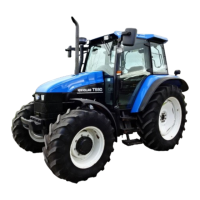
This document is an operator's manual for the New Holland T3.60F, T3.70F, and T3.80F series tractors, providing comprehensive information for their safe and efficient operation, maintenance, and troubleshooting. It is structured to guide the user through various aspects of the tractor, from general information and safety protocols to detailed operating instructions, maintenance schedules, and diagnostic procedures.
The manual begins with "General Information," which serves as an introduction to the tractor. It emphasizes the importance of reading the manual thoroughly to ensure optimal performance and longevity of the equipment. Users are advised to familiarize themselves with the tractor's features, operation, and maintenance requirements. The section highlights that the tractor is designed for normal and customary agricultural applications. It also provides a space for recording the tractor's model and product identification number (PIN), crucial for ordering parts and service. A prominent warning symbol is introduced, alerting operators to potential personal injury hazards and stressing the importance of obeying all safety messages to prevent serious injury or death. The manual clarifies that illustrations may show protective shielding open or removed for better clarity, but all shields must be replaced before operating the machine. It underscores that the machine is built to high-quality standards and complies with safety regulations, but adherence to elementary safety rules is still essential. The document advises against using the machine for purposes other than those described and recommends consulting a New Holland dealer for special attachments or modifications to ensure compliance with technical specifications and safety requirements. Any unapproved modifications are stated to invalidate the machine's initial conformity with safety requirements. Regular inspections, varying in frequency based on usage, are recommended, and operators are instructed to keep the manual in the operator's compartment, ensuring it is complete and in good condition. The manufacturer reserves the right to make improvements or changes to products without obligation to modify previously sold equipment.
The "General Information" section also includes an "Advice" subsection, detailing the tractor's compliance with European Regulations on electro-magnetic emissions. It warns that add-on equipment not meeting required standards could cause serious malfunction or unsafe situations. To prevent this, users must ensure all non-New Holland equipment fitted to the tractor bears the CE mark, and the emission power of any equipment (like radios or telephones) does not exceed national limits. The electro-magnetic field generated by add-on systems must not exceed 24 V/m near electronic components, as failure to comply will void the New Holland warranty. An "Abbreviation" table is provided, listing typical applications and their corresponding metric and imperial units, along with their symbols, for various measurements such such as area, electricity, force, frequency, length, mass, power, pressure, temperature, time, velocity, and volume. This table ensures clarity and consistency in terminology throughout the manual.
The manual then delves into "Safety Information," which is paramount for operating the tractor. This section covers personal safety, foreword, and a series of safety rules that span multiple pages, indicating the extensive nature of safety considerations. It includes specific safety rules related to warning indicators, alarms, instruments, and the tractor frame. A "Note to the Owner" within this section reiterates the importance of safety and provides information on "Safety signs SAFETY DECALS," which are crucial visual aids on the tractor itself. Basic instructions and further details on frame-related personal safety are also provided.
"Controls and Instruments" is the next major section, guiding the operator through the various interfaces of the tractor. It starts with the "Operator's seat," explaining how to adjust the pneumatically-adjusted operator seat and seat restraints for comfort and safety. The "Forward controls" subsection covers the electrical system (operating and control), external lighting control, mechanical transmission operation, and steering column control. "Left-hand side controls" details the console, differential lock control, four-wheel drive (4WD) system control, and creeper operation. "Right-hand side controls" describes the console, mechanical transmission operation, main lift system, differential lock mechanical control, and provides control identification for the right-hand console. "Rearward controls" focuses on external lighting localization. The "Display" subsection provides extensive information on the Analog-Digital Instrument Cluster (ADIC), detailing its programming and various functions across multiple pages. An additional "Instrument Cluster" subsection offers an overview of its localization.
"Operating Instructions" provides step-by-step guidance for starting and stopping the tractor. The "Starting the unit" part covers engine operation across three pages, followed by instructions on starting up and identifying the battery circuit breaker. The "Stopping the unit" part details brake and control operation, and engine stopping procedures.
"Transport Operations" is dedicated to preparing the tractor for road transport, including securing brakes and controls. It also covers "Recovery transport," specifically addressing towing procedures.
"Working Operations" focuses on the tractor's functional capabilities. It starts with the "One-speed rear Power Take-Off (PTO)," covering safety rules, turbocharger overview, personal safety related to PTO, PTO operating procedures (across multiple pages), PTO speed, and general specifications. The "Rear hitch" subsection details the main lift system control and three-point hitch control valve operation. "Remote control valves" explains their control. The "Rear three-point hitch linkage" covers its localization, top link arm adjustment, vertical rod adjustment, and stabilizer adjustment. The "Roll Over Protective Structure (ROPS) frame" section describes its adjustment. "Front wheels" and "Rear wheels" subsections provide general specifications for both. The "Wheels" section offers static descriptions and general specifications. Finally, "Ballasts and supports" covers static descriptions of ballasting, liquid ballasting, and weight.
"Maintenance" is a critical section for ensuring the tractor's longevity and reliable performance. It begins with "General information," including a foreword, fuel tank capacities, definitions, basic instructions, engine cooling system basic instructions, consumables, and hood basic instructions. "Maintenance planning" presents a maintenance chart. "Flexible Maintenance" details specific checks and adjustments for various components, such as clutch, brake pedals, alternator drive system belt, air cleaner, external lighting, hand brake lever, engine cooling system, radiator, wheels (tyre pressure and wheel disks nut torque), and intercooler cleaning. "WHEN THE WARNING LAMP LIGHTS" provides guidance on checking brake fluid reservoir and cleaning the air cleaner when warning lamps illuminate. The manual then outlines maintenance schedules: "EVERY 10 HOURS OR DAILY" for engine oil level checks, "EVERY 50 HOURS" for greasing the front axle system, and "EVERY 300 HOURS" for replacing fuel filters, cleaning the dry air filter, checking the alternator belt, battery capacity, greasing steering knuckle and king pin, checking front axle housing, and front axle reduction hubs. Further schedules include "EVERY 600 HOURS" for replacing transmission and hydraulic lift oil filters, checking transmission and hydraulic lift oil, adjusting the handbrake, and replacing engine lubrication system components. "EVERY 1200 HOURS" covers cleaning the dry air filter, fuel tank, and checking the drive shaft sleeve. "EVERY 1200 HOURS OR EVERY 2 YEARS" details changing fluids for the axle housing, wheel hub, transmission, and engine cooling system. "GENERAL MAINTENANCE" includes checking the battery, replacing main fuses and relay box, adjusting and replacing front headlight bulbs, cleaning the platform, cab, bodywork, and decals, and cleaning the air cleaner. Finally, a "Storage" subsection provides instructions for storing the tractor frame.
"Troubleshooting" helps operators diagnose and resolve issues. It is divided into "Fault code resolution," covering troubleshooting for the engine, electrical system, hydraulic systems, rear three-point hitch, and hydraulic service brakes. The "Alarm(s)" subsection provides troubleshooting for remote control valves, engine, electrical system (across two pages), rear three-point hitch, and hydraulic service brakes. "Symptom(s)" offers further troubleshooting guidance based on symptoms observed in the instrument cluster, including part identification and general specifications.
"Specifications" provides detailed technical information about the tractor. It includes dimensions of the frame, optional weight specifications for frames and ballasting, general specifications for the tractor, general specifications for wheels, and general specifications for electrical systems.
"Accessories" lists information about additional equipment. This section covers the localization of the beacon, operation of drawbars and towing hitches, general specifications for hitches, drawbars, and implement couplings, static description of trailer brake hydraulic control, and operation of trailer brake hydraulic control for dual-line and dual-line compatible with universal single-line trailers.
The manual concludes with "FORMS AND DECLARATIONS," which includes service record sheets for the first 50 hours, with separate copies for the owner and the dealer, ensuring proper documentation of initial service.
 General
| Engine Power | 80 hp |
|---|---|
| Cylinders | 4 |
| Displacement | 3.4 L |
| Transmission Type | Mechanical |
| Transmission Gears | 12 forward and 12 reverse |
| PTO Power | 65 hp |
| Engine Type | Diesel |
| Hydraulic Remotes | 2 |
| Hydraulic Pump Flow | 55 L/min |
| PTO Speed | 540/540E |


 To Next Page