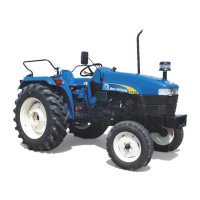
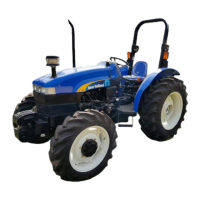
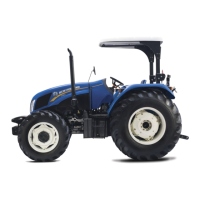
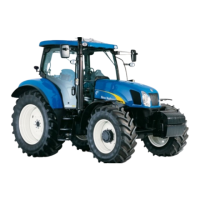
This document serves as an Operator's Manual for the New Holland TT55, TT65, and TT75 Tractor models, providing comprehensive guidance for their operation and maintenance. It is designed to assist operators in safely and efficiently utilizing these agricultural tractors.
Function Description
The New Holland TT55, TT65, and TT75 tractors are designed as self-propelled power units primarily for normal and customary agricultural applications. Their core function is to provide power and mobility for various farming tasks, ranging from tilling and planting to harvesting and transport. The manual emphasizes that these tractors are built for maximum performance, economy, and ease of operation across a wide spectrum of operating conditions.
Key functional components and systems covered include:
- Transmission: Details on transmission operation and available speeds are provided, crucial for adapting the tractor's power delivery to different tasks and terrains.
- Power Take-Off (PTO): This essential feature allows the tractor to power a wide range of PTO-driven implements. The manual outlines operating precautions, attachment procedures, and the use of protective caps and guards, ensuring safe and effective power transfer to external machinery. Both standard and ground speed PTO operations are discussed.
- Three-Point Linkage: This system is fundamental for attaching and controlling rear-mounted implements. The manual describes the linkage components, procedures for attaching 3-point implements, and the function of lift rods, lower links, and the top link.
- Hydraulic System: The hydraulic system is critical for controlling implements and providing auxiliary power. The manual details position control, draft control, mixed control, float operation, and the use of the Lift-O-Matic button and height limiter. Sensitivity and response control are also covered, allowing operators to fine-tune implement behavior. Remote control valves and auxiliary hydraulic valves are also described, highlighting the tractor's versatility in powering various hydraulic tools.
- Towing Attachments: The manual provides instructions for safe towing, emphasizing the use of appropriate hitch points and pins to prevent overturning.
Usage Features
The manual provides detailed instructions for operating the tractor safely and effectively.
- Commissioning and Starting: It covers the initial commissioning of the unit, including a running-in procedure for new tractors, and detailed steps for starting the engine, including jump-starting procedures.
- Stopping the Unit: Clear instructions are provided for safely stopping the engine.
- Road Transport: Guidance is given for transporting the tractor on public roads, including considerations for other vehicles, speed limits, and lighting adjustments. It also covers carrying the tractor on a transporter.
- Recovery Transport: Procedures for towing the tractor in case of breakdown are outlined.
- Working Operations: Specific sections address the use of the intercooler and turbocharger, essential for engine performance.
- Wheel Track Adjustment: Instructions for adjusting the front axle system, track rod, front and rear wheel track, and front wheel toe-in are provided. This feature allows operators to optimize the tractor's stability and maneuverability for different field conditions and implements.
- Ballasting and Tires: The manual explains how to select appropriate ballast for tires, including rear wheel weights, front weights, and liquid ballast. It also covers tire inflation and pressure, which are crucial for traction, stability, and fuel efficiency.
- Safety Information: A significant portion of the manual is dedicated to safety. It includes general safety rules, personal safety precautions, and specific safety guidelines for driving, operating, and servicing the tractor. Warnings about potential hazards, such as operating on slopes, using the PTO, and working with chemicals, are prominently featured. The importance of using handrails, keeping steps clear, and replacing damaged safety decals is stressed. Operators are advised against modifications without authorization and to ensure all guards are in place.
Maintenance Features
The manual provides a structured maintenance plan to ensure the tractor's longevity, reliability, and optimal performance.
- General Information: This section includes an introduction to maintenance, safety precautions during maintenance, and specific instructions for the first 50 hours of operation, including the first service. It also covers preventing system contamination, flexibility of maintenance intervals, and a lubrication and maintenance chart. Fueling the tractor, general specifications, fuel storage, and guards are also discussed.
- Maintenance Planning: A comprehensive maintenance chart outlines routine service tasks and their recommended intervals.
- Every 10 Hours of Operation or Daily: Daily checks include engine oil level, radiator coolant level, air pre-cleaner cleaning, hydrostatic steering oil level, fuel filter fluid drainage, and fuel-water separator filter cleaning.
- Every 50 Hours: This interval includes checking clutch pedal free play, adjusting brake pedals, checking the parking brake, inspecting wheel hubs, checking tire pressures and condition, adjusting the fan/alternator belt, greasing fittings, checking the battery, and inspecting the four-wheel drive (4WD) axle.
- Every 300 Hours: More extensive maintenance at this interval includes cleaning the air cleaner, replacing fuel filters, servicing the fuel feed pump filter, changing hydrostatic steering oil and filter, changing engine fluid and filter, checking transmission/hydraulics oil level, cleaning the hydraulic filter, and inspecting 4WD front axle reduction hubs, swivel bearings, drive shaft sleeve, and PTO clutch lever free play.
- Every 600 Hours: This interval requires replacing fuel filters, adjusting camshaft tappets, cleaning the transmission oil vapor breather, cleaning, re-greasing, and adjusting front wheel bearings, servicing fuel injectors, and adjusting front wheel toe-in.
- Every 1200 Hours: Major service tasks at this interval include changing transmission/hydraulics oil, changing the final drive oil, draining radiator fluid, changing steering oil reservoir fluid, checking 4WD front axle housing oil level, draining oil from the 4WD front axle final drives, and cleaning fuel tanks.
- General Maintenance: Additional maintenance tasks include bleeding the fuel injection system, adjusting engine idle speed, headlights, work lights, stop/turn/position lights, and canopy lights, replacing fuses, and maintaining electrical systems.
- Storage: Instructions for preparing the vehicle for storage are also provided.
The manual emphasizes the importance of using only Genuine New Holland replacement parts to maintain the tractor's design characteristics, safety, and warranty validity. It also advises against unauthorized modifications to the tractor.

 Need help?
 General

 To Next Page