
 Need help?
Do you have a question about the New Holland T6030 and is the answer not in the manual?
Introduction to the manual and tractor ownership.
Guidance on where to store the operator's manual.
Instructions for safely cleaning the tractor, especially with high pressure washers.
Overview of safety precautions to be observed for tractor operation.
Details about the initial service required after 50 hours of operation.
Information regarding the use of genuine New Holland replacement parts.
Explanation of the tractor's warranty terms and conditions.
Terms and conditions of the end user license agreement for the software.
Information on how to identify the tractor and its components.
Details on engine serial number and date code identification.
Details on driveline serial number identification.
Information on cab serial number and OECD certification.
Information on tractor and towed equipment weight limits.
Recommendations for environmentally sound use and disposal of substances.
Essential safety precautions for operating and servicing the tractor.
Key safety rules for tractor operation and maintenance.
Guidelines and precautions for safe tractor driving.
Procedures and safety measures for operating the tractor.
Safe operating procedures for the Power Take-Off (PTO).
General overview of lubrication and maintenance procedures.
Instructions for removing guards during maintenance.
A chart detailing lubrication and maintenance schedules.
Guidance on servicing the tractor when warning lights are illuminated.
Procedures for daily and 10-hour service intervals.
Procedures for 50-hour service intervals.
Procedures for 100-hour service intervals.
Procedures for 300-hour service intervals.
Procedures for 600-hour service intervals.
Procedures for 1200-hour or 12-month service intervals.
Procedures for 1200-hour or 24-month service intervals.
Procedures for 1800-hour service intervals.
Maintenance tasks to be performed every three years.
General maintenance tasks as needed.
Introduction to the fault finding section.
Troubleshooting common engine faults.
Fault finding for the 12x12 Synchro Command transmission.
Fault finding for the 24x24 Dual Command transmission.
Fault finding for the 16x16 Electro Command transmission.
Troubleshooting common hydraulic system faults.
Fault finding for the three-point lift system.
Troubleshooting common brake system faults.
Fault finding for cab related issues.
Troubleshooting common electrical system faults.
Information on the engine coolant immersion heater accessory.
Information on the transmission oil heater accessory.
Details about the 40 Amp socket and cable accessory.
Information on auxiliary headlights accessory.
Details about the battery isolator switch accessory.
Information on loader subframe and joystick control valve accessory.
Specifications for the tractor's general dimensions.
Specifications for the tractor's various weights.
Capacities for lubricants and fluids used in the tractor.
Engine specifications.
Specifications for the tractor's fuel system.
Specifications for the tractor's cooling system.
Details on available transmission options.
Brake system specifications.
Specifications for the rear power take-off.
Specifications for the front power take-off.
Steering system specifications.
Specifications for maximum operating angles.
Hydraulic system specifications.
Specifications for the rear three-point lift.
Specifications for remote control valves.
Specifications for the front power lift.
Specifications for front remote valves.
Specifications for electrical equipment.
Torque specifications for hardware.
Procedure for safely servicing the pressurized cooling system.
Safety guidelines for refuelling the tractor.
Importance of maintaining brakes and steering for safety.
Preventing fire or explosion hazards during servicing.
Warning against servicing the air conditioning system without expertise.
Requirement to stop the engine before performing any service.
Hazards associated with high-pressure hydraulic fluid and fuel.
Safe method for checking for leaks in fluid systems.
Procedure to relieve pressure before disconnecting lines.
Importance of tightening connections before pressurizing lines.
Medical attention advice for fluid injection into skin.
Warning against unauthorized modifications to the tractor.
Health risks associated with prolonged contact with used engine oil.
Importance of keeping equipment clean and maintained.
Proper disposal methods for drained fluids and filters.
Safety precautions for handling heavy tractor wheels.
Warning against mixing gasoline or alcohol with diesel fuel.
Precautions to take when refuelling the tractor.
Guidance on how to fill the fuel tank to allow for expansion.
Instructions for cleaning spills and securing the fuel tank cap.
Prohibition of using fuel for cleaning purposes.
Explanation of the operator protective structure's safety function.
Warning against modifying or repairing the protective structure.
Requirements for inspection and replacement after an accident.
Information on safety decal locations and their significance.
Instructions for keeping decals clean and legible.
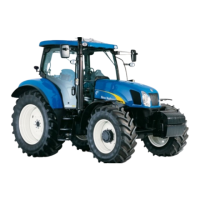
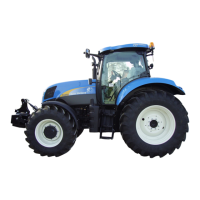
This document is an Operator's Manual for New Holland Delta and Plus Tractors, specifically models T6010, T6020, T6030, T6050, and T6070. It provides comprehensive information for the safe and efficient operation and maintenance of these agricultural tractors.
The New Holland Delta and Plus Tractors are designed for a wide range of agricultural applications. They are equipped with sophisticated electronic controls and various transmission options, including Synchro Command (12 x 12), Dual Command (24 x 24), and Electro Command (16 x 16). These tractors feature a robust engine, driveline, hydraulic system, and power take-off (PTO) capabilities, both rear and front, to power various implements. The three-point linkage system, quick hitch, and linkage stabilisers facilitate the attachment and control of implements. Remote control valves, including electro-hydraulic options, provide flexibility for operating hydraulic attachments. The tractors are also equipped with braking systems, including hydraulic and air-operated trailer brakes, to ensure safety when towing. Four-wheel drive (4WD) functionality enhances traction and braking performance, especially in challenging terrain.
The manual guides operators through the proper procedures for running-in, driving, and operating the tractor. It emphasizes safety precautions, starting with the importance of reading the manual thoroughly and ensuring only properly trained and qualified persons operate the tractor. When starting, the operator must be seated, apply the parking brake, place the PTO control in 'OFF', the lift control lever in the down position, and all transmission and remote control levers in neutral. The manual warns against bypassing neutral start switches and improper use of jump leads, which could lead to a tractor runaway.
Driving the tractor requires consideration for other road users, using a rotating beacon and/or Slow Moving Vehicle warning on public roads, and dipping lights at night. Operators are advised to reduce speed before turning or braking, and to apply both footbrakes simultaneously for emergency stops, ensuring they are locked together for road travel to activate trailer brakes and 4WD braking. The manual stresses maintaining the same gear when going downhill as when going uphill to avoid coasting. The differential lock should never be applied when turning. Operators must always check overhead clearance and drive carefully over rough ground, ditches, slopes, and when turning corners to prevent overturns. Extreme caution is advised on steep slopes, and if the tractor gets stuck or tires are frozen, reversing out is recommended to prevent overturning.
For PTO operation, the engine must be shut off, the PTO switched off, and the PTO allowed to stop completely before getting off the tractor or disconnecting equipment. Loose clothing should be avoided near rotating equipment. When operating stationary PTO-driven equipment, the parking brake must be applied, and rear wheels blocked. Cleaning, adjusting, or servicing PTO-driven equipment should only be done when the tractor engine is off and the PTO is switched off. The PTO guard must always be in position, and the PTO cap replaced when not in use.
The manual also covers the use of position control for attaching and transporting equipment, ensuring hydraulic couplers are properly mounted. For heavy implements, front-end or front-wheel weights should be installed to prevent the front end from rising. The clutch should be engaged slowly when driving out of ditches or up steep hillsides, and disengaged promptly if front wheels rise. Attached equipment and accessories must be correctly installed, approved for use, not overload the tractor, and maintained according to manufacturer instructions. Toxic spray chemicals require a protective mask, following chemical container directions.
The manual outlines a detailed maintenance schedule, including 10-hour/daily, 50-hour, 100-hour, 300-hour, 600-hour, 1200-hour/12 month, 1200-hour/24 month, 1800-hour, and every 3 years services, as well as general maintenance as required. It includes a lubrication and maintenance chart and specific instructions for servicing when warning lights illuminate.
Key maintenance safety points include:
The manual also provides guidance on fault finding for the engine, transmission, hydraulics, three-point lift, brakes, cab, and electrical system. It includes information on vehicle storage and accessories such as engine coolant immersion heater, transmission oil heater, 40 Amp socket and cable, auxiliary headlights, battery isolator switch, and loader subframe and control valve (joystick).
For fuel, the manual strictly prohibits adding gasoline, alcohol, or blended fuels to diesel fuel due to fire and explosive hazards. The fuel cap should never be removed, or the tractor refueled with the engine running or hot. Smoking near fuel is forbidden. The fuel tank should not be filled to capacity to allow for expansion, and spilled fuel must be wiped up immediately. The fuel tank cap must be securely tightened, and a lost cap replaced with an approved one. Fuel should not be used for cleaning.
The Operator Protective Structure (ROPS/FOPS) is a critical safety component. The manual states that no devices should be attached to it for pulling, and no holes should be drilled. Any damage, fire, corrosion, or modification will weaken the structure, and it MUST be replaced if compromised. After an accident, fire, tip, or roll-over, a qualified technician must inspect and replace the Protective Structure, mounting/suspension, operator seat, seat belts, and wiring within the protective system. Welding, drilling holes, attempting to straighten, or repairing the Protective Structure is strictly prohibited as it can reduce structural integrity and lead to serious injury or death.
 General
| Transmission | Semi-Powershift |
|---|---|
| Weight | 5, 600 kg |
| Wheelbase | 2, 656 mm |
| Engine Cylinders | 6 |
| Fuel Type | Diesel |
| PTO Power | 105 hp |
| Hydraulic Pump Flow | 113 L/min |
| Engine Type | Turbocharged |
| Cylinders | 6 |
| Displacement | 6.7 L |
| PTO Speed | 540/1000 RPM |
| Hydraulic Remotes | 3 |
| Fuel Capacity | 180 liters |
| Engine Model | NEF |
| Transmission Gears | 18 forward and 4 reverse |
| Fuel Tank Capacity | 180 liters |
| Rear Lift Capacity | 8, 818 lbs |
| Lift Capacity | 8, 818 lbs |
| Length | 4, 430 mm |
| Width | 2.13 m |







 To Next Page