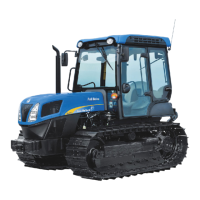
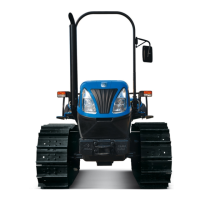
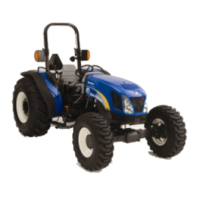
This document is an Operator's Manual for New Holland TK4020, TK4030, TK4040, TK4050, and TK4060 series tractors, specifically the 2nd edition in English, published in October 2010. It provides comprehensive information regarding the operation, maintenance, and safety of these agricultural machines.
Function Description:
The New Holland TK4020, TK4030, TK4040, TK4050, and TK4060 tractors are designed as power generators and drive-propulsion units primarily for agricultural use. Their core function is to power and propel themselves, and they are intended to load and move materials using a variety of buckets and forks. These tractors are built to provide maximum performance, economic running, and ease of use across a wide range of agricultural operations. They are capable of handling various allied attachments from other manufacturers, provided these are recommended and approved by New Holland. The manual emphasizes that any use other than agricultural is considered contrary to the specified use, and CNH America LLC will not be held liable for damages or injuries resulting from improper use.
Important Technical Specifications:
While specific detailed technical specifications like engine horsepower, dimensions, or weight are not explicitly listed on the provided pages, the manual highlights several key aspects related to the tractor's design and identification:
- Models Covered: TK4020, TK4030, TK4040, TK4050, TK4060. The "To the Owner" section specifically mentions TK4030V, TK4050, TK4050M, TK4060.
- Identification Data: The manual details the location of crucial identification plates:
- Frame and engine type identification (Fig. 1): Plate (1) on the right-hand side.
- Engine number and type identification data (MODEL TK4030V) (Fig. 2): Plate on the left-hand side of the engine near the hydraulic pumps.
- Engine number and type identification data (MODEL TK4050 TK4050M TK4060) (Fig. 2): Plate on the left-hand side of the engine.
- Frame number and type identification data (Fig. 3): Plate (1) on the right-hand side of the frame.
- Roll bar identification data (Fig. 3): Plate (1) on the right-hand side.
- Cab identification data (Fig. 3): Plate (1) on the left-hand upright inside the cab.
Users are instructed to record these serial numbers in the manual for future reference, especially for ordering parts or service.
- Emissions Compliance: The manual contains a "Proposition 65 Warning" for California, indicating that diesel engine exhaust and some constituents are known to cause cancer, birth defects, and other reproductive harm. It also warns that battery posts, terminals, and related accessories contain lead and lead compounds, advising users to wash hands after handling. A critical warning states that the engine and fuel circuit are designed to satisfy current regulations on emissions standards for pollutants, and tampering is strictly forbidden, leading to fines, reconditioning costs, invalidation of warranty, and potential confiscation.
- Electromagnetic Interference (EMC): The manual outlines rules for add-on equipment to prevent interference with the tractor's electronics. The maximum power of emission equipment (radio, telephones, etc.) must not exceed national limits, and the electro-magnetic field generated by add-on systems should not exceed 24 V/m at any time near electronic components. Add-on equipment must not interfere with on-board electronics; failure to comply voids the warranty.
Usage Features:
The manual provides detailed instructions for safe and effective operation:
- General Operation: Users are advised to read the manual carefully to understand the tractor's operation, adjustments, and maintenance. New Holland dealers provide instruction on general operation and factory-trained service technicians are available for questions.
- Safety Precautions: A significant portion of the manual is dedicated to safety. It introduces "DANGER," "WARNING," and "CAUTION" statements, color-coded (RED, ORANGE, YELLOW) to indicate the severity of potential hazards. Key safety instructions include:
- Always exercise caution to prevent accidents.
- Read the manual before any operation, maintenance, or refuelling.
- Read and follow all safety decals, replacing damaged or illegible ones.
- The tractor is exclusively for agricultural use; other uses require authorization.
- Keep a first aid kit on hand.
- Only responsible, trained, and authorized personnel should operate the tractor.
- Do not alter injection system calibration to increase engine speed.
- Do not wear loose clothing that may get trapped in moving parts.
- Check that all rotating parts connected to the power take-off are protected.
- Do not alter pressure relief valve calibration in hydraulic circuits.
- Avoid using the tractor in unsuitable physical conditions.
- Use provided steps and handles for entry/exit, keeping them clear of debris.
- Always operate with the roll bar correctly and securely fitted, checking for looseness or damage. Do not modify the roll bar.
- Starting the Tractor: Specific steps for starting are provided:
- Check that the handbrake is on, and gears and power take-off are disengaged, even with a start-up safety device. Never disconnect the safety switch.
- Ensure all attached implements are lowered to the ground.
- Check that all covers and guards (roll bar, bonnet, power take-off guard) are in position.
- Never start or maneuver the tractor unless seated in the driving position.
- Check that the area is free of persons or obstacles before moving.
- Never run the engine in a closed space without adequate ventilation due to harmful exhaust fumes.
- Environmental Considerations: The manual includes a section on "Ecology and the Environment," offering helpful hints for responsible use and disposal of chemical and petrochemical products:
- Understand and comply with relevant legislation.
- Obtain information from suppliers regarding the safe storage, use, and disposal of oils, filters, batteries, fuels, antifreeze, and cleaning agents.
- Avoid spillage during refuelling and draining fluids.
- Do not burn contaminated fuels or waste oils in ordinary heating systems.
- Store drained fluids safely for proper disposal.
- Replace modern coolant mixtures every two years and dispose of them safely.
- Do not open the air-conditioning system yourself; it contains gases that should not be released into the atmosphere.
- Repair leaks in engine cooling or hydraulic systems immediately.
- Do not increase pressure in pressurized circuits.
- Protect hoses during welding.
Maintenance Features:
The manual emphasizes the importance of routine maintenance for long service life and trouble-free operation.
- Pre-delivery Inspection: All machines are carefully inspected by the manufacturer and authorized dealer before delivery to ensure perfect condition.
- Routine Maintenance: Section 4 of the manual details routine maintenance operations and specified intervals.
- First 50-Hour Service: This critical initial service is to be performed by the dealer after the first 50 hours of use, including manufacturer's checks and certificate completion. Both the user and dealer must sign the service documentation.
- Service Parts: New Holland dealers carry genuine service parts, manufactured and inspected for high quality and accurate fitting. Users are advised to provide the model and PIN number when ordering parts.
- Warranty: The warranty is in accordance with current legislation and contractual agreements. However, it becomes invalid if the rules and instructions for use and maintenance described in the manual are not observed.
- Cleaning: Instructions for cleaning the tractor include avoiding directing water jets on electrical components, seals, or intake openings, and never directing cold water jets at a hot engine or exhaust.
- Improvements: CNH America LLC continually strives to improve its products and reserves the right to make improvements or changes without obligation to modify previously sold equipment.
- Unauthorized Modifications: Any arbitrary modifications to the machine will release CNH America LLC from liability. The manufacturer is not responsible for damage resulting from the use of "non-original" spare parts or components not approved by CNH America LLC. The warranty is also voided if such unapproved parts cause malfunction.

 Need help?
 General

 To Next Page