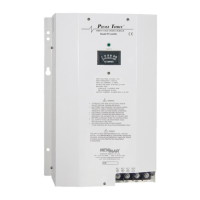
The document describes the Phase Three Three Stage Smart Charger, models PT-24-20U and PT-40U, an installation and operation manual. This battery charger is designed to provide optimal charging for various battery types, ensuring longevity and performance.
Function Description
The Phase Three Battery Charger employs a "smart" switching circuitry that implements a three-stage charge process: bulk, absorption, and float. This regimen is initiated each time AC power is applied, especially when batteries are significantly discharged.
- Bulk Charge: When batteries are significantly discharged, the charger delivers a high amount of DC current, at or near its maximum rated output, to rapidly replenish them. This stage maintains a high charging current as battery voltage increases, continuing until the battery reaches about 75-80% of its capacity. A current limiting circuit prevents charger overload during this maximum output stage.
- Absorption Charge: In this second stage, battery voltage is maintained at a "charge" voltage level. Output current tapers off as the battery plates become saturated. This stage continues until the current sensing circuit detects that output current has tapered to about 5-15% of the charger's rating, at which point batteries are approximately 95% full. This phase can also be ended by a time-out circuit.
- Float Charge: For extended battery life and to prevent overcharging, the charger automatically switches to a lower float voltage level. This stage keeps batteries at peak condition without overcharging, allowing the charger to be left connected for months without attention.
The charger is equipped with a Gel-Cell/Lead-Acid Selector Switch to adapt its charge and float voltages based on the battery type (gel-cell or lead-acid/AGM). Gel-cell batteries typically require a slightly lower charge voltage to prevent electrolyte loss or damage. The charger is factory-set for Lead-Acid/AGM batteries.
An optional Temperature Compensation Sensor (TCS-12/24) fine-tunes the output voltage based on the battery's ambient temperature. This is crucial because low temperatures increase charging resistance, while high temperatures reduce impedance, requiring a lower charge voltage. The sensor adjusts the output voltage at approximately -3mV per cell per °C, preventing overcharging in hot environments and undercharging in cool ones. This option is strongly recommended for sealed, valve-regulated, or gel-cell batteries.
The charger can also operate as a DC Power Supply (stand-alone DC Power Source). Unlike many battery chargers, the Phase Three charger produces an extremely well-filtered DC output, making it suitable for powering most DC electronic devices directly, even without a battery attached. Its current limiting circuitry handles high start-up surges associated with inductive loads.
Usage Features
The Phase Three charger is designed for continuous duty, capable of delivering its full rated output continuously, 24 hours a day, seven days a week. It is built with rugged stainless steel and aluminum, powder-coated, and features marinized internal circuitry. An optional dripshield is provided for extra protection against moisture.
Multiple Output Banks: The charger features multiple output banks that charge independently based on demand, allowing for efficient charging of several battery banks simultaneously.
Universal AC Input: The charger accepts a wide AC voltage range of 90-264 VAC, 47-63 Hz, making it suitable for use anywhere in the world.
Current Limiting: This feature prevents damage to the charger in case of overloading and protects against high current demands, such as during engine cranking.
Thermally Controlled Cooling Fan: Two integral cooling fans draw air through the bottom and expel it out the top, allowing for continuous operation at full-rated output while maintaining proper operating temperature. The fans also reduce the possibility of drawing in water drops.
High Charge Voltage Time-Out Circuit: To prevent overcharging and electrolyte loss during continuous high amperage demand, a special time-out circuit forces the charger into float mode after a pre-set interval (approximately 8-10 hours at factory setting). If current demand falls below 5-15% of capacity before the time-out, the charger automatically switches to float mode. If demand rises, it returns to the absorption phase until the time-out.
Output Ammeter: A front panel ammeter indicates the total charging output current for all connected battery banks.
Power-On Indicator: A green LED glows when the charger is receiving AC power.
Optional Remote Monitor Panel (for 12-volt models, PT-40U only): The EVM-12-2 remote monitor allows users to monitor the charger's "on" status and the state of readiness of up to two battery banks. Red, yellow, and green bar LEDs indicate the battery's state of charge, while a green "Charger On" LED illuminates when AC power is connected. Flashing red bars indicate high or low voltage. The display has a sleep mode to conserve power, with periodic flashing indications of battery voltage, and automatically comes out of sleep mode to alert the operator if battery voltage drops to a critical level.
Maintenance Features
Robust Construction: The charger is constructed with materials highly resistive to corrosive effects of moisture, though it is not waterproof.
Fuse Protection: The AC input is protected by an internal fuse, which is not user-replaceable and requires a qualified service person for replacement. Internal DC wiring is protected by internal DC output fuses. If these fuses blow, it may indicate a reverse polarity hook-up or an internal short. Always disconnect AC before checking fuses.
Battery Care Tips: The manual emphasizes the importance of regular maintenance for batteries, including monthly checks of electrolyte level for wet lead-acid batteries and ensuring proper load sizing. It recommends leaving the charger connected continuously to the AC distribution system to maintain batteries at peak voltage and compensate for natural self-discharge, preventing repeated deep discharges that shorten battery life.
Cleaning Batteries: Dirt and electrolyte salts can accumulate on battery tops, causing discharge. It is recommended to disconnect battery cables at least twice a year and scrub the battery with a baking soda solution, rinse with fresh water, and dry with a clean cloth. Terminal post corrosion prevention rings and occasional light silicone lubricant are also suggested.
Routine Checks and Maintenance: Batteries should be periodically "exercised" (slowly discharged and then recharged) to maintain top condition. For non-sealed batteries, distilled water should be added to cover plates by about 1/2", avoiding overfilling. Only distilled water should be used to prevent altering electrolyte properties or creating insulating coatings on battery plates.
Troubleshooting Guide: The manual includes a troubleshooting section to address common issues such as batteries not reaching full charge, continuous high current draw, charger not charging, repeatedly blown fuses, and reverse polarity connections, providing possible causes and solutions.


 To Next Page
 General