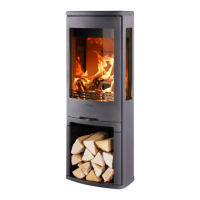
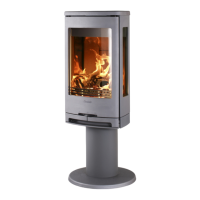
This document provides installation and operating instructions for the Handöl 24 wood-burning stove, manufactured by NIBE AB/NIBE Brasvärme. The manual, identified as 511295 IAV SE/EX 0542-2, covers installation procedures for various flue connections and includes important safety information and technical specifications.
Function Description
The Handöl 24 is a wood-burning stove designed for heating residential spaces. It operates by burning wood logs to generate heat, which is then radiated into the room. The stove is designed to be an efficient and environmentally friendly heat source, incorporating advanced combustion technology. It can be connected to a chimney via either a rear flue connection or a top flue connection, with options for through-the-ceiling or high-level elbow-joint connections. The stove requires an external air supply for proper combustion, which can be provided directly from outdoors or indirectly through a vent in an external wall. Optional accessories include a floor-plate, soapstone mantelshelf, cast-iron/aluminium mantelshelf, and flexible tubing for combustion air. The design emphasizes lasting quality and enduring aesthetics.
Important Technical Specifications
- Heat Output: 3-9 kW
- Nominal Output: 6 kW (approximately 1.8 kg logs/hr)
- Combustion Efficiency: Up to 80%
- Weight (low model): 150 kg
- Width: 600 mm
- Depth: 455 mm
- Height (low model): 1500 mm
- Connecting Sleeve External Diameter: Ø150 mm
- Chimney Requirements:
- Must withstand flue gas temperatures of at least 350 °C.
- Draught must produce a negative pressure of at least 12 Pa.
- Shortest recommended chimney length: 3.5 metres.
- Cross-sectional area: 150-200 cm² (140-160 mm diameter).
- Maximum horizontal flue length: 1.0 metre (provided vertical flue is at least 5.0 metres).
- Air Supply Duct: External diameter of connecting collar on fire-box is 64 mm. For ducts longer than 1.0 metre, pipe diameter must be increased to 100 mm. Insulation with 30 mm mineral wool and a moisture seal is required for ducts passing through heated spaces.
- Installation Distances (to combustible materials):
- Combustible Wall (Rear Flue): Minimum 760 mm from back of stove.
- Combustible Wall (Top Flue): Minimum 890 mm from back of stove.
- Fire-retardant Wall (Rear Flue): Minimum 300 mm from back of stove (50 mm from side).
- Fire-retardant Wall (Top Flue): Minimum 300 mm from back of stove (50 mm from side).
- Combustible Ceiling (Top Flue): Minimum 2200 mm from floor to top flue connection.
- Floor-plate: Must extend at least 300 mm in front of the stove and 100 mm along each side if the floor is combustible.
- Type Approvals:
- European standard EN-13240 class 1
- Swedish environmental and quality marking, "P mark" cert. no. 22 03 12
- Norwegian standard NS 3059, cert. no. xxx-xxx
- German standard DIN 18.891, RO-xx xx XXX
- Danish standard 887-1, ID no. xxx
Usage Features
- Combustion Control: The stove is equipped with an air supply control mechanism to regulate the burning process.
- Ash-pan: A dedicated ash-pan facilitates the removal of ash, contributing to easier cleaning and maintenance.
- Log Guard: A log guard is integrated to prevent logs from rolling out of the fire-box.
- Mantelshelf Options: Users can choose between a soapstone mantelshelf or a cast-iron/aluminium mantelshelf, both available as optional accessories, to customize the stove's appearance and functionality.
- Telescopic Chimney Mantle: This feature allows for flexible installation, adapting to different ceiling heights and flue connection types.
- Extension Mantle: For rooms with very high ceilings, an extension mantle can be installed to ensure the chimney system reaches the ceiling.
Maintenance Features
- Smoke Baffle Removal: For soot cleaning, the smoke baffle can be easily lifted and moved to one side, simplifying access to the chimney interior.
- Accessible Soot Hatches: The chimney design ensures that soot hatches are easily accessible for regular cleaning by a chimney sweep.
- Sealing Rope and Heat-resistant Sealant: These materials are used to ensure tight seals at flue connections, preventing smoke leakage and maintaining combustion efficiency.
- Adjustable Mantelshelf Screws: Both soapstone and cast-iron/aluminium mantelshelves feature adjustable screws to ensure they lie flush against the stove hood, allowing for precise fitting and stability.
- Insulation and Retaining Plates: The design incorporates insulation and retaining plates for the flue system, which can be accessed and adjusted during installation and potentially for maintenance.
The manual strongly emphasizes the importance of consulting local authorities and qualified inspectors before and during installation to ensure compliance with safety regulations and building codes. It also advises informing the local chimney sweep about the installation to establish routines for regular chimney-sweeping services. Users are instructed to read the separate "Lighting and Operating Instructions" carefully before using the stove for the first time.

 Need help?
 General

 To Next Page