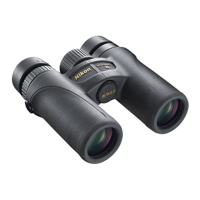
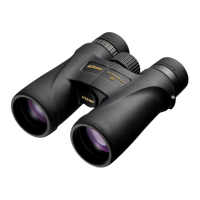
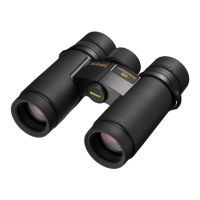
This document provides comprehensive instructions for the Nikon Monarch 7 binoculars, available in 8x42 and 10x42 models. It covers nomenclature, usage, safety precautions, operation, and maintenance, ensuring users can properly handle and care for their device.
Function Description
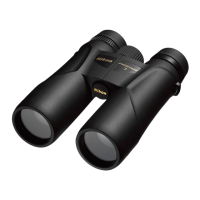
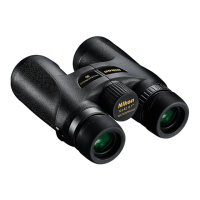
The Nikon Monarch 7 binoculars are designed for observing distant subjects, providing clear and magnified views. They feature a Dach prism central focusing type, allowing for precise focus adjustment. The binoculars are waterproof, capable of being submerged up to 1 meter for 10 minutes without damage to the optical system. This waterproof design, combined with nitrogen filling, makes them resistant to condensation and mold, allowing for use in high humidity, dusty, and rainy conditions.
Usage Features
Nomenclature:
The binoculars consist of several key components:
- Eyecup (1): Adjustable for comfortable viewing with or without eyeglasses.
- Neck strap eyelet (2): For attaching the neck strap.
- Focusing ring (3): Used to adjust the focus for sharp images.
- Objective lens (4): The front lenses that gather light from the subject.
- Interpupillary distance (5): The adjustable distance between the two eyepiece tubes to match the user's eye separation.
- Dioptre ring (6): Used for fine-tuning focus to balance vision between the left and right eyes.
- Dioptre index (7): A marker for the dioptre setting.
- 0 (zero) dioptre position (8): The neutral dioptre setting.
- Central shaft (9): The main body connecting the two optical tubes.
Eyecups:
Eyecups can be adjusted by turning them.
- For eyeglass wearers: Use fully retracted. Two click stops before full retraction can also be used for accurate adjustment.
- For non-eyeglass wearers: Use fully extended. Two click stops before full extension can also be used for accurate adjustment.
Neck Strap and Caps:
- Neck Strap: Attach the neck strap to the eyelets (2) as illustrated in image (A), ensuring it is not twisted.
- Objective Lens Caps: Attach the objective lens caps (B) so that the hinge opens downward from the binocular tube when folded open. The slit on each binocular tube should be visible from the eyepiece side to confirm correct positioning.
- Eyepiece Cap: The eyepiece cap can be positioned in two ways during observation:
- Remove it from the eyepieces and let it hang from the neck strap.
- Remove it from the eyepieces, then detach the right strap from the cap and allow it to hang from the left neck strap (C).
- Attaching/Detaching Caps from Neck Strap (D):
- Attaching: c → b → a
- Detaching: a → b → c
- Flipdown Objective Lens Caps: The binoculars are used with the objective lens caps folded open (C).
Operation (Adjusting Interpupillary Distance and Diopter Adjustment):
- Adjusting Interpupillary Distance: Match the distance between the right and left eyepiece tubes to your interpupillary distance by moving the tubes closer or farther apart until the two circular viewfields merge into one.
- Diopter Adjustment (Balancing Right and Left Eyesight):
- For central focusing binoculars with the diopter adjustment ring on the right eyepiece:
- Rotate the focusing ring until the subject in the left eyepiece is sharp.
- Rotate the diopter adjustment ring of the right eyepiece until the same subject in the right eyepiece is sharp.
- Check focusing on both eyes.
- When viewing a different subject, adjust the focusing ring until a sharp image is obtained.
- For binoculars with the diopter adjustment ring on the left eyepiece (some zoom models):
- Set the zoom lever at the maximum magnification.
- Rotate the focusing ring until the subject in the right eyepiece is sharp.
- Rotate the diopter adjustment ring of the left eyepiece until the same subject in the left eyepiece is sharp.
- Check focusing on both eyes.
- When viewing a different subject, adjust the focusing ring until a sharp image is obtained.
- For individual focusing binoculars: Focus right and left eyes separately. When the subject changes, focus with both eyes separately. Diopter adjustment is generally unnecessary for these models.
- Note for zoom binoculars: When viewing at different magnifications, first adjust focus at a higher magnification to minimize blurring when changing magnification. If focusing is adjusted at low magnification and then magnification is increased, serious image blurring may occur.
- Remember the diopter index position once correctly adjusted for easier future adjustments.
- To focus on a nearby subject, rotate the diopter adjustment ring or focusing ring counterclockwise; for a distant subject, rotate clockwise.
Safety Precautions:
- WARNING: Never look directly at the sun with the binoculars, as this can cause serious eye damage (Fig. 1).
- CAUTION:
- Do not leave binoculars in unstable places where they might fall and cause injury.
- Do not look through binoculars while walking to avoid accidents (Fig. 2).
- Do not swing binoculars by their straps, as they might hit someone (Fig. 3).
- Prolonged use of rubber eyecups may cause skin inflammation; discontinue use and consult a doctor if symptoms appear.
- Be careful not to pinch fingers when adjusting interpupillary distance or diopter, especially with children (Fig. 4).
- Keep polyethylene packaging bags away from small children to prevent suffocation (Fig. 5).
- Ensure small children do not swallow caps or eyecups; consult a doctor immediately if this occurs.
- Do not disassemble the binoculars; repairs should be performed by a Nikon-authorized service representative (Fig. 6).
Operation Precautions:
- Do not open the right and left binocular tubes beyond their limits, and avoid rotating the diopter ring, focusing ring, and zoom lever beyond their limits (Fig. 7).
- Avoid rain, water splashes, sand, and mud (Fig. 8). While waterproof models can withstand some exposure, wipe off any water as soon as possible.
- Protect binoculars from shock. If a normal image cannot be obtained after dropping or getting wet, take them to a Nikon-authorized service representative (Fig. 9).
- If exposed to sudden temperature changes, condensation may form on lens surfaces. Dry thoroughly at room temperature.
Maintenance Features
Storage:
- To prevent water condensation or mold due to high humidity, store binoculars in a cool, dry place. After use in rainy or humid conditions, thoroughly dry them at room temperature before storage.
- For long-term storage, keep binoculars in a plastic bag or airtight container with a desiccant. If not possible, store them in a clean, well-ventilated place, separate from the case, as they are easily affected by moisture (Fig. 10).
- Do not leave binoculars in a hot car or near heat-generating equipment, as this can cause damage (Fig. 11).
Maintenance & Storage:
- Remove dust from the focusing unit, diopter adjustment unit, or other rotating parts with a soft brush (Fig. 12).
- After removing dust with a blower, clean the body surface with a soft, clean cloth. After seaside use, lightly wipe the body with a soft, clean cloth dampened with water to remove salt, then dry with a dry cloth. Do not use benzene, thinner, or other organic solvents (Fig. 13).
- For dust on lens surfaces, use a soft, oil-free brush.
- To remove stains or smudges like fingerprints from lens surfaces, gently wipe with a soft, clean cotton cloth. Use a small amount of pure alcohol (ethanol) or lens cleaner, wiping from the center of the lens outwards in a circular motion. Avoid using anything hard that could scratch the lens surface (Fig. 14).
- Specifications and design are subject to change without notice.
- No reproduction of this manual, in whole or in part, is permitted without written authorization from NIKON VISION CO., LTD.

 Need help?
 General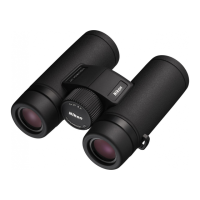



 To Next Page