
 Need help?
Do you have a question about the Nintendo TETRIS and is the answer not in the manual?
Explains basic movement controls for blocks and game selection.
Explains how to select game and music types before starting.
Details the objective and gameplay of the endurance mode.
Details the objective and gameplay of the 25-line challenge mode.
Explains bonus scoring for B-TYPE games and provides a score table.
Details the 90-day warranty, service procedures, and limitations.
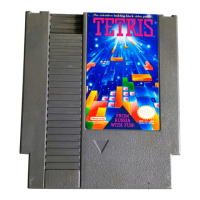
This document is an instruction booklet for the Nintendo Entertainment System (NES) game, Tetris. It provides comprehensive information on how to play the game, understand its mechanics, and utilize the controller effectively.
Tetris is a puzzle game where the primary objective is to manipulate falling blocks of various shapes to form complete horizontal lines. When a line is completely filled with blocks and has no gaps, it disappears, and the player earns points. The game continues as long as the blocks do not pile up to the top of the game field. If the blocks reach the top, the game ends. The game is designed to test reflexes and strategic thinking, offering a simple yet highly addictive gameplay experience.
The game's name, Tetris, is derived from the Greek word "tetra," meaning four, as all the game pieces are composed of four squares. There are seven distinct shapes, each formed by rearranging four squares.
The instruction booklet details two main game types:
Endurance Game A: This mode is a test of endurance, where players aim to achieve the highest possible score by completing as many lines as they can. Players can select the initial falling speed of the blocks (LEVEL) on the A-TYPE LEVEL setting screen. A higher LEVEL means faster falling blocks. As the game progresses, the LEVEL gradually increases, making the game progressively more challenging. The game ends when the blocks reach the top of the game field.
Game B: In this mode, the objective is to complete 25 lines. Players can set both the LEVEL (falling speed) and HEIGHT (initial height of random blocks at the bottom of the game field) on the B-TYPE LEVEL setting screen. A higher HEIGHT setting means the random blocks are placed higher up from the bottom. Unlike Game A, the game level in Game B does not change during play. The game ends if blocks reach the top of the game field.
The game utilizes the NES Controller 1, with specific buttons assigned for various actions:
Control Pad (Directional Pad):
A Button: Rotates the falling block 90 degrees clockwise each time it is pressed.
B Button: Rotates the falling block 90 degrees counter-clockwise each time it is pressed.
SELECT Button:
START Button:
The game screen provides several key pieces of information:
For experienced players, a "high-speed mode" can be activated. By holding down the A button and pressing START on the LEVEL setting screen, the falling speed of blocks will be the preset LEVEL + 10, offering a much faster and more challenging experience.
The instruction booklet includes important precautions for handling the Tetris Game Pak:
The manual also states that Nintendo Entertainment System specifications and design are subject to change without notice, in the interest of product improvement. It also contains a 90-day limited warranty and information regarding compliance with FCC regulations.
 General
| Platform | Game Boy |
|---|---|
| Genre | Puzzle |
| Publisher | Nintendo |
| Release date | June 14, 1989 |
| Mode | Single-player, multiplayer |
| Media | Game Boy cartridge |







 To Next Page