Need help?
Do you have a question about the NKT Photonics Koheras BASIK and is the answer not in the manual?
Presents the purpose of the manual and important safety warnings concerning the Koheras BASIK laser module.
Details the Koheras BASIK as a single frequency DFB fiber laser system and its applications.
Covers basic operation, organizational measures, personnel qualifications, and safety instructions for safe laser usage.
Details physical hazards, personnel safety, constructive safety features, and general safety aspects related to laser operation.
Lists safety compliance standards including CE, FDA, UL, and CSA approvals.
Describes safety labels, their meaning, types (Classification, Laser, Specification, Item, Aperture), and positions on the Koheras BASIK unit.
Specifies room and operation conditions required for Koheras BASIK, including compliance with laser safety regulations.
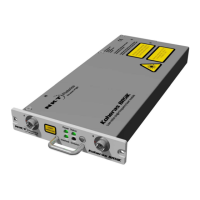
Details the components and functions of the front panel, including optical outputs, LEDs, and mounting holes.
Describes the rear panel elements such as electrical interface, heat transfer surface, and mounting holes.
Explains the Variable Optical Attenuator (VOA) option for adjusting output power and relevant part numbers.
Details the optional optical monitor output, its typical power level, and its relation to the VOA option.
Describes how wavelength is controlled by temperature changes and mentions substrate types and register usage.
Covers external/internal signals, modulation frequency, amplitude, waveform, coupling, and locking to an external cavity.
Explains amplitude modulation using input signals or internal generator, including modulation mode, frequency, level, and waveform.
Discusses operating modes (Current vs. Power) and their impact on performance for different Koheras BASIK variants.
Details the trigger logic input/output signal for initiating or indicating laser emission, including voltage levels and configuration.
Explains the Auto-Start feature for automatic emission upon power-up.
Describes the emission delay, shutdown delay, and high temperature shutdown mechanisms.
Covers automatic shutdown due to high temperature.
Details automatic shutdown based on monitored output power drop relative to pump current.
Details the interface board, its connectors (DIN 41612, USB, Interbus), LEDs, and power options.
Describes Extra I/O connections, Wavelength Modulation (CONN2), and Amplitude Modulation (CONN3) connectors and their pin functions.
Details recommended methods for mounting the Koheras BASIK module, including heat sink connection and screw usage.
Highlights essential precautions during system operation, including laser aperture control and connector cleanliness.
Provides a step-by-step procedure for powering on the Koheras BASIK module and verifying stable laser operation.
Provides detailed dimensional drawings and measurements for the Koheras BASIK module.
Details the dimensions of the Koheras BASIK module when used with an adaptor board.
 General
| Linewidth | <1 kHz |
|---|---|
| Polarization | Linear |
| Polarization Maintaining Fiber (PMF) | Yes |
| Polarization Extinction Ratio | >20 dB |
| Stability | <1 pm over 8 hours |
| Storage Temperature | -20°C to 60°C |

 To Next Page