
 Need help?
Do you have a question about the Nokia 230 Dual SIM and is the answer not in the manual?
Turn off device in prohibited zones like aircraft and hospitals.
Prioritize safe driving and obey local traffic laws.
Be aware of potential interference from wireless devices.
Only authorized personnel should perform repairs.
Use only approved accessories for the device.
Ensure the device stays dry as it is not water-resistant.
Avoid high volumes to prevent hearing damage.
Identifies physical buttons and components with a diagram.
Step-by-step guide for hardware installation.
Configure which SIM is active for calls, messages, and data.
Set up call forwarding between dual SIM cards.
Learn to access menus, apps, and return to the home screen.
Instructions to toggle the device's LED flashlight.
Adjust audio levels for calls, media, and notifications.
Customize the home screen background image.
Assign custom ringtones for different SIM cards or contacts.
Learn efficient typing, predictive text, and special character entry.
Access the internet for information and online services.
Guide to initiating, receiving, and ending phone calls.
Method to store and organize phone numbers and names.
Instructions for composing and managing text messages.
Capture moments with the camera, zoom, use flash, and view images.
Shoot videos, start/stop recording, and watch video clips.
Playing MP3 files from a memory card.
Tuning into FM radio stations with a headset.
Watching video files stored on the device or memory card.
Configuring the phone as an alarm clock.
Adding events and setting up timely reminders.
Manually adjusting the phone's clock settings.
Transferring files wirelessly using Bluetooth.
Moving data between the phone and a PC.
Deleting personal data before disposal or transfer.
SIM card security codes for access and unblocking.
Phone's lock code for unauthorized access prevention.
Unique identifier for network and service purposes.
How to find model and IMEI for service and identification.
Information on network requirements and potential data charges.
Procedures and precautions for making emergency calls.
Guidelines for proper handling, cleaning, and upkeep.
Proper disposal and recycling of electronic products and batteries.
Critical safety precautions for device power accessories.
Precautions regarding potential interference with medical implants.
Warnings about headset use and potential hearing damage.
Safeguarding against malware and untrusted online content.
Guidelines for safe installation and use of the device in vehicles.
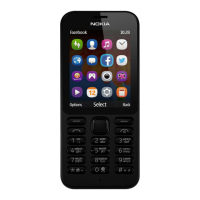
This document describes the Nokia 230 Dual SIM, a mobile phone designed for basic communication, entertainment, and personal organization. It emphasizes user safety, ease of use, and practical features for everyday mobile phone operation.
The Nokia 230 Dual SIM is a feature phone that supports GSM 900 and 1800 MHz networks, allowing users to make calls, send messages, and browse the web. Its dual SIM capability enables the use of two SIM cards simultaneously, offering flexibility for managing calls, messages, and mobile data across different networks or plans. The device includes a camera for taking photos and recording videos, an FM radio, and a music player for entertainment. It also features an alarm clock and calendar for personal organization.
Getting Started: The phone's basic setup involves inserting the SIM cards, a memory card (for storing media), and the battery. Users are guided to slide the back cover lock, lift the cover, insert the battery, open the SIM holder to place SIM cards face down, and then slide in the memory card. The device is designed to be used with standard SIM cards only, and incompatible cards may cause damage. It is recommended to use compatible memory cards approved for the device. The phone is partially charged at the factory, but users may need to recharge it before initial use by plugging the charger into a wall outlet and then connecting it to the phone. USB charging is also an option when a wall outlet is unavailable, allowing data transfer while charging.
Keypad Lock: To prevent accidental key presses, the keypad can be locked by quickly pressing the end key and selecting "Lock." To unlock, press the end key again and select "Unlock."
SIM Card Management: For dual SIM users, the phone allows selection of which SIM card to use for calls, messages, and mobile data. This is configured through the "Dual SIM settings" menu. The "Smart Dual SIM" feature enables call forwarding between the two SIMs, ensuring calls are managed seamlessly even when one SIM is busy or out of reach.
Navigation and Interface: The phone's interface is navigated using a scroll key (up, down, left, right) to access apps and features from the main menu. The selection keys are used to choose options, and the end/power key is used to go back to the home screen or power off the device.
Flashlight: A built-in flashlight can be switched on by quickly scrolling up twice on the home screen and switched off by scrolling up once. Users are advised not to shine the light directly into anyone's eyes.
Volume Control: The device's volume can be adjusted by scrolling up or down during a call or while listening to the radio, allowing users to customize the sound level to their preference in various environments.
Personalization: Users can change the background wallpaper of their home screen through the "Display settings" menu. Ringtones can also be customized, with the option to set different ringtones for each SIM card.
Text Input: Text entry is done using the keypad, where keys are pressed repeatedly to cycle through letters. A space is entered by pressing '0', and special characters or punctuation marks by pressing '*'. Character cases can be switched by repeatedly pressing '#'. Predictive text, based on a built-in dictionary, can speed up typing, and users can add new words to the dictionary or switch between predictive and traditional text input.
Web Browsing: The phone allows users to browse the internet via the "Internet" menu. To avoid data costs, users can switch off the mobile data connection.
Calling and Messaging: Making a call involves typing the number and pressing the call key. Answering a call is done by pressing the call key. The phone supports hands-free calling when paired with a compatible Bluetooth headset. Phone numbers and names can be saved as contacts, with options to choose the memory location for storage. Text messages can be composed and sent to individual recipients or contacts, with support for special characters and symbols. Longer messages are sent as multiple parts, and character limits are affected by accents or special language options. Messages can be read from the lock screen or through the "Messaging" menu.
Social Features: The device supports social apps for connecting with friends and family, allowing users to sign in to instant messaging, sharing, and social networking services.
Camera and Video: The phone includes a camera for taking photos and recording videos. Users can switch on the camera, zoom in or out, and capture images. A selfie mode is available, and the flash can be toggled on or off. When using the flash, a safe distance should be maintained from people or animals, and the flash should not be covered. Videos can also be recorded, and both photos and videos can be viewed immediately after capture or later through the "Photos" or "Videos" menus. Storing videos on a memory card is recommended for more space.
Entertainment: The phone features a music player for MP3 files, which must be stored on a memory card. Wireless headphones can be used by pairing them via Bluetooth. An FM radio is also available, requiring a compatible headset to be connected as an antenna. Videos can be played through the "Videos" menu, with options to pause or resume playback.
Office Tools: The device includes an alarm clock, which can be set with specific times and saved. A calendar allows users to add event reminders, with options to set the time and reminder duration. Calendar entries can be viewed and deleted. The phone's time and date can be manually adjusted by switching off auto-update and setting the values using the scroll key.
Device Care: Users are advised to handle the device, battery, charger, and accessories with care. Key recommendations include:
Battery and Charger Safety: Important safety guidelines for batteries and chargers include:
Recycling: Users are encouraged to return used electronic products, batteries, and packaging materials to dedicated collection points for proper recycling. This helps prevent uncontrolled waste disposal and promotes the recovery of valuable materials. The crossed-out wheeled-bin symbol on the product indicates that it should not be disposed of with unsorted municipal waste.
Security and Data Management: The phone uses various access codes for security:
Content Management: Users can share content like contacts, photos, and videos using "Slam via Bluetooth" by moving the phone close to another Bluetooth-enabled device. For security, it's recommended to operate in hidden mode and only accept connections from trusted sources. Content can be copied between the phone and a computer using a USB cable, selecting "Mass storage" on the phone, and then dragging and dropping files.
Removing Private Content: Before disposing of or recycling the phone, users can remove personal data:
Protection from Harmful Content: Users are advised to take precautions against viruses and harmful content:
Medical Devices and Vehicles:
Potentially Explosive Environments: The device must be switched off in potentially explosive environments, such as near petrol pumps, chemical plants, or blasting operations, as sparks could cause an explosion or fire. These areas may not always be clearly marked.
Hearing Safety: When using a headset, users should be aware that their ability to hear outside sounds may be affected and should avoid using it where safety is compromised. Some wireless devices may interfere with hearing aids.
 General
| Display type | LCD |
|---|---|
| Display diagonal | 2.8 \ |
| External display | No |
| Touch technology | Multi-touch |
| Display resolution | 320 x 240 pixels |
| Display number of colors | 262144 colors |
| Internal memory | - MB |
| Compatible memory cards | MicroSD (TransFlash) |
| Maximum memory card size | 32 GB |
| Digital zoom | 3 x |
| Photo effects | Black&White, Negative film, Sepia |
| White balance | Auto, Daylight, Fluorescent, Manual |
| Rear camera resolution | 1280 x 960 pixels |
| Image formats supported | JPG |
| Rear camera resolution (numeric) | 1.3 MP |
| WAP | - |
| Data network | GPRS, GSM |
| SIM card type | MicroSIM |
| SIM card capability | Dual SIM |
| 2G bands (primary SIM) | 850, 900, 1800, 1900 MHz |
| Bluetooth version | 3.0+HS |
| Bluetooth profiles | A2DP, AVRCP, DUN, FTP, HFP, HSP, OPP, PBAP |
| USB version | 2.0 |
| USB connector type | Micro-USB B |
| Headphone connectivity | 3.5 mm |
| Multimedia Messaging Service (MMS) | Multimedia Messaging Service (MMS) is a standard way to send messages that include multimedia content to and from a mobile phone over a cellular network |
| Video playback speed | 25 fps |
| Video capturing speed | 15 fps |
| Video compression formats | 3GP, H.263, H.264, MP4 |
| Ringer type | MP3 |
| Voice codecs | AMR-NB, AMR-WB, EFR, FR, HR |
| Audio formats supported | AMR, AMR-NB, AMR-WB, MIDI, MP3, MP4, WAV |
| Talk time (2G) | 12 h |
| Battery voltage | 3.7 V |
| Battery capacity | 1020 mAh |
| Standby time (2G) | 501 h |
| Continuous audio playback time | 42 h |
| Continuous video playback time | 8 h |
| Subscription type | No subscription |
| Type | Feature phone |
| Product color | Black |
| Form factor | Bar |
| Personal info management (PIM) | Alarm clock, Calculator, Calendar, Detailed contact information, Events reminder, Games, Notes, Recorder |
 Weight and Dimensions
| Depth | 13.2 mm |
|---|---|
| Width | 58.6 mm |
| Height | 99.5 mm |
| Weight | 89.2 g |


 To Next Page