Table 1. Interface Description
PWR,
GND
Ships’ power (8-30VDC), 50 mA. typical current draw.
TLK NMEA 0183 ‘Talker’ output for data coming from PC (via
USB). 4800 baud, fixed.
com Common (data ground) terminal for TLK and OUT
outputs.
OUT Combined output from the IN1-IN3 inputs. 4800 baud,
fixed.
OUTh +,
OUTh -
Combined output from all inputs, IN1-IN3 and INh.
RS-422, 38.4K baud (default).
INh +,
INh -
Hi-speed input for AIS or other NMEA 0183-HS data.
38,400 baud (default)
IN1-IN3 +,
IN1-IN3 -
Lo-speed inputs for regular NMEA 0183 data. 4800 baud,
fixed (exc. IN1, which can be reprogrammed to 9600 baud)
USB
Conn.
USB interface to computer (virtual COM port). Any baud
rate can be set in PC for this interface.
NMEA 0183 Inputs. The four AM43 input connections are labeled IN1, IN2, IN3, and INh. IN1 – IN3 are set for 4800
baud, but IN1 can be reprogrammed to 9600 baud, if required (see Appendix A). INh is a hi-speed input, which is set to
38,400 baud. AIS data, or encapsulated data, should always be sent to this input. If necessary, the INh baud rate can be
changed (see Appendix A).
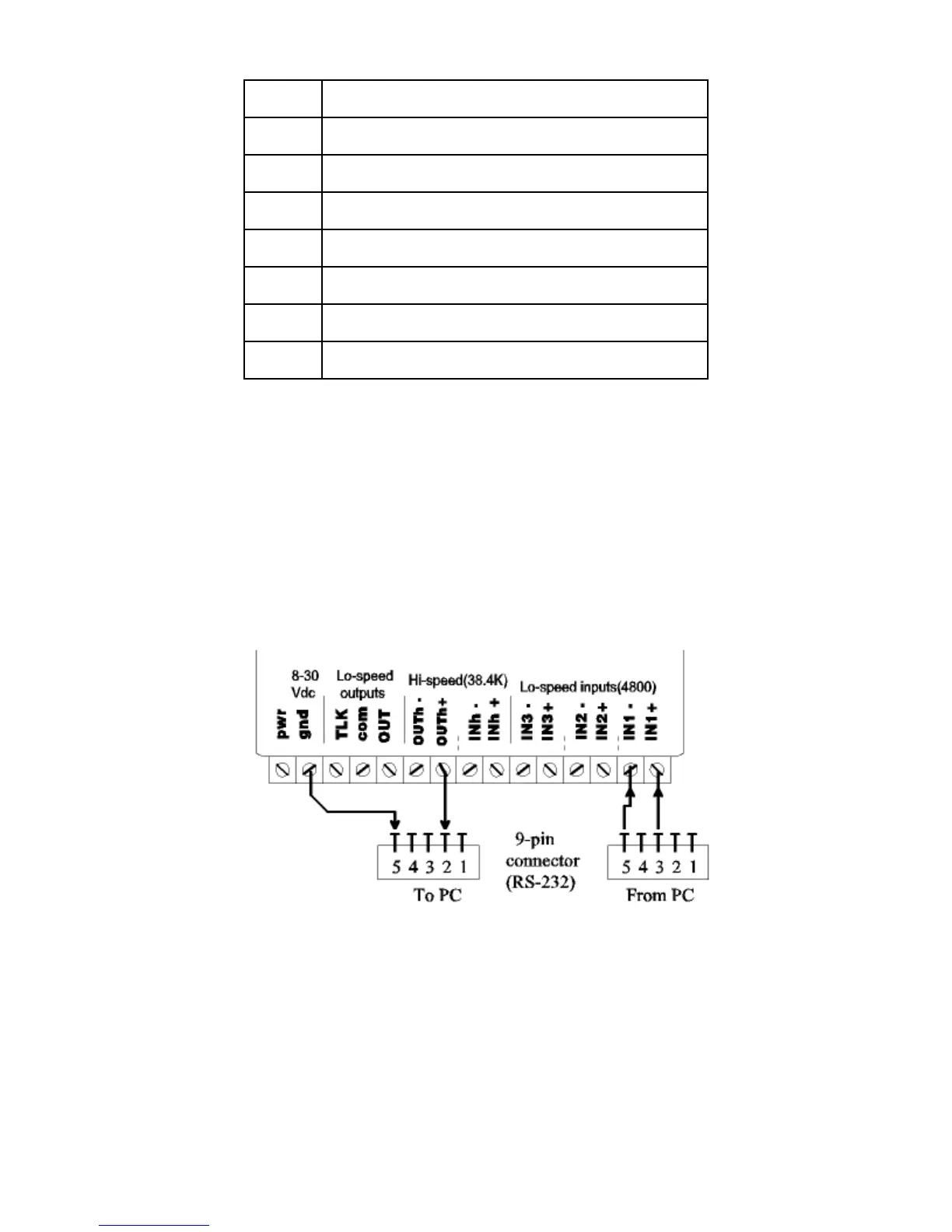
Always connect the “+” terminal of each talker to the corresponding “+” or “A” terminal of each listener. Likewise, connect
the “-” terminal of each talker to the corresponding “-“ or “B” terminal of each listener. In some cases a device will not
have “+/-” or “A/B” connections, but rather only a “Data in” or “Data out” which is referenced to ground. These are known
as “single-ended” devices. An example of connecting a single-ended signal (e.g., RS-232) to an AM43 input is shown in
Figure 2.
Figure 2. Connecting Single-ended Devices
NMEA 0183 Outputs. The AM43 has 3 NMEA 0183 outputs, OUT for lo-speed (4800 baud) devices, OUTh for hi-speed
(38,400 baud) devices, and TLK specifically for sentences from the PC. The lo-speed OUT terminal only has combined data
from the three lo-speed inputs (IN1 – IN3). The OUTh output, however, has the combined data from all four inputs. AIS
units usually send and receive data at 38,400 baud while most other instruments use 4800 baud.
The lo-speed OUT terminal has combined data from the lo-speed inputs (IN1 – IN3). The baud rate for this output is fixed at
4800. The OUTh output (OUTh+, OUTh-) gets the combined data from all four inputs. The main purpose of this output is
to combine data from the hi-speed input, INh, with the other inputs (IN1-IN3) into a single hi-speed output. This output is


 To Next Page
 Loading...