differential RS-422. It can, however, drive an RS-232 listener, such as a PC, as shown in Figure 2. The baud rate of this
output is set to 38,400 per the NMEA 0183-HS (Hi-Speed) standard but can be changed (see Appendix A).
TLK Output. This output is specifically for data from the PC (via USB). This would normally be data such as waypoints,
routes, or steering commands. The data rate is fixed at 4800 baud. A special feature of the AM43 is its ability to redirect
OUT data to the TLK terminal when data from the PC is lost. This OUT - TLK switchover is useful if a device like an
Autopilot is receiving steering commends from a PC , but then loses this data. After a 5-second delay, all data from the OUT
would also appear at TLK. This gives the listener (e.g., Autopilot) a backup source of data. This switchover function must
be user enabled (see Appendix A).
USB Connector. The USB connector on the rear of the AM43 provides a computer interface. The USB gets all the same
data as OUTh plus any error sentences generated by the AM43. The USB interface requires a software driver be installed on
the computer to which it is connected. The driver converts the USB connection into a “Virtual COM Port” so that any
software expecting a Serial “COM_” port can send and receive data. The user can set the baud rate of the “Virtual COM
port’ to any value desired.
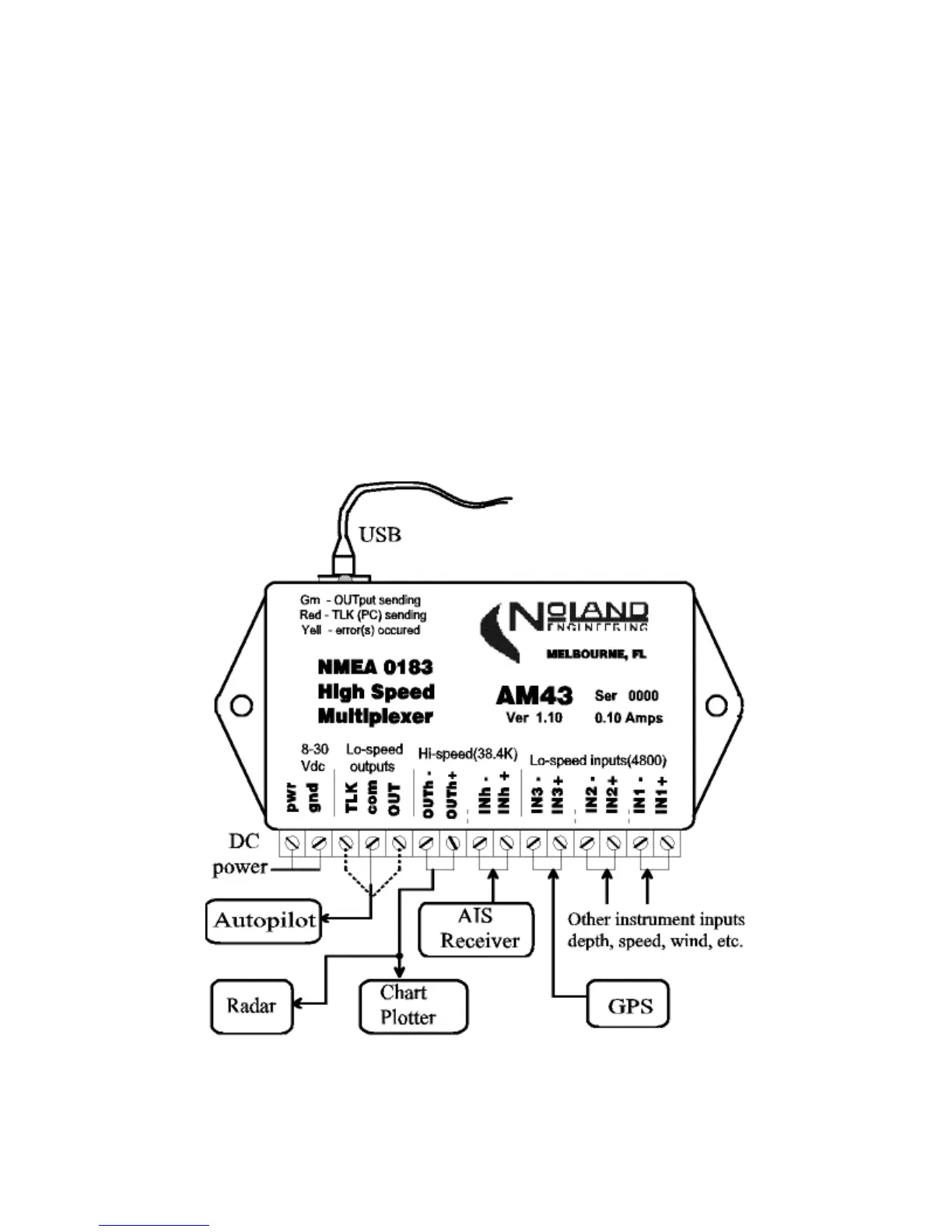
Typical Installation. A typical AM43 installation with a computer connected to the USB interface might resemble Figure
2. In this example, a computer is present to collect all the data from onboard instruments and also to send steering commands
to an autopilot and send waypoints to the GPS. The GPS provides position information while the autopilot provides heading.
Any other instruments, such as a chartplotter, may obtain the combined data from the OUT terminal. The hi-speed interfaces
(INh, OUTh) are for AIS, Radars and other equipment operating at 38.4K baud.
Figure 3. Typical Installation


 To Next Page
 Loading...