As an example, the sentence
$PNOLE,4,7
indicates that IN3 had sync, char, and dolr errors. We know this because 7 is the sum of 1(sync) + 2(char) + 4(dolr). Each
of the five types of errors is assigned a binary power (1, 2, 4, 8, F). The sum of any of these binary powers equals a unique
number, which can be decomposed into the simple error types. F quantities over 9, letters are used to represent the quantities
10(A), 11(B), 12(C), 13(D) … and so on.
The encoding of the error channel follows this same scheme used for error type. Table 4 provides codes, which represent
multiple error types and multiple error channels. The “TLK” error code and the “ovfl” error code are not shown in Table 4,
because they rarely occur in practice. If a “TLK” or “ovfl” error occurs with other errors, Table 5 can be used to decipher the
codes.
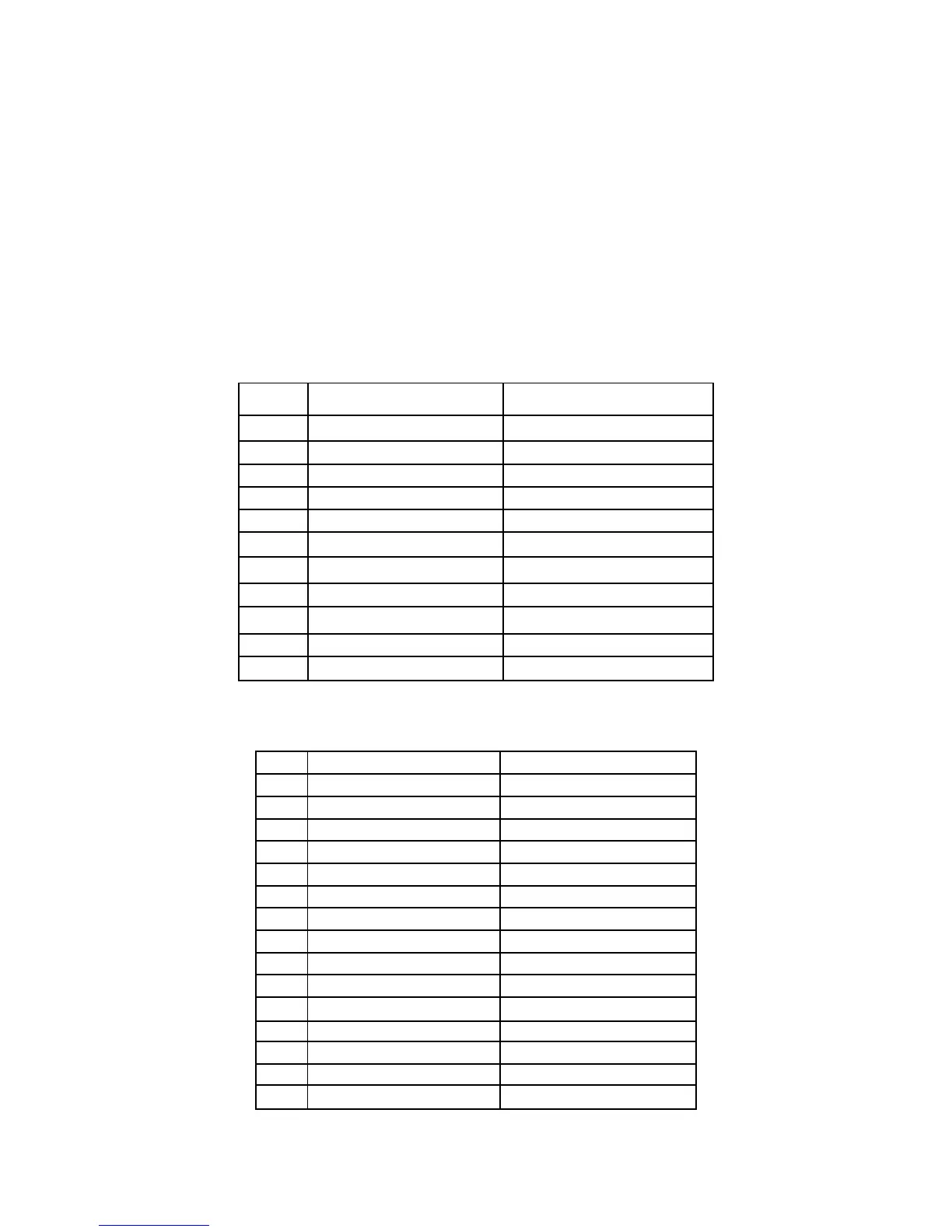
Table 4. Multiple Error Codes
CODE ERROR CHANNEL(S) ERROR TYPE(S)
3
char + sync
5
dolr + sync
6
dolr + char
7
dolr + char + sync
9
lnfd + sync
A(10)
lnfd + char
B(11)
lnfd + char + sync
C(12)
lnfd + dolr
D(13)
lnfd + dolr + sync
E(14)
lnfd + dolr + char
F(15)
lnfd + dolr + char + sync
Table 5. Multiple Error Codes including TLK & ovfl
CODE ERROR CHANNEL(S) ERROR TYPE(S)
H(17) TLK+IN1 ovfl+sync
I(18) TLK+IN2 ovfl+char
J(19) TLK+IN2+IN1 ovfl+char+sync
K(20) TLK+IN3 ovfl+dolr
L(21) TLK+IN3+IN1 ovfl+dolr+sync
M(22) TLK+IN3+IN2 ovfl+dolr+char
N(23) TLK+IN3+IN2+IN1 ovfl+dolr+char+sync
O(24) TLK+INh ovfl+lnfd
P(25) TLK+INh+IN1 ovfl+lnfd+sync
Q(26) TLK +INh+IN2 ovfl+lnfd+char
R(27) TLK+INh+IN2+IN1 ovfl+lnfd+sync
S(28) TLK+INh+IN3 ovfl+lnfd+dolr
T(29) TLK+INh+IN3+IN1 ovfl+lnfd+dolr+sync
U(30) TLK+INh+IN3+IN2 ovfl+lnfd+dolr+char
V(31) TLK+INh+IN3+IN2+IN1 ovfl+lnfd+dolr+char+sync


 To Next Page
 Loading...