Encapsulation sentences are a recent addition to the NMEA standard introduced with AIS. They begin with a “!” rather than
a “$”, and the data is illegible in a Terminal Window because of its encoding, which is not standard ASCII like NMEA 0183
data. Encapsulated data is used little outside AIS instruments. The AM43 will pass encapsulation sentences through INh
only.
To view NMEA 0183 data, a terminal program such as “Hyperterminal” is needed.. The following settings are used to view
NMEA 0183 data:
Baud Rate 4800 (38,400 for -HS Standard)
Data Bits 8
Parity none
Stop Bits 1
Flow Control none
NMEA 0183 devices may be either talkers or listeners or both. Data is typically sent once each second.
4. TROUBLESHOOTING
A useful feature of the AM43 is the detection and reporting of errors. There are five types of errors, which can be detected,
in any of the five internal channels (4 inputs + talker). An error message identifies both the channels and types of errors that
have occurred. It is available at both the USB interface and the OUT+/OUT- terminals. The error message is sent
simultaneously with the error LED (yellow) being displayed.
The error message identifies the error channels and types with an alphanumeric code. The format is as follows:
$PNOLE, c, t
where c represents an alphanumeric code identifying the error channel(s), and t represents an alphanumeric code identifying
the error types.
The codes for a single error and their meaning are presented in Table 3. The error message is sent only once each half second
when errors are present. The message will contain a summary of all error channels and types which occurred during the
previous interval (~1/2 sec).
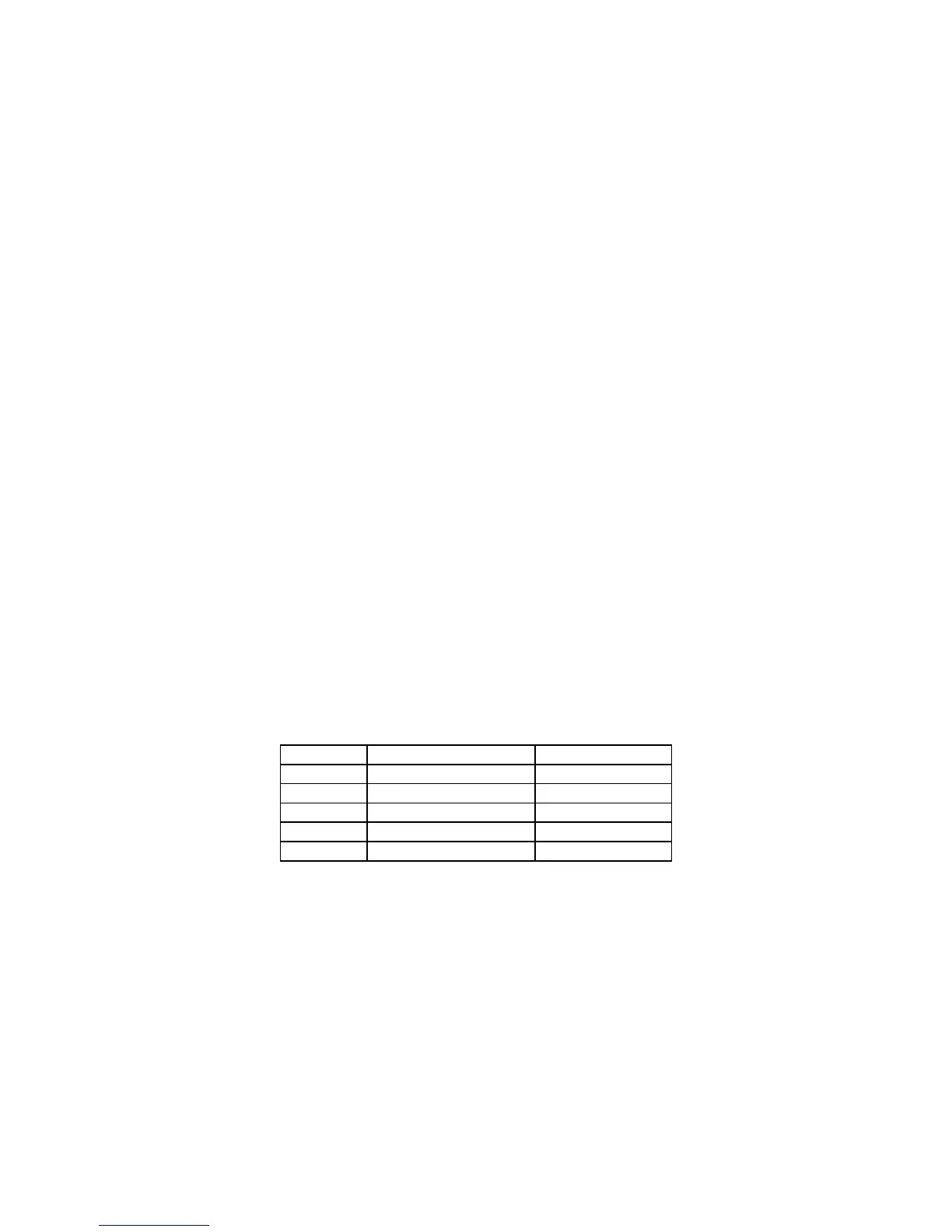
Table 3. Single Error Codes
CODE ERROR CHANNEL ERROR TYPE
1 IN1 sync
2 IN2 char
4 IN3 dolr
8 INh lnfd
G(16) TLK ovfl
The meaning of the error types is as follows:
sync This is a synchronization, or framing, error caused by an invalid START or STOP bit, usually from corrupted data.
char This is a character error which occurs when an 8-bit ASCII character is detected.
dolr This is an error generated when a “$” (start of sentence) character is not received when expected.
lnfd This is an error generated by a missing linefeed character or a sentence containing too many characters.
ovfl This is a buffer overflow error which occurs when more data is coming into the AM43 than it can send out.
In most instances only a single channel will have an error, but there may be several errors occurring during the reporting
interval. For example, synchronization errors will usually occur simultaneously with character errors and possibly dollar
and/or linefeed errors. If an input is connected or disconnected “on-the-fly” while it is sending data, an error will most likely
occur. If an input is reverse polarized, it will generate continuous error messages about twice per second.



 To Next Page
 Loading...