The CWT 450 is a circular saw designed for cutting wooden planks, joists, and similar materials. It is identified as a "Fixed blade" machine, meaning the circular blade is applied under the workbench, and the material is manually brought into contact with it. The machine operates with a three-phase power supply of 400V 50 Hz.
Function Description:
The primary function of the CWT 450 is to provide precise and efficient cutting of wood. It utilizes a work bench where the operator feeds the material into a fixed circular blade. The machine is designed to achieve maximum performance, productivity, and technological results while ensuring the safety of personnel and the integrity of the machine. It is equipped with safety systems to mitigate risks associated with processing.
Important Technical Specifications:
- Model: CWT 450
- Code: 70184631920
- Power Supply: 3 Kw - 400V tri phase
- Blade: Ø450 Ø30 sp 4.4/3, Z36 (28 teeth)
- RPM: 2860 g/min
- Useful Cut: 155 mm
- Machine Weight: 102 Kg
- Dimensions: Table 70x108 cm, Extendable table 48x74 cm. Overall dimensions are approximately 102 cm (height), 185 cm (length with extension), and 78 cm (width).
- Noise Levels (with special blade, 28 teeth, Ø 315mm):
- Equivalent continuous sound pressure level in the workplace: 93.7 dB (A)
- Sound power level emitted by the machine: 104.7 dB (A)
- Dust Emission Level (cutting new fir boards): mg / Nm34.7
- Construction: Base frame made of electro-welded sheet metal, painted with synthetic RAL enamel.
- Safety Features: Self-adjusting blade guard, dividing wedge, optically transparent anterior cap for cutting line visibility. The blade guard is fixed to a wedge-shaped bracket, with the dividing knife at a maximum distance of 3 mm from the blade teeth. The part of the blade under the work surface is enclosed in a special casing with a chip discharge slot.
Usage Features:
- Positioning: A minimum space of 1.5 meters around the machine is required for safe operation and maintenance. The machine must be placed on a stable and level surface.
- Starting and Stopping: The machine is started by pressing a green button and stopped by pressing a red button. It features a motor protection switch with thermal protection, current surge protection, and a release coil for voltage absence. The stopping time of the blade is less than 10 seconds.
- Three-phase Motor Rotation Inverter: The socket includes a phase inverter, allowing the direction of motor rotation to be changed by inserting a flat screwdriver, pressing, and rotating 180°.
- Cutting: For cutting boards, hands should be kept at a safe distance, and the wood should be advanced regularly without swinging, holding it to open the cut. For narrow or long planks, special pushers supplied with the machine should be used.
- Square Guide: The machine is equipped with a parallel square for longitudinal cuts, which can be locked with a special knob and adjusted longitudinally. It can also be used in a lower position. A transversal square allows for cuts at desired angles.
- Longitudinal and Side Pushers: Special pushers are provided to avoid accidental contact with the blade. The longitudinal pusher (Fig. 11) guides long, narrow boards, while the side pusher (Fig. 12, Fig. 13) guides pieces tightly against the square and removes small scraps. Pushers should be used simultaneously to prevent injury.
- Wedge Cutting: Wedges can be built by adjusting the distance between the wood support and the blade using the parallel square.
- Work Bench Extension: An extensible workbench is supplied for supporting long boards. An additional stand may be needed for excessively long boards. The extension is lifted to table height and hooked into place.
- Chip Discharge and Suction: The machine has an Ø 80mm suction mouth for connecting an aspirator. When using suction, the chip discharge slot must be closed using two knobs. If the aspirator is not connected, the slot must be open.
- Safety Precautions:
- All adjustments and maintenance must be performed with the power socket disconnected.
- The plug should be unset when the machine is not in use.
- Do not use the machine with voltages other than indicated.
- The switch box is electronic and should not be opened; consult an electrician if needed.
- Only adults and competent people are allowed to use the machine.
- Always use personal protective equipment: protective helmet, ear muffs, protective goggles or visor, heavy or safety footwear, and work gloves. Avoid loose clothing.
- Never leave the machine unattended.
- Do not use the machine if there is abnormal noise.
- Keep the workplace clean to prevent ignition sources.
- It is forbidden to change the blade diameter from Ø 450 mm.
- Do not use hands to clean the worktop; use a brush with a handle or a wooden cut with the engine off.
- Wear sturdy gloves when handling the blade during maintenance.
- The machine should not be used by persons under the influence of alcohol, drugs, or medicines.
- The guards and safety devices must always be in place and in good condition.
Maintenance Features:
- Preliminary Checks: Before use, ensure the machine is on a stable surface, the cutting disc is sharp and free of cracks, the blade nut is tightened, and the power socket matches motor characteristics with appropriate protection (differential switch and magneto-thermal protection, max 15 Amp fuse).
- Belt Replacement: Check the tension of the transmission belts as indicated in Fig. 24. This operation must be carried out with the power socket off.
- Blade Replacement:
- Unscrew and extract the screw using two 13mm wrenches, noting that the support (A) will rise due to springs.
- Remove the blade protection.
- Unscrew knob (B) under the counter, then lift and extract the blade insert.
- Unlock the nut using the supplied wrench. Rotate the blade to the left with light strokes, banging the key on the bench.
- Unscrew the nut (left-hand thread) and remove the flange. Extract the blade upwards.
- Assemble the new blade, flange, and nut. Lock the nut using the supplied wrench, rotating the blade to the right with small strokes while hitting the wrench on the bench.
- Braking Time Control Test:
- Boot the motor and allow the blade to reach maximum rotation speed.
- Switch off the engine with the stop button.
- Check the stopping time with a stopwatch; it should not exceed 10 seconds.
- If braking is inefficient, contact the manufacturer for original spare parts.
- Periodic Checks (Before Use):
- Check for damaged parts, work area clutter, blade rotation direction, blade sharpness, blade braking time (less than 10 sec), locked adjustments, and proper functioning of all protections (whenever the machine is used).
- Check pushers and chip extractor/blade compartment (whenever the machine is used).
- Check lifting eye screws (each time the machine is lifted).
- Check drive belts and pulleys (every 10 days).
- Extraordinary Maintenance (Every 15 days): Check blade shaft bearings, all welds, tightening screws of the structure, motor, switch, and protections. This should be done in a suitably equipped workshop by specialized personnel.
- Dismantling: Electrically disconnect the machine. All parts must be scrapped and disposed of according to local laws. The machine does not require special precautions as it has no toxic components.
- Spare Parts: Spare parts lists and exploded views are available on the Norton Clipper after-sales website: https://spareparts.nortonabrasives.com.

 Need help?
 General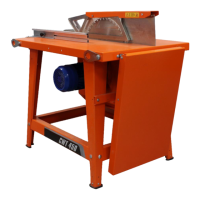

 To Next Page