Need help?
Do you have a question about the Nova Precision Midi and is the answer not in the manual?
This document outlines the service procedure for Nova chucks, specifically covering the Precision Midi, G3, SuperNOVA2, and Titan models. The primary function of these chucks is to securely hold workpieces for various turning applications, and this guide focuses on their disassembly, cleaning, and reassembly to ensure optimal performance and longevity.
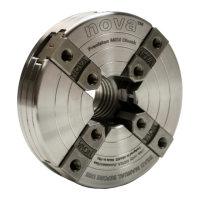
Nova chucks are essential tools for woodturning, providing a robust and adjustable gripping mechanism for securing timber workpieces to a lathe. They typically consist of a main chuck body, a scroll ring, jaw slides, pinion gears, a backing plate, and a retaining ring. The scroll ring, when rotated, moves the jaw slides simultaneously, allowing for concentric gripping of the workpiece. This synchronized movement ensures that the workpiece is centered and held firmly, which is crucial for safe and accurate turning. The different models (Precision Midi, G3, SuperNOVA2, Titan) likely cater to varying sizes of lathes and workpieces, offering different gripping capacities and features. The chucks are designed to be durable and precise, providing a reliable interface between the lathe and the material being worked on.
The Nova chucks are designed for ease of use in securing workpieces. Before any disassembly or maintenance, it is crucial to remove any jaws or accessories attached to the chucks. This ensures that the chuck body is clear for the service process and prevents damage to these components. The chucks are typically mounted directly onto the lathe spindle, either through a direct thread or an insert type, depending on the specific model and lathe compatibility. The jaw slides are designed to move smoothly within the chuck body, allowing for quick and efficient clamping and unclamping of workpieces. The scroll ring is the primary control for adjusting the grip, and its rotation dictates the opening and closing of the jaws. The design allows for the jaw slides to be positioned at any point during operation, offering flexibility in gripping various workpiece shapes and sizes. When reassembling, the jaw slides are designed to form a square in the center when correctly positioned, indicating proper alignment for the scroll ring to engage. The chucks are built to withstand the forces of woodturning, providing a stable and secure hold throughout the turning process.
The maintenance of Nova chucks, as detailed in this guide, is critical for their continued performance and extends their lifespan. The process involves a thorough disassembly, cleaning, and reassembly.
The disassembly process begins with placing the chuck face down, ensuring the jaw slides can be in any position. The first step is to remove the retaining ring using external circlip pliers. This ring holds the backing plate in place. Once the retaining ring is removed, the backing plate can be carefully lifted off. This step can sometimes be tricky if old lubricants have caused the backing plate to stick to the chuck body. Two methods are suggested for removing the backing plate: using two flat-head screwdrivers to lift it straight out or, for insert-type chucks, threading an insert into the chuck and using a soft mallet to give it a sharp impact to release the plate. After the backing plate is off, the pinion gears are removed by pushing them outwards, which might require some force due to accumulated dirt. Finally, the scroll ring is removed; it should slide out, but tapping might be needed if it's stuck. Before sliding out the jaw slides, it is crucial to mark them with a permanent marker. Each jaw slide has a corresponding slideway, and marking them ensures they are reinserted into their original positions. Specifically, the #1 jaw slide fits where there is a dimple. Once the scroll ring is removed, the jaw slides are free to slide out of the chuck body. At the end of disassembly, it's important to verify that all parts are accounted for: the chuck body, pinion gears, backing plate, scroll ring, retaining ring, and all four jaw slides.
Cleaning is a vital step to remove accumulated dirt, grime, and rust that can impede the chuck's smooth operation. The process starts by wiping off as much visible dirt as possible from each part using a disposable cloth or towel. The scroll ring is used as an example, but this procedure applies to all main parts, including the chuck body and jaw slides. Next, a degreaser or rust remover (such as WD40) is applied to each part to tackle built-up grime. These parts are left to soak for at least two hours or as directed by the product instructions. After soaking, a wired brush is used to remove rust and grime. It's important to run the brush in between the slits of the scroll ring and jaw slides to reach hard-to-clean areas. Finally, a clean disposable cloth or towel is used to wipe the parts dry after brushing. The parts should feel dry and free of any sticky residue, indicating a thorough cleaning.
Reassembly requires careful attention to detail and proper lubrication to ensure the chuck operates smoothly. Before reassembling, a generous amount of lubricant is applied to all surfaces that come into contact with other parts, particularly the inner surface of the chuck body, the jaw slide slots, and the spiral teeth side of the scroll ring. The jaw slides are then reinserted into their original slots. A key detail here is that the jaw slide numbers should count up from 1 to 4 in a clockwise direction when looking from the front of the chuck. Next, the chuck is flipped onto its face, and the jaw slides are positioned to form a square in the center. The scroll ring is then slid back into the chuck body. Once in place, the scroll ring is rotated back and forth until it engages with the jaw slides. This engagement should be felt as the scroll ring drops into place, exposing the slot for the snap ring. It's crucial to ensure the jaw slides do not move before sliding the scroll ring in. A generous amount of lubricant is then applied to the geared side of the scroll ring. The pinion gears are inserted back into the chuck body. The scroll ring is rotated with a chuck key to check that the jaw slides correctly match up at the center, forming a square. If the scroll ring is hard to turn or not smooth, potential causes include binding pinion gears, insufficient lubrication, or defective parts. Once the jaw slides match up correctly, the backing plate is put back on. The final step is to put the snap ring back on, ensuring it is correctly installed in its groove to secure the backing plate.
Overall, the maintenance process is designed to be comprehensive, addressing wear and tear, and ensuring the chucks remain precise and reliable tools for woodturning enthusiasts. Safety glasses are emphasized as a critical safety measure during maintenance, especially when dealing with snap rings, which can fly off unexpectedly.
 General
| Brand | Nova |
|---|---|
| Model | Precision Midi |
| Category | Outdoor Furnishing |
| Language | English |

 To Next Page