
 Need help?
Do you have a question about the Novexx Solutions ALS 104 and is the answer not in the manual?
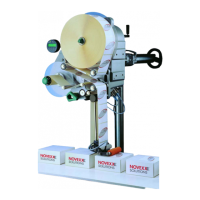
The Novexx ALS 104 is a labeler designed for industrial applications, offering precise and efficient labeling solutions. This installation manual provides comprehensive instructions for its setup, operation, and maintenance, ensuring safe and optimal performance.
The ALS 104 is primarily used for applying labels to various products. It operates by dispensing labels from a roll and applying them to items, typically as part of an automated production line. The device is designed to handle different label sizes and materials, making it versatile for diverse labeling needs. Its core function involves accurate label dispensing and placement, which is critical for product identification, branding, and regulatory compliance. The labeler can be integrated into existing systems and offers various options for sensor types and dispensing edges to suit specific application requirements.
The ALS 104 operates with a firmware version of 3.21 (Frontend) and 1.85 R02 (Drive). It is designed for use with 230 V (AC) or 115 V (AC) power supplies, making it adaptable to different regional electrical standards.
Label Sensor: The label sensor can be configured for PNP or NPN types, with a default machine setting of NPN. Available article numbers for sensors include:
The sensor is crucial for detecting labels and ensuring accurate dispensing. The manual details how to switch between PNP/NPN modes and provides a table for LED output based on the sensor type and mode.
Capacitive Label Sensor (Option): An alternative to the photoelectric label sensor, the capacitive label sensor (A7775) is suitable for transparent and metallised labels. This sensor comes with a bracket and connection cable.
Product Sensor: The product sensor can be PNP or NPN, with a default setting of PNP. The order number for the product sensor is A7112 (47B). It uses a light/dark switching mechanism.
Roll Diameter Sensor: The ALS 104 includes an optional photoelectric sensor to check the outer diameter (OD) sensor of the label roll. This sensor helps in managing label consumption and ensuring continuous operation. The default setting for the roll diameter sensor is PNP, with order numbers RH A8192 and LH A8204.
Rotary Encoder: The ALS 104 can be equipped with an automatic speed adjustment rotary encoder, which communicates with the conveyor belt speed to ensure precise label dispensing. Permitted sensor types are Push-Pull, PNP, or NPN, with a preset of PNP.
Recommended rotary encoders include:
Dimensions: The manual includes detailed dimension diagrams for the ALS 104, showing various measurements in millimeters. These diagrams are essential for planning installation and integration into production lines.
Installation and Deinstallation: The manual provides detailed instructions for unpacking, assembling, and connecting the machine. It emphasizes the importance of proper handling during transport, recommending the use of an eye ring M10 for lifting. Setting up involves mounting the machine on a support stand, ensuring it is stable and level. Different attachment points (rear side, side plate, base plate) are described, along with the necessary tools and tightening torques.
Attaching the Dispensing Edge: The ALS 104 supports L-shaped and V-shaped dispensing edges. The manual explains how to mount these edges, including adjusting the height of the adjustable dispensing edge holder. This flexibility allows the labeler to adapt to various product shapes and labeling positions.
Connecting to Mains Power Supply: Safety is paramount when connecting the machine to the power supply. The manual warns against contact with energized components and emphasizes ensuring the machine is switched off before connecting the power cable. It also details how to remove and insert fuses, check voltage settings, and ensure proper grounding. The power cable should be as short as possible, ideally not exceeding 3m.
Connecting/Mounting the External Operator Panel: The external operator panel (Article number: A7474) can be connected via a mini-DIN connection (27A). The manual provides instructions for feeding the operator panel cable through a cover box and mounting the external operator panel, including drilling holes and securing it with screws.
Connecting the Sensors: Detailed instructions are provided for connecting the label sensor, product sensor, roll diameter sensor, and rotary encoder. This includes pin assignments and jumper settings for different sensor types (PNP/NPN) and operating modes.
Setting the Label Sensor: The label sensor requires precise adjustment for different label materials. The manual describes how to use an adjustment screwdriver to set the potentiometer, place backing paper and labels, and perform autoteaching to optimize label detection. It also explains how to restore factory settings.
Setting the Roll Diameter Sensor: Adjusting the roll diameter sensor involves measuring the diameter of the prepared roll, loosening thumb screws, shifting the reflector to the upper or lower position, and inserting the label roll. A function test is included to verify proper operation.
Adjusting the Rotary Encoder: The rotary encoder can be adjusted to the label dispenser by setting the machine setup parameters for encoder resolution and speed adaption.
General Information: The manual highlights the importance of regular maintenance and repair work. It advises blocking access to the working area of the machine when maintenance is performed by unauthorized persons and posting a notification sign.
Electro-static Discharge: When opening the casing, it is crucial to protect the electronics from damage due to electro-static discharge by wearing an anti-static arm band.
Tools: Only suitable tools should be used for maintenance. It is important to ensure all tools are at hand before beginning work and to avoid using improper tools that could damage the machine.
Rubber and Plastic Parts: Do not allow hoses, seals, and other rubber or plastic parts to come into contact with grease, petrol, benzene, kerosene, or mineral oil, as these substances can cause damage.
Environmental Protection and Eco-friendly Disposal: The manual emphasizes environmental protection, advising the use of cleaning cloths sparingly and reusing packing material. It also recommends storing operating materials, such as fresh or used cleaning agents, in suitable containers. Old batteries, removed parts, and used cleaning agents should be disposed of in an eco-friendly manner. For eco-friendly disposal, the manual suggests sorting waste as much as possible, separating metals from plastics, and avoiding contaminating the waste. It also advises dropping off waste at collection points provided for that purpose, having waste collected by suitable recycling agencies, and using any on-site options. All relevant rules, ordinances, and laws must be observed.
Rules for Electromagnetic Compatibility: The manual provides guidelines for ensuring electromagnetic compatibility, including connecting all metallic parts to each other, laying signal lines and power cables close to metal parts, and twisting together unshielded lines from the same circuit. It also details requirements for wire inductive components and shielding signal and control lines.
Power Filter: The power filter should be mounted directly at the power supply, and the filter casing connected to the EMC grounding via large metal surfaces.
After Servicing or Repair Work: After any maintenance or repair, it is essential to re-install all covers and safety equipment, check for firm seating of all screw connections, remove all tools and other aids, verify flawless functioning of all safety equipment, and check the printer according to regulations.
Decommissioning, Dismantling, Disposal: The manual outlines procedures for taking the machine out of operation, including disconnecting power and all cables. For dismantling, it warns about the danger of injury from the machine falling to the ground and the risk of acute injury from heavy loads. It advises having at least two persons loosen the clamping at the support stand and wear safety footwear. For machine disposal, it states that removable reusable machine components should be kept as long as the machine is firmly mounted. It also provides instructions for disposing of remaining machine parts and sorting waste properly.
 General
| Brand | Novexx Solutions |
|---|---|
| Model | ALS 104 |
| Category | Printer |
| Language | English |

 To Next Page

